Biography · Chemist no. 50 of 350
Henri Moissan: The Chemist Who Tamed Fluorine and Harnessed the Electric Arc
Introduction
Henri Moissan (1852-1907) was a French chemist who succeeded in isolating fluorine, the most reactive element, after many leading chemists had failed for decades. He also developed the electric arc furnace, with which he made new carbides, borides and pure metals. In 1906 he won the Nobel Prize in Chemistry. He died only a few weeks after receiving it. Legacy in one line: he showed that extremely high temperatures and electrical methods can open up whole new areas of chemistry.
Early Life & Family
Ferdinand Frédéric Henri Moissan was born in Paris on 28 September 1852. His father was an employee of the French railway company, and his mother was a seamstress. The family moved to the town of Meaux, east of Paris, where Henri attended school. As a child he was lively and interested in the natural world. The family was not wealthy, and Henri had to find practical work.
Education & Mentors
Moissan began as an apprentice in a pharmacy in Paris, which was a common route into chemistry. He studied chemistry alongside his work and entered the laboratories of the capital. He became a student of Edmond Frémy at the Muséum d'Histoire Naturelle, and worked at the École supérieure de pharmacie. Frémy himself had tried to isolate fluorine, so Moissan inherited the problem. He also learned from Henri Sainte-Claire Deville and Pierre Paul Debray. He gained his pharmacy qualification and his doctorate of science, and his early research dealt with the chemistry of chromium compounds and cyanogen derivatives. Later he became a professor at the École supérieure de pharmacie in Paris.
Career Timeline
| Year | Event |
|---|---|
| 1852 | Born in Paris |
| 1870s-1880s | Qualifies in pharmacy and earns his doctorate; marries Léonie Lugan; later has a son, Louis |
| 1886 | Isolates fluorine on 26 June |
| 1886 | Appointed professor at the École supérieure de pharmacie, Paris |
| 1891 | Elected to the Académie des Sciences |
| 1892 | Builds the electric arc furnace; prepares calcium carbide and other carbides |
| 1893 | Studies a mineral in the Canyon Diablo meteorite, later named moissanite |
| 1900 | Appointed professor of inorganic chemistry at the Sorbonne |
| 1906 | Awarded the Nobel Prize in Chemistry |
| 1907 | Dies in Paris on 20 February |
Major Scientific Contributions
- Isolation of fluorine (1886): electrolysis of KHF₂ in anhydrous HF in a platinum apparatus at low temperature. The companion article on Moissan's fluorine experiment gives the chemistry in detail.
- Electric arc furnace (1892-1893): reached about 3000-3500 °C, allowing the preparation of metals such as chromium, tungsten, molybdenum, vanadium and uranium in pure form, and of many carbides, borides and silicides.
- Calcium carbide: prepared in the furnace, and shown to give acetylene with water. This became the basis of the acetylene industry, along with independent work by the American Thomas Willson.
- Diamond experiments: he dissolved carbon in molten iron and cooled it quickly, and obtained tiny crystals he believed to be diamonds. Later studies cast serious doubt on this claim, and the question remains debated by historians of science.
- Hydrides and other compounds: he also made fluorine compounds, such as PF₅, SF₆ and CF₄ by direct reaction, and studied metal hydrides.
Awards, Honours & Nobel Prize
Moissan received the Nobel Prize in Chemistry in 1906 "in recognition of the great services rendered by him in his investigation and isolation of the element fluorine, and for the adoption in the service of science of the electric furnace called after him." Dmitri Mendeleev was also considered for the prize that year, and it is often said that he lost by a single vote in the Nobel committee; Mendeleev died in early 1907. Moissan also received the Davy Medal of the Royal Society (1896). He was elected to the Académie des Sciences in 1891.
Personality, Struggles & Lesser-Known Facts
- Self-taught start. Without a university degree at first, he rose from a pharmacy apprentice to a Sorbonne professor through determination.
- Danger in the laboratory. His experiments with fluorine and hydrogen fluoride were dangerous, and he is recorded as having been affected by the toxic fumes during his fluorine research.
- The ill timing of prize and death. He travelled to Stockholm in December 1906 to receive the Nobel Prize. Ill with appendicitis, he returned to Paris, where he died on 20 February 1907 after an operation.
- A son lost in war. His only son Louis was killed in action in 1914 in World War I, several years after his father's death.
- Industrial links. His work on calcium carbide gave cheap acetylene for lighting, which was used in India in carbide lamps and by vendors for many decades.
Legacy & Influence on Modern Chemistry
Moissan opened fluorine chemistry, which today includes Teflon, refrigerants, fluorinated drugs and uranium hexafluoride for nuclear fuel. His arc furnace technology led to the development of industrial electric furnaces used in making steel alloys, ferroalloys, silicon, aluminium-related materials and abrasives. Silicon carbide, called moissanite, is used as an abrasive and as a gemstone, and in power electronics. His name appears in many chemistry histories. Without his methods, the chemistry of high-temperature solids would have developed much later.
Lessons for Students
- Persistence on a hard problem pays. Fluorine resisted chemists for 70 years.
- Choose materials wisely. Platinum and fluorspar equipment made the isolation possible.
- Safety matters. Moissan's health suffered from poisonous substances.
- A non-traditional start is no barrier. He began as a pharmacy apprentice.
Quick Facts Box
- Born: 28 September 1852, Paris, France
- Died: 20 February 1907, Paris, France
- Nationality: French
- Field: Inorganic chemistry
- Famous for: Isolation of fluorine (1886); electric arc furnace
- Nobel: Chemistry, 1906
FAQ
Who isolated fluorine?
Henri Moissan, on 26 June 1886.
What is a Moissan furnace?
An electric arc furnace that can reach about 3500 °C, used to prepare refractory metals and carbides.
How long after the Nobel Prize did he die?
About two months; he received the prize in December 1906 and died in February 1907.
Which mineral carries his name?
Moissanite, natural silicon carbide.
Published by ABC Chemistry — IIT-JAM | CSIR-NET | GATE Chemistry Coaching. Visit abcchemistry.com
About the chemist
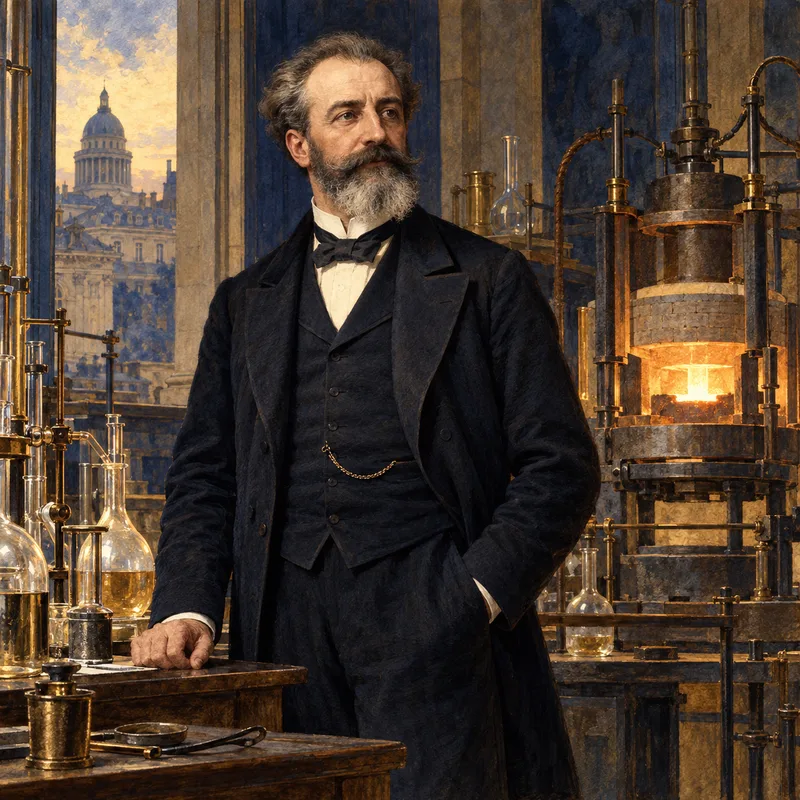
Henri Moissan
1852-1907 · France · Nobel Chemistry 1906
Isolated fluorine; electric arc furnace