The discovery, explained · Chemist no. 50 of 350
Henri Moissan and the Isolation of Fluorine
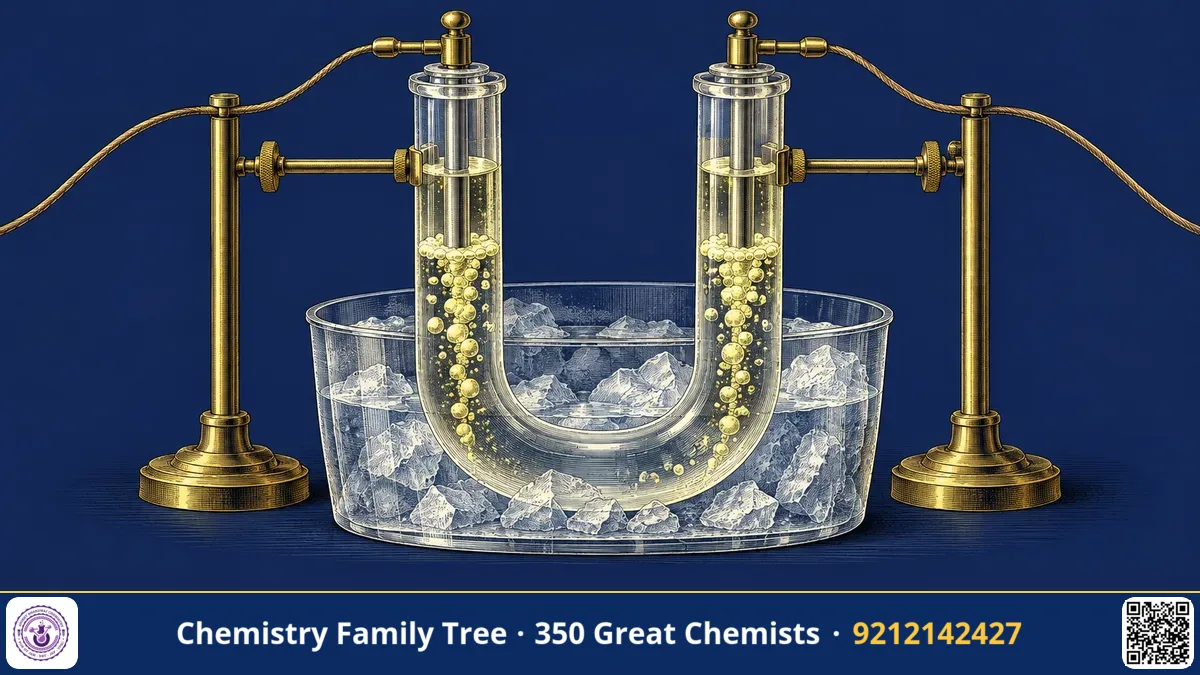
For almost seventy years, chemists knew that there was an element hidden in fluorspar (CaF₂) and in hydrofluoric acid, but nobody could isolate it. Several of the best chemists of the 19th century, among them Humphry Davy, Edmond Frémy and George Gore, failed. Some were poisoned. On 26 June 1886, the French chemist Henri Moissan finally collected a pale yellow gas at the anode of an electrolytic cell. It was fluorine, the most electronegative and most reactive of all elements. He later invented the electric arc furnace and prepared many new carbides, borides and hydrides. He received the Nobel Prize in Chemistry in 1906. This article explains the discovery and its chemistry for Class 12, B.Sc., IIT-JAM, CSIR-NET and GATE.
The Scientific Problem Before the Discovery
Fluorine is the first element of the halogen group. Its compounds were well known: fluorspar was used as a flux in metallurgy (the name comes from Latin fluere, to flow), and hydrofluoric acid etched glass. In 1810 Ampère proposed that HF contains a new element analogous to chlorine, and Davy agreed. But isolating the element was extremely hard.
- Fluorine is so reactive that it attacks almost every material, including glass, most metals, water and even organic stoppers and greases.
- Chemical oxidation, which worked for chlorine (MnO₂ + HCl), failed because no oxidising agent is strong enough to oxidise fluoride ions. The reduction potential of F₂ + 2e⁻ → 2F⁻ is about +2.87 V, so F⁻ is extremely hard to oxidise.
- Electrolysis of aqueous HF gave only oxygen at the anode, since water is oxidised more easily than F⁻.
- Anhydrous HF is a poor conductor and very poisonous, and the gas can cause serious burns.
The Discovery: Step by Step
- Choosing the electrolyte. Moissan used anhydrous (water-free) hydrogen fluoride, to which he added potassium hydrogen fluoride (KHF₂), to make it conduct electricity. KHF₂ is the source of ions: KHF₂ ⇌ K⁺ + HF₂⁻.
- Choosing the apparatus. He used a U-shaped tube made of platinum, a metal that resists attack because a protective fluoride layer forms. The electrodes were made of a harder platinum-iridium alloy, and the stoppers were made of fluorspar (CaF₂), which does not react with fluorine.
- Cooling. He cooled the cell to about −50 °C in a cold bath, so that HF did not evaporate and the fluorine was less reactive.
- Passing current. Using a battery, he passed a direct current. Hydrogen formed at the cathode, and a new gas at the anode.
- Proving it was fluorine. The gas was pale greenish-yellow, attacked glass, and made silicon burst into flames. It decomposed water to give ozone-containing oxygen, and combined violently with hydrogen even in the dark and at very low temperatures.
Cathode (reduction):  2H⁺ + 2e⁻ → H₂
Anode (oxidation):    2F⁻ → F₂ + 2e⁻
Overall:              2HF → H₂ + F₂
Moissan reported his result to the Académie des Sciences in June 1886, and a committee of senior chemists was appointed to watch the experiment before the discovery was accepted.
The Chemistry Behind It
Why is fluorine so reactive?
Fluorine has the highest electronegativity (3.98 on the Pauling scale) and a very small atom. The F–F bond is surprisingly weak (bond energy about 159 kJ/mol, weaker than Cl–Cl at 243 kJ/mol) because of repulsion between lone pairs on small atoms. In contrast, bonds formed by fluorine with other elements are very strong (C–F about 485 kJ/mol; H–F about 565 kJ/mol), which makes its reactions highly exothermic.
Key reactions
H₂ + F₂ → 2HF                  (explosive even in the dark)
2F₂ + 2H₂O → 4HF + O₂          (with cold dilute water, also some O₃ and OF₂)
Xe + F₂ → XeF₂                 (heat or light)
S + 3F₂ → SF₆
U + 3F₂ → UF₆
Anomalous behaviour of fluorine
- Fluorine shows only the −1 oxidation state (no d-orbitals, highest electronegativity).
- HF is a weak acid in water (Ka about 6.8 × 10⁻⁴) due to strong H–F bond and hydrogen bonding, unlike HCl, HBr and HI. It also exists as H-bonded associated molecules, with a high boiling point (293 K).
- F⁻ is a hard base, forming strong bonds with silicon and calcium; HF attacks glass: SiO₂ + 4HF → SiF₄ + 2H₂O.
- Oxidising power: F₂ > Cl₂ > Br₂ > I₂ in aqueous solution (E° = +2.87, +1.36, +1.09, +0.54 V).
Moissan's other work: the electric arc furnace
In 1892 Moissan built an electric arc furnace that reached temperatures near 3500 °C. In it he prepared pure metals and refractory compounds. Heating lime and carbon gave calcium carbide, which reacts with water to give acetylene:
CaO + 3C → CaC₂ + CO        (electric furnace, about 2000 °C)
CaC₂ + 2H₂O → Ca(OH)₂ + C₂H₂
Silicon carbide, SiC (carborundum), is also named moissanite after him: Moissan discovered a natural form of it in meteorite material in 1893.
Applications Today
- Nuclear fuel: UF₆ is the volatile compound used for uranium enrichment by gas centrifuges, which is also relevant to India's nuclear programme.
- Polymers: PTFE (Teflon), with the repeating unit –CF₂–CF₂–, is used in non-stick cookware, seals and chemical equipment.
- Refrigerants and pharmaceuticals: fluorinated hydrocarbons (HFCs now replacing CFCs, which damage the ozone layer) and fluorinated drugs such as fluoroquinolone antibiotics, fluoxetine and many others. About a fifth of pharmaceuticals contain fluorine.
- Dental care: sodium fluoride and stannous fluoride in toothpaste harden enamel by forming fluorapatite.
- Electrical industry: SF₆ gas, a very inert insulator, used in high-voltage switchgear.
- Metallurgy: cryolite, Na₃AlF₆, is the solvent in the Hall-Héroult process for aluminium.
Exam Corner
- Fluorine was isolated by Moissan in 1886 by electrolysis of KHF₂ in anhydrous HF at about −50 °C using a platinum-iridium apparatus.
- Fluorine has the highest electronegativity (3.98) and highest standard reduction potential (+2.87 V) among elements; the F–F bond is weaker than Cl–Cl.
- Electron affinity order: Cl > F > Br > I (fluorine is anomalous because of its small size and inter-electronic repulsion).
- HF has the highest boiling point among hydrogen halides due to hydrogen bonding; it is the weakest acid of the series.
- Moissan won the Nobel Prize in Chemistry in 1906.
Common Misconceptions
- "Fluorine has the highest electron affinity." Chlorine does; fluorine's small size causes repulsion in the compact 2p shell.
- "Aqueous electrolysis can give fluorine." It gives oxygen; anhydrous conditions are needed.
- "HF is a strong acid because F is most electronegative." HF is weak in water because of its strong H–F bond and hydrogen bonding.
Quick Revision Box
- Moissan isolated F₂ on 26 June 1886; Nobel Prize 1906.
- Electrolyte: KHF₂ in anhydrous liquid HF, temperature about −50 °C.
- Apparatus: platinum-iridium U-tube, CaF₂ stoppers.
- F₂: pale yellow gas, E° = +2.87 V, only −1 oxidation state.
- Electric arc furnace (1892): CaC₂, SiC and metal carbides.
- Uses: UF₆, PTFE, SF₆, CFC/HFC, toothpaste fluoride.
FAQ
Why couldn't earlier chemists isolate fluorine?
No chemical oxidant could take electrons from F⁻, and fluorine attacked every container material.
Why is platinum used in the apparatus?
It forms a thin protective layer of fluoride and resists further attack by HF and F₂.
Does fluorine occur free in nature?
No. It is too reactive; it occurs as fluorspar (CaF₂), cryolite (Na₃AlF₆) and fluorapatite.
What is moissanite?
Silicon carbide (SiC), named after Moissan, who first found it as a natural mineral in a meteorite crater.
Published by ABC Chemistry — IIT-JAM | CSIR-NET | GATE Chemistry Coaching. Visit abcchemistry.com
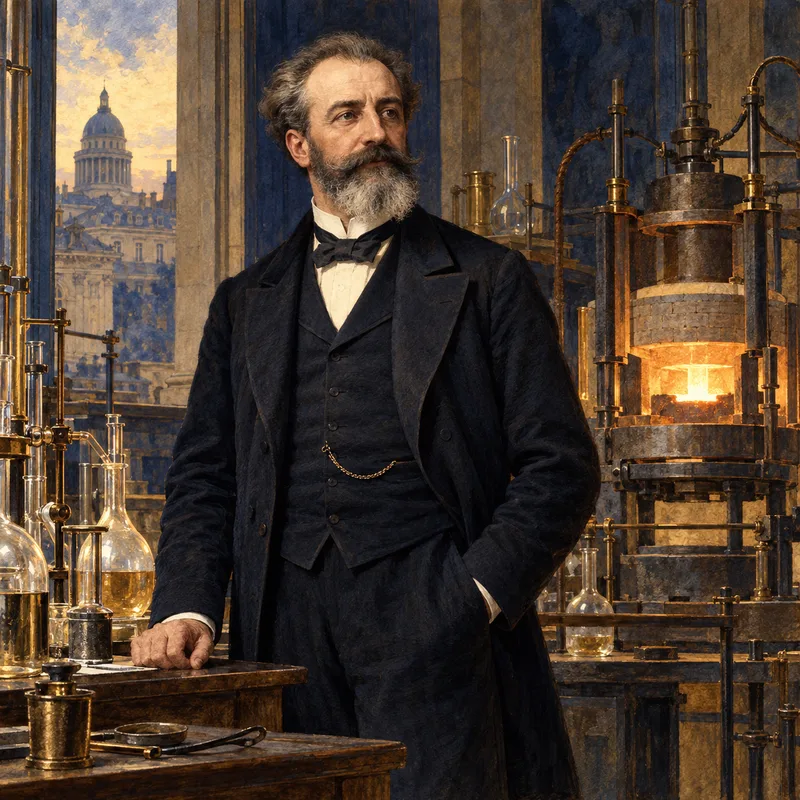
About the chemist
Henri Moissan
1852-1907 · France · Nobel Chemistry 1906
Isolated fluorine; electric arc furnace