Biography · Chemist no. 235 of 350
Henry Cavendish: The Shy Millionaire Who Weighed the World
Henry Cavendish (1731–1810) was among the most gifted experimental scientists of the 18th century, and also one of the most reclusive. He identified hydrogen as a distinct gas, showed that water is formed from hydrogen and oxygen, noticed the unreactive bubble that later proved to be argon, and measured the density of the Earth. Yet he published little, avoided company, and many of his best results became known only after his death. His one-line legacy: a master of precise measurement who showed that careful quantity beats grand theory.
Early Life and Family
He was born on 10 October 1731 in Nice, then part of the Kingdom of Sardinia, where his mother, Lady Anne Grey, had gone for her health. She died when Henry was about two years old. His father, Lord Charles Cavendish, was a respected scientist in his own right and a member of the Royal Society, and the family belonged to the high English aristocracy, being related to the Dukes of Devonshire and Kent. Henry grew up in London in a house devoted to scientific interests, and in later life he inherited large sums from relatives, which made him very wealthy. He never married.
Education and Mentors
He attended a school in Hackney, then entered Peterhouse, Cambridge, in 1749. He left in 1753 without taking a degree, possibly because the religious tests required for a degree were unacceptable, though the reason is not fully known. He then lived in London and worked in a laboratory in his father's house. His father's scientific circle and the Royal Society provided his main scientific environment. Cavendish had no single famous mentor, but he learned much from his father's experimental habits, such as precise instrument-making.
Career Timeline
| Year | Event |
|---|---|
| 1731 | Born in Nice. |
| 1749–1753 | Studies at Peterhouse, Cambridge; leaves without a degree. |
| 1760 | Elected Fellow of the Royal Society. |
| 1766 | Publishes papers on "factitious airs", describing hydrogen (inflammable air) and carbon dioxide. |
| 1766 | Receives the Royal Society's Copley Medal for the work on factitious airs. |
| 1783–1784 | Reports experiments on air and the formation of water from hydrogen and oxygen. |
| 1785 | Experiments on sparking air; notes the residual bubble later shown to be argon. |
| 1798 | Publishes his torsion-balance experiment to determine the density of the Earth. |
| 1803 | Becomes a foreign associate of the French Institut. |
| 1810 | Dies in London on 24 February. |
Major Scientific Contributions
- Hydrogen: shown to be a distinct, very light, flammable gas; see our discovery blog on Cavendish.
- Water as a product: 2H₂ + O₂ → 2H₂O, in a 2:1 volume ratio.
- Analysis of air: showed that the composition of ordinary air is nearly constant (about 20.8% by volume oxygen in his measurements) in samples collected in different places, which was a surprising result at the time.
- The Cavendish experiment (1797–98): using a torsion balance originally built by John Michell, he measured the tiny attraction between lead spheres and found the mean density of the Earth to be about 5.4 times that of water, close to the modern value of about 5.5. This is often described as "weighing the Earth" and allowed later calculation of the gravitational constant G.
- Electricity: he carried out careful experiments on electrical conduction and capacitance, finding relationships that anticipated Ohm's and Coulomb's laws, but kept them unpublished. His electrical papers were edited and published by James Clerk Maxwell in 1879.
- Specific and latent heat: he made quantitative studies of heat that supported Joseph Black's ideas.
Awards, Honours and Nobel Prize
There was no Nobel Prize in his time. His recognised honours were the Royal Society's Copley Medal, awarded in 1766 for his work on factitious airs, his election as a Fellow of the Royal Society in 1760, and election as a foreign associate of the Institut de France. The Cavendish Laboratory at the University of Cambridge, opened in 1874 and funded by his relative William Cavendish, 7th Duke of Devonshire, carries the family name and honours him, and it became the site of the discoveries of the electron and the neutron.
Personality, Struggles and Lesser-Known Facts
- Extreme shyness. Contemporaries wrote that he avoided speaking to women and communicated with his female servants by notes. He rarely spoke to strangers and attended scientific dinners quietly.
- Simple tastes. Despite his great wealth, he wore old-fashioned clothes and ate plain food, spending his money mainly on books and apparatus. His library was open to scholars, though he himself preferred to stay out of sight.
- Unpublished manuscripts. Many of his results were published only long after his death. His papers contain early statements of ideas later credited to others, which is why historians call him a "lost discoverer".
- Phlogiston loyalty. He kept to the phlogiston framework for years, even though his own data supported Lavoisier's picture.
- Dispute over water. James Watt and Cavendish's later supporters debated who first understood water's composition. The matter was argued for decades.
Legacy and Influence on Modern Chemistry
Cavendish's real legacy is method: weigh, measure, repeat and quantify. His gas analysis helped lay the foundation of pneumatic chemistry, and his data on combining volumes pointed to the laws later stated by Gay-Lussac and Dalton. The leftover bubble from his air experiments eventually led to the discovery of the noble gases by Rayleigh and Ramsay, who acknowledged that Cavendish had observed their residue. The constant G, first accessible from his torsion balance results, underlies modern physics. In India, school lessons on the composition of water and on the Haber process for ammonia rest on the quantitative approach that he demonstrated.
Lessons for Students
- Measure carefully. Quantities, not just observations, make a discovery lasting.
- Do not ignore small anomalies. A 1/120 bubble became the discovery of a whole group of elements.
- Publish your work. Cavendish's silence cost him credit.
- Curiosity can come in many personalities. You do not need to be outgoing to make major contributions.
Quick Facts Box
- Born: 10 October 1731, Nice (then Kingdom of Sardinia)
- Died: 24 February 1810, London
- Nationality: British (English)
- Field: Chemistry and physics
- Famous for: Hydrogen, composition of water, density of the Earth
- Nobel Prize: None (pre-dates the prize)
FAQ
Is the Cavendish Laboratory named after Henry Cavendish?
It is named in honour of him, and was funded by his relative William Cavendish, the 7th Duke of Devonshire, who was Chancellor of Cambridge.
What was the Cavendish experiment?
It was a measurement of the gravitational attraction between lead balls using a torsion balance, from which the Earth's density was derived.
Did he discover hydrogen?
Hydrogen gas had been produced earlier, but Cavendish was the first to show clearly that it is a distinct substance with specific properties.
Why did he publish so little?
He was extremely reserved and perfectionist. Much of what he did was published only after his death.
Published by ABC Chemistry — IIT-JAM | CSIR-NET | GATE Chemistry Coaching. Visit abcchemistry.com
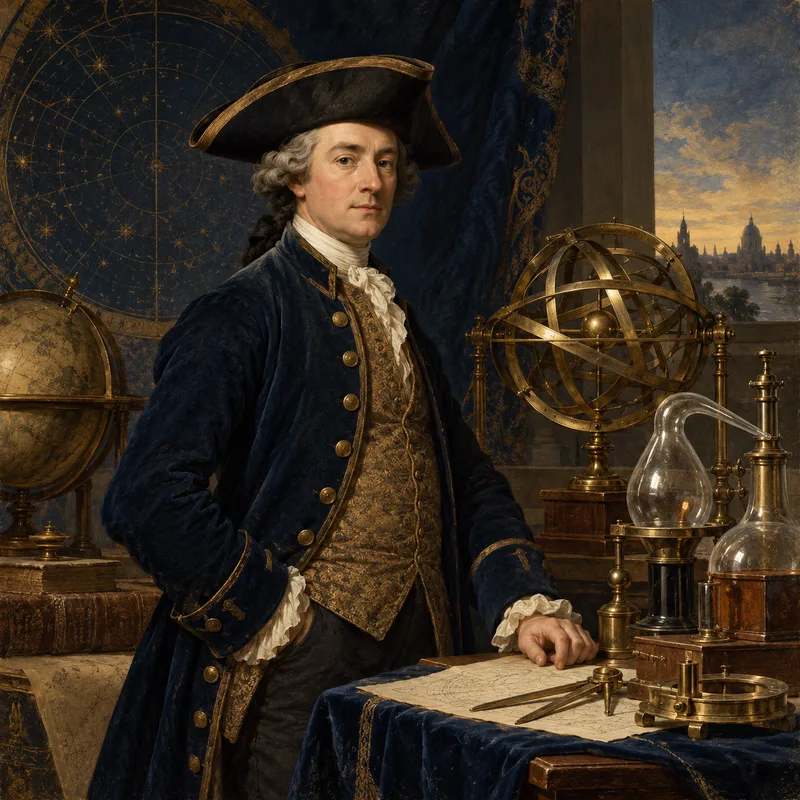
About the chemist
Henry Cavendish
1731-1810 · United Kingdom
Discovery of hydrogen; Cavendish experiment