The discovery, explained · Chemist no. 235 of 350
Henry Cavendish: Inflammable Air, the Birth of Water and a Bubble That Waited a Century
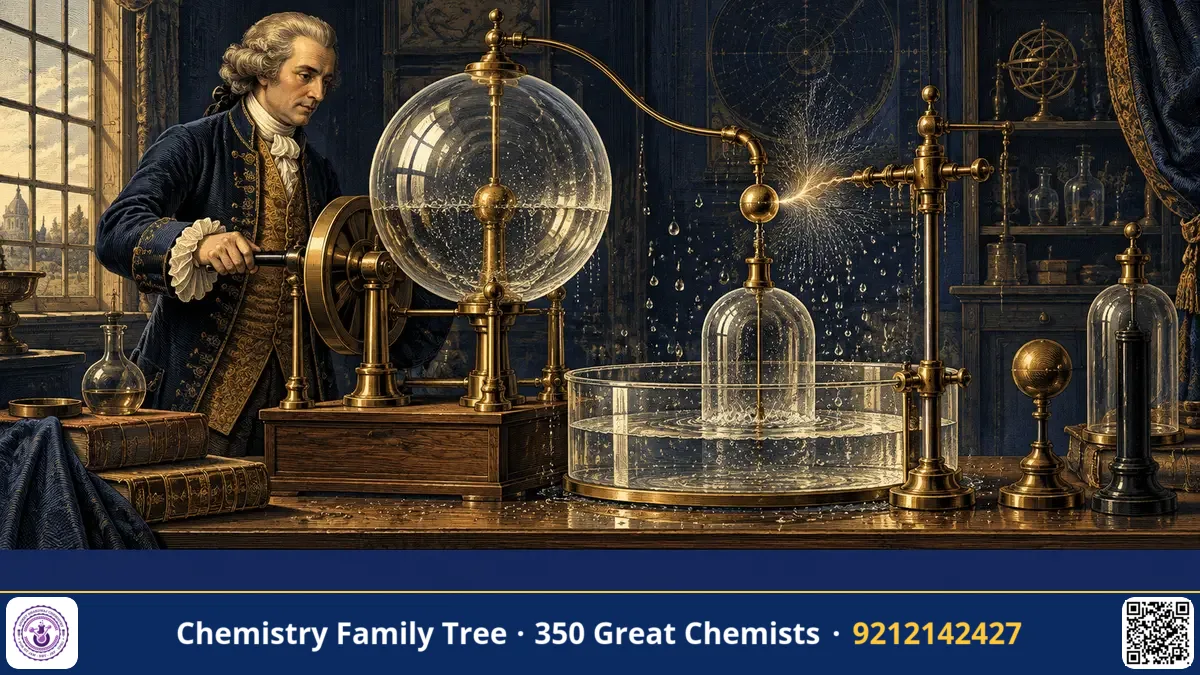
Water was one of the four classical elements for two thousand years. In the 1780s, a shy English scientist named Henry Cavendish showed that it is not an element at all: it is formed when "inflammable air" (hydrogen) burns in "dephlogisticated air" (oxygen). Earlier, in 1766, he had carefully described the properties of hydrogen and shown that it is a distinct gas. And in an experiment on air, he left behind a small bubble that would only be explained after more than a century, when argon was discovered. In this post we follow these experiments step by step and then translate them into modern chemistry.
The Scientific Problem Before the Discovery
In the mid-18th century, "air" was regarded as a single substance, although Joseph Black had just shown that "fixed air" (carbon dioxide) was something different. When metals dissolve in dilute acids, a gas bubbles out; chemists had seen it before, for instance Boyle and Paracelsus's circle, but it was usually treated as just another kind of air, or confused with other gases. Water was considered an element; no one could say what it contained. The theory of combustion was phlogiston theory: burning released a substance called phlogiston. Cavendish's problem was to isolate gases, to measure them accurately, and to relate them to each other.
The Discovery: Step by Step
Step 1: Preparing and collecting the gas (1766)
Cavendish reacted zinc, iron and tin with dilute sulfuric or hydrochloric acid and collected the gas over water, using the pneumatic trough developed by Stephen Hales. The reaction is:
Zn + H₂SO₄ → ZnSO₄ + H₂↑
He showed that the gas was the same regardless of the metal or acid used, which suggested it was a specific substance. He measured its density and found it very much lighter than ordinary air, many times lighter than air (the modern value is about fourteen times lighter). He published this in the paper "Three Papers, Containing Experiments on Factitious Air" (1766).
Step 2: Burning the gas
He found that inflammable air burns, and that when it is mixed with air and ignited by an electric spark in a closed vessel, a dew forms on the glass walls. He was careful to weigh and measure the volumes of gas used.
Step 3: Forming water (1781–1784)
Following a hint from John Warltire and Joseph Priestley, he repeated the experiment with great care. He exploded mixtures of inflammable air and common air, and later of inflammable air and dephlogisticated air (oxygen), in a closed glass vessel. By measuring volumes, he found that about two volumes of inflammable air combined with one volume of dephlogisticated air, and that the product was pure water:
2H₂ + O₂ → 2H₂O
Cavendish read his results to the Royal Society in 1784, and published them in 1784 in the Philosophical Transactions ("Experiments on Air"). He interpreted the results in the language of phlogiston, and he did not state strongly that water is a compound. A priority dispute with James Watt and, later, with Lavoisier followed; Lavoisier, however, understood and announced the compound nature of water in the oxygen framework.
Step 4: Nitric acid and the leftover bubble (1785)
While sparking air with excess oxygen in the presence of alkali, Cavendish converted nitrogen into nitrous products that were absorbed by the alkali:
N₂ + O₂ → 2NO (spark); 2NO + O₂ → 2NO₂; 2NO₂ + 2NaOH → NaNO₂ + NaNO₃ + H₂O
He found that a small bubble, about 1/120 of the original volume of air, would not react. He noted this and moved on. In 1894 Lord Rayleigh and William Ramsay identified this unreactive residue as a new element, argon, which makes up about 0.93% of air. That makes Cavendish's bubble a classic example of a discovery waiting for the right question.
The Chemistry Behind It
- Metal–acid reaction: an active metal above hydrogen in the reactivity series displaces H₂ from dilute non-oxidising acids: Zn + 2HCl → ZnCl₂ + H₂.
- Gay-Lussac's law of combining volumes (1808), a later generalisation: gases combine in simple whole-number ratios by volume. Cavendish's 2:1 ratio is a precursor.
- Composition of water: mass ratio H:O = 1:8, since in 2H₂ + O₂, 4 g H₂ reacts with 32 g O₂ to give 36 g water, so the ratio is 1:8. This supports the law of constant composition.
- Energetics: 2H₂(g) + O₂(g) → 2H₂O(l), ΔH = −572 kJ for the equation as written (−286 kJ per mole of water).
- Density: hydrogen has a molar mass of about 2 g/mol and air about 29 g/mol, which is why hydrogen is much lighter than air.
- Noble gas inertness: argon has a complete octet (3s² 3p⁶), so it does not react with sparked oxygen.
Applications Today
Hydrogen is central to the modern chemical industry: the Haber process (N₂ + 3H₂ → 2NH₃) makes the ammonia that supports fertiliser production across India, and hydrogen is used in petroleum refining, hydrogenation of vegetable oils and methanol production. Green hydrogen, made by electrolysis of water with renewable power, is a national priority under India's National Green Hydrogen Mission. Fuel cells combine hydrogen with oxygen to give electricity and water, which is Cavendish's reaction run in reverse and under control. Argon is used for welding shields, in bulbs, and in labs as an inert atmosphere. The gas-collection and volumetric methods he refined remain the basis of gas analysis.
Exam Corner
- Cavendish (1766) identified "inflammable air" (hydrogen) as a distinct substance; Lavoisier later named it hydrogen ("water-former").
- Water forms from hydrogen and oxygen in the volume ratio 2:1; mass ratio H:O = 1:8.
- The inert residue he noticed in 1785 (about 1/120 of the air) was later identified as argon by Rayleigh and Ramsay (1894).
- 2H₂ + O₂ → 2H₂O with ΔH = −572 kJ (for 2 mol water); this is a standard thermochemistry calculation.
- Gay-Lussac's law, Avogadro's hypothesis and the law of constant proportions are all supported by the water experiment.
Common Misconceptions
- "Cavendish discovered oxygen." Priestley and Scheele are credited with that. Cavendish used it.
- "Lavoisier did the water experiment first." Cavendish's experiments came first, but Lavoisier interpreted them correctly as showing water is a compound.
- "Hydrogen is only a fuel." It is also an important industrial reagent and reducing agent.
Quick Revision Box
- 1766: hydrogen shown to be a distinct gas (inflammable air).
- 1781–84: hydrogen + oxygen → water; volume ratio 2:1.
- Name hydrogen was given by Lavoisier.
- 1785: a 1/120 residue of unreactive air; argon identified in 1894.
- Water: constant composition, H:O mass ratio 1:8.
- 2H₂ + O₂ → 2H₂O, ΔH = −572 kJ.
FAQ
Why did Cavendish call hydrogen "inflammable air"?
Because it burns in air. The names hydrogen and oxygen came later from Lavoisier.
Did Cavendish know water was a compound?
His data showed it, but he explained it using phlogiston. Lavoisier gave the oxygen-based explanation.
What is the argon connection?
He noticed a small unreactive bubble in his experiments on air. More than a century later, that residue was shown to contain argon.
What apparatus did he use?
Glass vessels, a pneumatic trough over water or mercury, an electric spark source and precise balances and volume measurements.
Published by ABC Chemistry — IIT-JAM | CSIR-NET | GATE Chemistry Coaching. Visit abcchemistry.com
About the chemist
Henry Cavendish
1731-1810 · United Kingdom
Discovery of hydrogen; Cavendish experiment