The discovery, explained · Chemist no. 302 of 350
Absolute Rate Theory: How Henry Eyring Calculated Reaction Rates
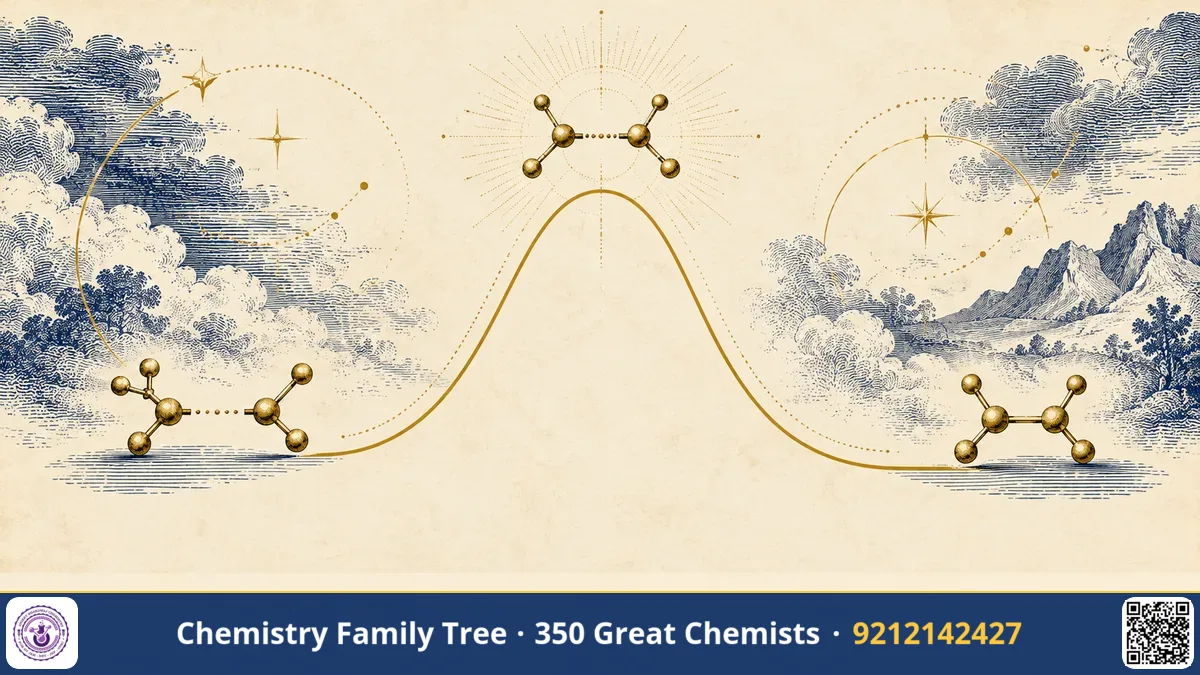
Can the speed of a chemical reaction be calculated from first principles, using only the properties of the molecules involved? This was the dream of early twentieth-century physical chemists. In 1935 the American chemist Henry Eyring (1901-1981) published his absolute rate theory, today known as transition state theory (TST). It expressed the rate constant in terms of the thermodynamic properties of an activated complex at the top of the energy barrier. The resulting Eyring equation, k = (k_BT/h)·exp(-ΔG‡/RT), is now one of the most used formulas in chemistry and biochemistry. It appears in every physical chemistry syllabus, including IIT-JAM, CSIR-NET and GATE.
The Scientific Problem Before the Discovery
The Arrhenius equation, k = A·exp(-Ea/RT), describes how rate constants depend on temperature. It was an empirical law. Chemists could measure Ea and A, but could not predict them. Collision theory, based on the kinetic theory of gases, gave an upper limit for A for bimolecular gas reactions, but real values were often much smaller, and the theory had no way to account for the structure of molecules (steric factor) or for reactions in solution. In the late 1920s, quantum mechanics made it possible to calculate the energy of a group of atoms as a function of their positions. Fritz London's approximate equation for H₃ and the work of Eyring and Michael Polanyi in 1931 produced the first potential energy surface for a chemical reaction. A new question arose: given a surface with a saddle point, how can the rate be computed?
The Discovery: Step-by-Step
Eyring, then at Princeton University, worked out the answer using statistical mechanics. The central assumptions of the theory are:
- Potential surface. The reaction proceeds along the minimum-energy path on the potential energy surface, passing through a saddle point.
- Activated complex. At the saddle point there is a configuration called the activated complex (or transition state), written ‡. It has all the vibrational modes of a normal molecule except one, the motion along the reaction coordinate, which is treated as a translation over the barrier top.
- Quasi-equilibrium. The activated complexes are in equilibrium with the reactants: A + B ⇌ [AB]‡ → products.
- Rate of passage. The rate is the concentration of complexes times the frequency with which they cross the barrier, which is k_BT/h (from the partition function of the free translational mode along the reaction coordinate).
Combining these gives:
rate = (k_BT/h) [AB]‡ = (k_BT/h) K‡ [A][B]
k = κ (k_BT/h) K‡ = κ (k_BT/h) exp(-ΔG‡/RT)
ΔG‡ = ΔH‡ - TΔS‡
k = κ (k_BT/h) exp(ΔS‡/R) exp(-ΔH‡/RT)
Here κ is the transmission coefficient (usually taken as 1, but less than 1 if some complexes fall back to reactants, and greater than 1 if quantum tunnelling is important). In terms of partition functions, K‡ = (q‡/q_A q_B)·exp(-E₀/RT), which allows calculation of the rate constant if the structure and vibrational frequencies of reactants and the activated complex are known.
Worked example. At 298 K, k_BT/h = 6.2 × 10¹² s⁻¹. For a first-order reaction with k = 1 s⁻¹, ΔG‡ = RT ln(k_BT/hk) = 2.479 kJ/mol × ln(6.2 × 10¹²) = 2.479 × 29.5, which is about 73 kJ/mol. A reaction with a free-energy barrier of about 73 kJ/mol therefore has a half-life of less than a second at room temperature, and each increase of about 5.7 kJ/mol in ΔG‡ slows the reaction by a factor of 10.
The Chemistry Behind It
The Eyring plot. Taking logarithms gives ln(k/T) = -ΔH‡/R · (1/T) + ln(k_B/h) + ΔS‡/R. A plot of ln(k/T) against 1/T is a straight line with slope -ΔH‡/R and intercept ln(k_B/h) + ΔS‡/R. From a set of rate constants at various temperatures, one can therefore find both the enthalpy and the entropy of activation.
Relation to Arrhenius. Comparing the two equations, for a reaction in solution Ea = ΔH‡ + RT, and A = e·(k_BT/h)·exp(ΔS‡/R) (with e = 2.718). For a gas-phase bimolecular reaction, Ea = ΔH‡ + 2RT.
| Type of reaction | Typical ΔS‡ | Reason |
|---|---|---|
| Bimolecular association | Negative (about -80 to -120 J/(mol·K)) | Two particles lose freedom to form one complex |
| Unimolecular dissociation | Positive or near zero | The complex is looser than the reactant |
| Ion combination in water | Positive or negative depending on charges | Solvent reorganisation (electrostriction) |
| Protein denaturation | Large positive | Unfolding releases ordered structure |
Kinetic isotope effect. The rate of a reaction in which a C-H bond is broken is higher than that of the C-D analogue (kH/kD up to about 7 at room temperature) because the zero-point energy difference is partly lost in the transition state. This is a direct consequence of TST.
Effect of ionic strength and pressure. TST explains the primary salt effect on ionic reactions and the pressure dependence of rates through the volume of activation ΔV‡.
Beyond reaction rates: Eyring's other rate processes
Eyring extended the same approach to viscosity, diffusion and plastic flow. In his theory, a molecule in a liquid moves by jumping over an energy barrier into a neighbouring hole, so viscosity follows η = (hN_A/V)·exp(ΔG‡/RT), which explains the exponential drop in viscosity as the temperature rises. He applied similar ideas to biological processes such as bioluminescence, enzyme action and the effect of temperature and pressure on organisms.
Applications Today
- Enzyme kinetics: Eyring plots give ΔH‡ and ΔS‡ for enzyme reactions and protein unfolding.
- Computational chemistry: TST is used with quantum chemical calculations to estimate rate constants for atmospheric, combustion and catalytic reactions.
- Pharmaceutical stability: Shelf-life and degradation rates are extrapolated using Eyring or Arrhenius analysis.
- Materials science: The Eyring model for flow and creep is used in polymers, glass and rheology.
- Organic chemistry: Mechanisms are distinguished by the sign of ΔS‡ (associative or dissociative) and ΔV‡.
Exam Corner
- Eyring equation: k = (k_BT/h)·exp(-ΔG‡/RT) = (k_BT/h)·exp(ΔS‡/R)·exp(-ΔH‡/RT).
- Eyring plot: ln(k/T) versus 1/T; slope = -ΔH‡/R; intercept = ln(k_B/h) + ΔS‡/R.
- k_BT/h ≈ 6.2 × 10¹² s⁻¹ at 298 K (the universal frequency factor).
- Ea = ΔH‡ + RT for reactions in solution and unimolecular reactions; ΔH‡ + 2RT for bimolecular gas-phase reactions.
- Negative ΔS‡ indicates an associative, more ordered transition state.
Common Misconceptions
- "The transition state is a stable species that can be isolated." It is a fleeting configuration at the barrier top, lasting about one vibrational period (around 10⁻¹³ s).
- "Eyring and Arrhenius parameters are identical." They are related but not equal: A and Ea differ from k_BT/h·exp(ΔS‡/R) and ΔH‡ by small terms.
- "TST works at absolute zero." It assumes classical barrier crossing, so it can fail at very low temperatures where quantum tunnelling dominates.
Quick Revision Box
- Absolute rate theory (1935): rate = frequency of crossing the barrier × concentration of activated complex.
- Universal frequency: k_BT/h ≈ 6.2 × 10¹² s⁻¹ at 298 K.
- k = κ (k_BT/h) exp(-ΔG‡/RT).
- Eyring plot gives ΔH‡ (from slope) and ΔS‡ (from intercept).
- ΔG‡ of about 73 kJ/mol means a rate constant of about 1 s⁻¹ at 298 K.
- Also applied to viscosity, diffusion and biological rate processes.
FAQ
What is the difference between the Arrhenius and Eyring equations?
Arrhenius is an empirical equation with parameters A and Ea. Eyring is derived from statistical mechanics and gives the rate constant from the free energy of activation, providing a physical meaning for each parameter.
What is k_BT/h?
It is the universal frequency factor, the rate at which any activated complex crosses the barrier, equal to about 6.2 × 10¹² s⁻¹ at 298 K.
What does the transmission coefficient κ represent?
It corrects for the fraction of activated complexes that actually become products. Its value is usually close to one, but it can be smaller (recrossing) or larger (tunnelling).
Why is the entropy of activation useful?
Its sign and size indicate how ordered the transition state is, which helps to distinguish associative from dissociative mechanisms.
Published by ABC Chemistry — IIT-JAM | CSIR-NET | GATE Chemistry Coaching. Visit abcchemistry.com
About the chemist
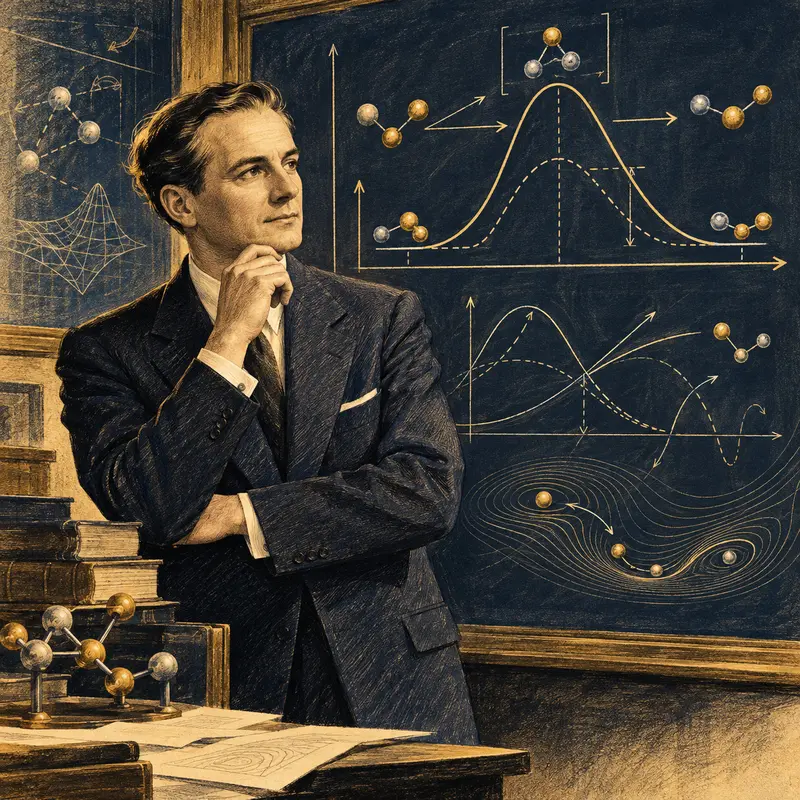
Henry Eyring
1901-1981 · United States
Transition state theory