Biography · Chemist no. 302 of 350
Henry Eyring (1901-1981): From a Mexican Colony to the Top of the Energy Barrier
Introduction
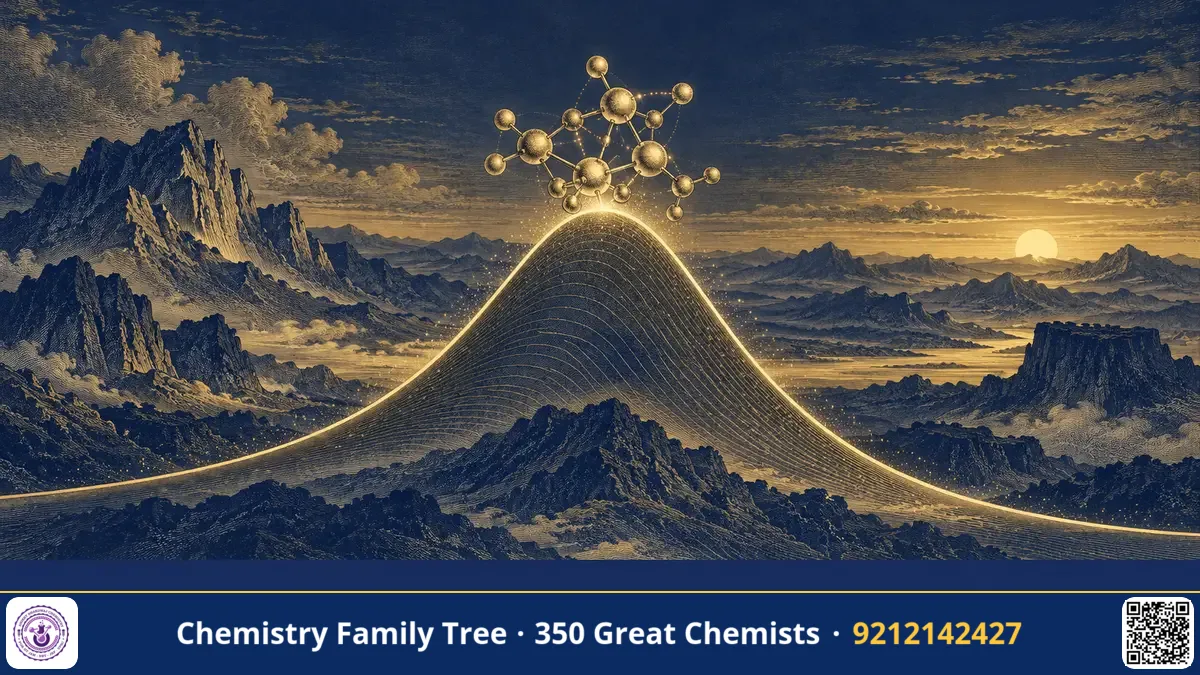
Henry Eyring was a Mexican-born American theoretical chemist who created the absolute rate theory of chemical reactions, now called transition state theory. The Eyring equation, k = (k_BT/h)·exp(-ΔG‡/RT), is used by chemists, biochemists and engineers around the world. He also developed significant theories of liquids, viscosity and plastic flow, and applied rate theory to biology. His legacy in one line: he showed that the speed of a reaction can be understood through the thermodynamics of a fleeting state at the top of the energy barrier.
Early Life and Family
Eyring was born on 20 February 1901 in Colonia Juárez, in the state of Chihuahua, in northern Mexico. His family belonged to a community of American Latter-day Saints (Mormon) settlers who had moved to Mexico. During the unrest of the Mexican Revolution in 1912, the family left their ranch and settled in Arizona in the United States. The young Henry, who was about 11 years old, had to adjust to a new country and a new school system, and later spoke of the hardship of that move. He remained a deeply religious man throughout his life, and saw no conflict between science and faith.
Education and Mentors
He studied at the University of Arizona, where he obtained a bachelor's degree in mining engineering in 1923 and a master's degree in metallurgy in 1924. He then moved to the University of California, Berkeley, to study chemistry, receiving his PhD in 1927 under the physical chemist Gerhard Rollefson. After a period of teaching and research in the United States, he spent a year (1929-1930) in Berlin, where he worked with Michael Polanyi. There he learned the new quantum-mechanical methods and, with Polanyi, calculated a potential energy surface for the reaction H + H₂. This visit changed his career.
Career Timeline
| Year | Event |
|---|---|
| 1901 | Born in Colonia Juárez, Mexico |
| 1912 | Family leaves Mexico and settles in Arizona |
| 1923-1924 | BS (mining engineering) and MS (metallurgy), University of Arizona |
| 1927 | PhD in chemistry, University of California, Berkeley |
| 1929-1930 | Works in Berlin with Michael Polanyi; potential energy surface for H₃ |
| 1931 | Joins Princeton University |
| 1935 | Publishes the theory of absolute reaction rates (the activated complex) |
| 1941 | Co-authors the book The Theory of Rate Processes with Glasstone and Laidler |
| 1946 | Moves to the University of Utah as dean of the graduate school and professor of chemistry |
| 1960s | Develops significant structure theory of liquids and applies rate theory to biology |
| 1981 | Dies in Salt Lake City, aged 80 |
Major Scientific Contributions
1. Absolute rate theory
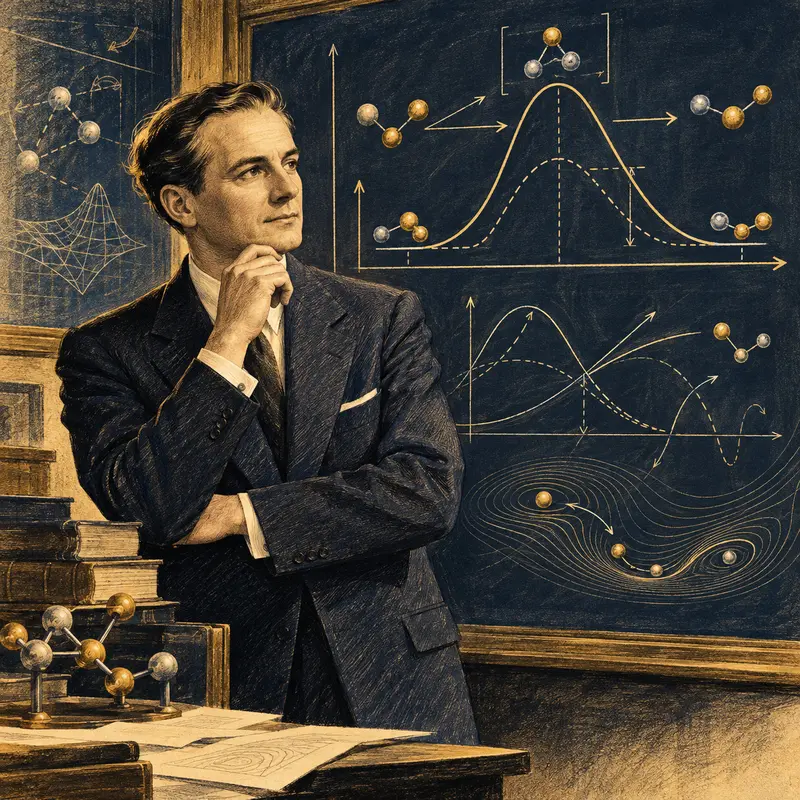
Treating the activated complex as being in quasi-equilibrium with the reactants, he derived a general expression for the rate constant in terms of thermodynamic quantities. This theory made the rate of a reaction calculable from molecular properties. See our companion article for the equations, a worked example and the meaning of the entropy of activation.
2. Potential energy surfaces
With Polanyi, he calculated the first reaction surface using quantum mechanics, and later carried out calculations on many other systems. This approach is now a basic part of computational chemistry.
3. The Theory of Rate Processes
The book by Glasstone, Laidler and Eyring (1941) spread the theory to the world of chemistry and became a classic text, used for decades.
4. Liquids, viscosity and flow
Eyring developed a "hole" theory of liquids, in which molecules move by jumping into vacancies. The Eyring model for viscosity and non-Newtonian flow is still used in rheology.
5. Biological rate processes
He applied rate theory to enzyme action, protein denaturation, nerve conduction, bioluminescence and ageing, showing that physical chemistry can describe living systems.
Awards, Honours and Nobel Prize
Eyring did not receive a Nobel Prize, and many chemists were surprised by this. He received numerous other honours, including the Wolf Prize in Chemistry (1980), the National Medal of Science (1966). He served as president of the American Chemical Society in 1963. He was a member of the United States National Academy of Sciences and held many honorary degrees.
Personality, Struggles and Lesser-Known Facts
- Refugee as a child. The Mexican Revolution forced his family to leave their home when he was 11.
- From mining to quantum chemistry. His early degrees were in mining engineering and metallurgy, and he turned to chemistry only afterward.
- Scientist and believer. He was an active member of his church, and wrote books about the relationship between science and religion, including The Faith of a Scientist.
- Prolific. He published hundreds of papers and many books during his career and trained many graduate students.
- Humour and warmth. Colleagues remembered him for his optimism, humour and willingness to work with anyone who had an interesting idea.
Legacy and Influence on Modern Chemistry
Transition state theory is the language of kinetics. Chemists speak of ΔH‡ and ΔS‡, draw reaction profiles and design catalysts that stabilise transition states, such as enzymes and transition state analogue drugs (like many protease inhibitors). Modern computational methods locate transition states and compute rate constants using the Eyring formalism. His approach also appears in material science through creep and flow models. In India, TST is part of every undergraduate and postgraduate physical chemistry course.
Lessons for Students
- Do not worry if your first degree is in another field: Eyring began in mining engineering.
- Travel and learn from others: his year in Berlin with Polanyi shaped his career.
- Use theory to understand experiments, and experiments to test theory.
- Apply good ideas widely: rate theory works for reactions, viscosity, enzymes and more.
- Stay positive through hardship.
Quick Facts Box
- Born: 20 February 1901, Colonia Juárez, Chihuahua, Mexico
- Died: 26 December 1981, Salt Lake City, USA
- Nationality: American (born in Mexico)
- Field: Theoretical and physical chemistry
- Famous for: Absolute rate theory, Eyring equation, potential energy surfaces, theory of liquids
- Nobel Prize: None; Wolf Prize 1980, National Medal of Science 1966
FAQ
Where was Henry Eyring born?
He was born in Colonia Juárez, Mexico, to American parents, and moved to Arizona in 1912.
Who was his doctoral supervisor?
He earned his PhD at Berkeley in 1927 under Gerhard Rollefson, and later worked with Michael Polanyi in Berlin.
What is the Eyring equation used for?
It gives the rate constant of a reaction from the free energy of activation, and, through the Eyring plot, allows the determination of the enthalpy and entropy of activation.
Did Henry Eyring win a Nobel Prize?
No. He received other major honours, including the Wolf Prize in Chemistry and the US National Medal of Science.
Published by ABC Chemistry — IIT-JAM | CSIR-NET | GATE Chemistry Coaching. Visit abcchemistry.com
About the chemist
Henry Eyring
1901-1981 · United States
Transition state theory