Biography · Chemist no. 43 of 350
Henry Louis Le Chatelier: The Engineer-Chemist Who Taught Equilibrium to Respond
Introduction
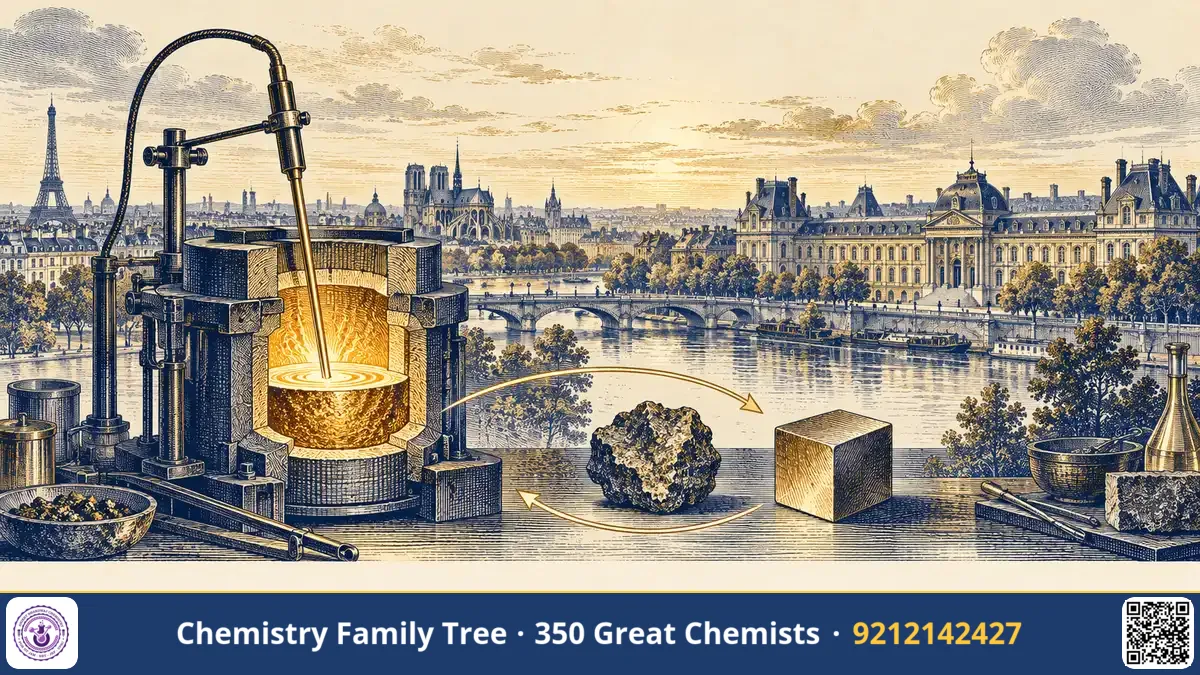
Henry Louis Le Chatelier (1850-1936) was a French chemist and mining engineer whose name is known to every student of chemical equilibrium. He was also a pioneer of cement science, high-temperature measurement, flame and explosion research and metallurgy. Unlike many theoretical chemists, he worked at the meeting point of laboratory science and industry. Legacy in one line: he gave chemists a simple rule to predict how equilibria respond to change, and he applied science to the real problems of furnaces, mines and cement.
Early Life & Family
Le Chatelier was born in Paris on 8 October 1850 into a family closely tied to French engineering and industry. His father, Louis Le Chatelier, was a senior engineer in the Corps des Mines and was involved in the development of French railways and the aluminium industry. The household valued science and public service, and Henry was one of several brothers who also became engineers or industrialists. He grew up in an atmosphere where technical problems were discussed at the dinner table, and this practical outlook shaped his future work.
Education & Mentors
He entered the École Polytechnique in 1869, one of the most selective schools in France, and then continued at the École des Mines in Paris, as was usual for future mining engineers. After qualifying as a mining engineer of the Corps des Mines, he held engineering posts and then returned to Paris. In 1877 he became a professor of chemistry at the École des Mines, where he began teaching and research that would continue for decades. In his time the chemists Henri Sainte-Claire Deville and Marcellin Berthelot were leading figures of French chemistry, and Le Chatelier belonged to the same circle of scientific thought about thermochemistry and dissociation.
Career Timeline
| Year | Event |
|---|---|
| 1850 | Born in Paris on 8 October |
| 1869 | Enters the École Polytechnique |
| 1877 | Professor of chemistry at the École des Mines, Paris |
| 1884 | States the principle of chemical equilibrium that bears his name |
| 1887 | Doctoral thesis on the chemistry of hydraulic mortars and cements |
| 1892 | Introduces the platinum/platinum-rhodium thermocouple for high temperatures |
| 1895 | Develops work leading to the oxyacetylene torch |
| 1898 | Professor at the Collège de France |
| 1907 | Professor at the Sorbonne, succeeding Henri Moissan |
| 1920s | Continues to write, advise industry and promote scientific management |
| 1936 | Dies on 17 September at Miribel-les-Échelles, France |
Major Scientific Contributions
- Le Chatelier's principle (1884): a system at equilibrium shifts to oppose an imposed change. For the equations, see our companion article on Le Chatelier's principle.
- Cement chemistry: using the microscope and thermal analysis he showed that Portland cement contains separate crystalline phases, and he explained that setting is due to hydration and crystallisation of calcium silicates and aluminates. Silicate phases are still named in cement notation, and the Le Chatelier flask is used even today to measure the density of cement.
- Thermoelectric pyrometer: a thermocouple of platinum and platinum-rhodium allowed accurate measurement of furnace temperatures beyond the reach of ordinary thermometers.
- Flames and explosions: his studies on the ignition and propagation of flames in gas mixtures were motivated by firedamp explosions in coal mines, and gave a rule for the flammability limits of mixtures of gases.
- Oxyacetylene welding: his work on the temperature of the acetylene-oxygen flame (above 3000 °C) helped make cutting and welding of steel practical.
- Metallurgy: he contributed to the study of alloys, phase diagrams and the microscopic structure of metals.
Awards, Honours & Nobel Prize
Le Chatelier never received a Nobel Prize, although he was widely admired. He was elected to the French Académie des Sciences in 1907 and received many honours from learned societies in France and abroad. Among scientists, his honour is that the name "Le Chatelier" appears in the syllabus of every country that teaches chemical equilibrium.
Personality, Struggles & Lesser-Known Facts
- The missed ammonia synthesis. Around 1901 Le Chatelier tried to make ammonia from nitrogen and hydrogen under pressure. An explosion in his laboratory, caused by air entering the apparatus, made him abandon the work. Years later Fritz Haber and Carl Bosch succeeded. The episode is a famous example of how close a great discovery can come to being made by someone else.
- Industry and management. He was interested in the organisation of work and promoted the ideas of the American engineer Frederick W. Taylor in France, translating Taylor's writing on scientific management.
- Science for industry. He argued throughout his career that scientific research should serve industry, and he spent much time advising manufacturers of cement, glass, ceramics and metals.
- Prolific author. He wrote many books and articles on chemistry, metallurgy, glass, ceramics and fuel, as well as essays on the relation of science and society.
- Long life. He lived to the age of 85, and his scientific activity lasted over half a century.
Legacy & Influence on Modern Chemistry
The principle is taught from school to postgraduate level and is used in designing industrial reactors. In materials science, his cement microscopy led to the modern understanding of concrete; billions of tonnes of cement are produced every year, with India being the world's second largest producer. High-temperature thermocouples of the platinum-rhodium type (Type S and Type R) are still used for furnace and glass-industry control. The flammability limit rule named after him is used in safety engineering.
Lessons for Students
- Connect theory with practice. Le Chatelier's ideas grew from problems in mines, furnaces and factories.
- Do not drop a problem too early. His abandoned ammonia project shows that persistence and good apparatus matter.
- Measure carefully. A good thermocouple is as valuable as a good theory.
- Write and teach. Clear communication spreads ideas far.
Quick Facts Box
- Born: 8 October 1850, Paris, France
- Died: 17 September 1936, Miribel-les-Échelles, France
- Nationality: French
- Field: Physical chemistry, metallurgy, cement chemistry
- Famous for: Le Chatelier's principle (1884); Pt/Pt-Rh thermocouple
- Nobel: None
FAQ
Was Le Chatelier a chemist or an engineer?
Both. He trained as a mining engineer and became a professor of chemistry.
Which French institutions did he teach at?
The École des Mines, the Collège de France and the Sorbonne.
What is the Le Chatelier flask used for?
It measures the density of cement and other powders by displacement of a liquid.
Did Le Chatelier invent the Haber process?
No. He attempted high-pressure ammonia synthesis around 1901 but stopped after an accident; Haber and Bosch later developed it.
Published by ABC Chemistry — IIT-JAM | CSIR-NET | GATE Chemistry Coaching. Visit abcchemistry.com
About the chemist
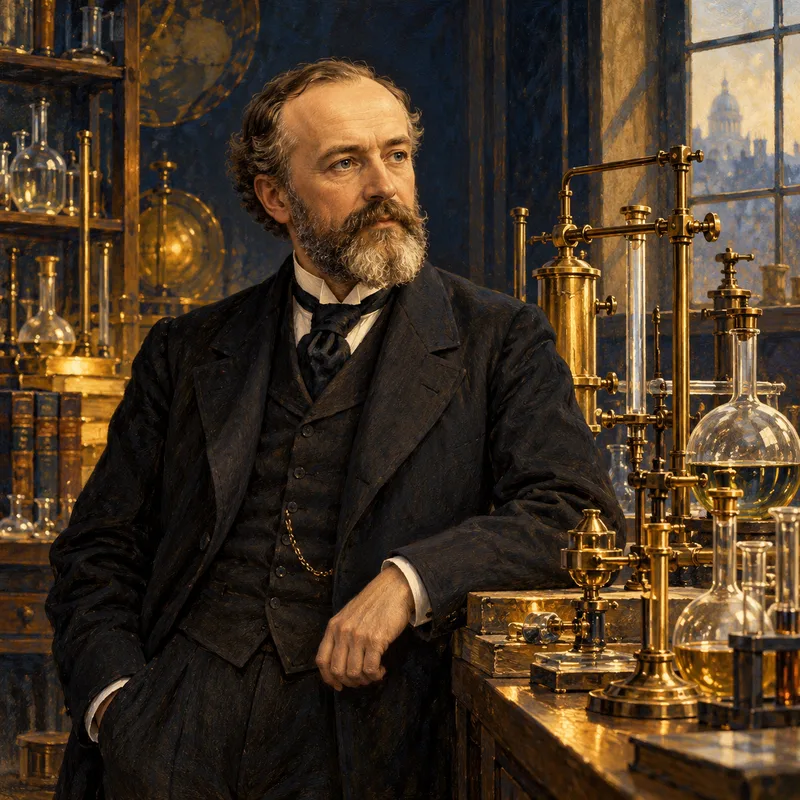
Henry Louis Le Chatelier
1850-1936 · France
Le Chatelier's principle