The discovery, explained · Chemist no. 43 of 350
Le Chatelier's Principle: How Equilibrium Responds to Stress
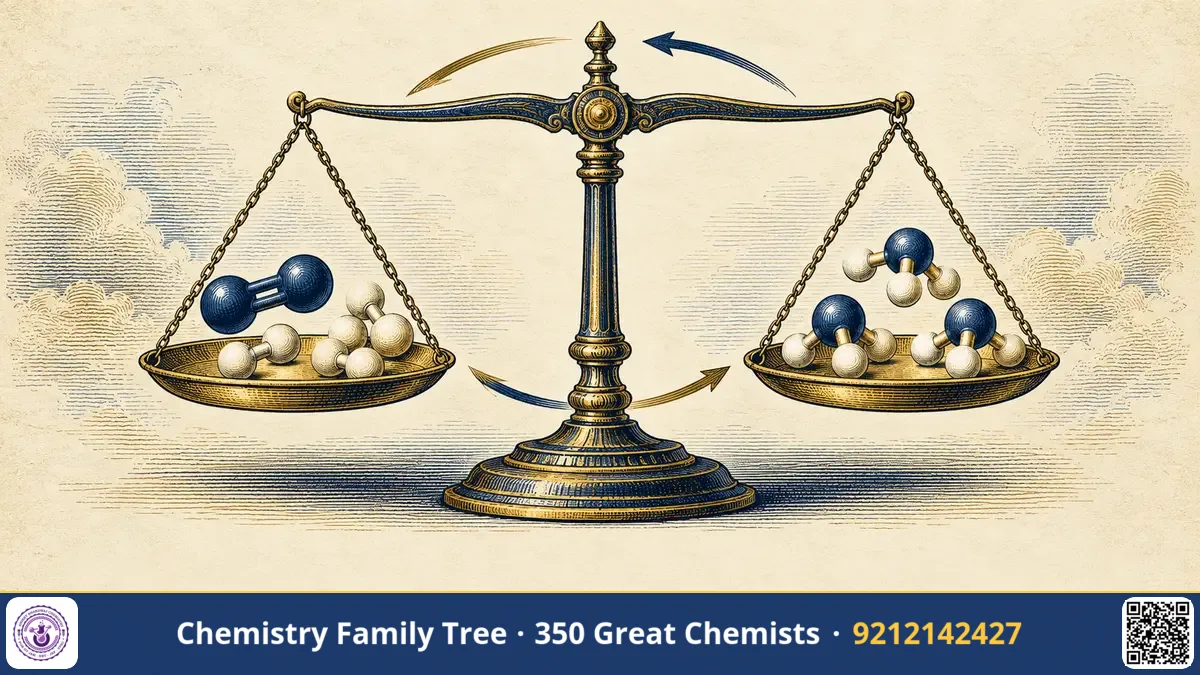
Press a spring and it pushes back. Squeeze a balloon and the air inside resists. In 1884 the French chemist Henry Louis Le Chatelier stated that chemical equilibrium behaves in a similar way: when you disturb a system at equilibrium, it shifts in the direction that reduces the disturbance. This simple rule lets a chemist predict, without any calculation, how changes of concentration, pressure and temperature will change the yield of a reaction. It is the guiding idea behind the Haber process, the Contact process for sulphuric acid and countless other industrial syntheses, and it appears every year in Class 11-12 boards, IIT-JAM, CSIR-NET and GATE.
The Scientific Problem Before the Discovery
By the 1870s, thermodynamics had been developed by Gibbs and van 't Hoff, and the law of mass action by Guldberg and Waage (1864-67). But in practice, industrial chemists in France and Germany faced a simple question: how should we change temperature or pressure to get more product? The mathematics of Gibbs was powerful but hard to apply. Van 't Hoff had already stated a principle of "mobile equilibrium" for temperature in 1884. A general, qualitative rule covering all variables was missing.
The Discovery: The Statement of the Principle
Le Chatelier, a professor at the École des Mines in Paris, published his statement in 1884 in the Comptes Rendus. In modern wording it is:
If a system at equilibrium is subjected to a change of concentration, pressure or temperature, the equilibrium shifts in the direction that tends to counteract the change.
Let us follow this using the standard example, the synthesis of ammonia:
N₂(g) + 3H₂(g) ⇌ 2NH₃(g) ΔH = −92 kJ mol⁻¹
- Add N₂ or H₂. The system tries to use up the added reactant, so the equilibrium shifts forward and more NH₃ forms.
- Remove NH₃ (by liquefying it). The system tries to replace it, so the equilibrium shifts forward again.
- Increase pressure (by decreasing volume). There are 4 moles of gas on the left and 2 on the right. The system reduces the number of moles to relieve the pressure, so it shifts to the right.
- Raise temperature. The forward reaction is exothermic, so heat is a "product". Adding heat shifts the equilibrium to the left, lowering the yield.
- Add a catalyst. No shift occurs. Equilibrium is reached faster, but the composition is unchanged.
The Chemistry Behind It
Concentration change and the reaction quotient
The principle can be tested using the reaction quotient Q. If a reactant is added, Q becomes smaller than K, so the reaction moves forward until Q = K again. If product is added, Q > K and the reaction moves backwards.
Kc = [NH₃]² / ([N₂][H₂]³)
Pressure change
For gas reactions with Δn ≠ 0, Kp is related to Kc by Kp = Kc (RT)^Δn. Increasing pressure by compression favours the side with fewer moles of gas. If Δn = 0, as in H₂ + I₂ ⇌ 2HI, pressure has no effect. Adding an inert gas at constant volume does not change the partial pressures, so there is no shift; at constant total pressure it increases the volume and the equilibrium moves to the side with more moles.
Temperature change: the only factor that changes K
Only temperature changes the value of the equilibrium constant. The direction follows the van 't Hoff equation:
d(ln K)/dT = ΔH° / RT²
For an exothermic reaction (ΔH° < 0), K decreases when T rises. For an endothermic reaction, K increases with T. Concentration, pressure and catalyst do not change K; they only change the position of equilibrium.
Industrial compromise in the Haber process
| Condition | Theory says | Actual choice |
|---|---|---|
| Pressure | High pressure favours NH₃ | About 150-250 atm (cost and safety limit) |
| Temperature | Low temperature favours NH₃ | About 400-500 °C (rate would be too slow if cooler) |
| Catalyst | No effect on yield | Iron with Al₂O₃ and K₂O promoters (faster rate) |
| NH₃ removal | Shifts equilibrium forward | Liquefied and removed continuously |
This shows that Le Chatelier's principle tells us about the equilibrium yield only. The rate is a separate matter dealt with by kinetics.
Other examples
2SO₂(g) + O₂(g) ⇌ 2SO₃(g)     ΔH = −198 kJ   (Contact process, V₂O₅ catalyst)
N₂O₄(g) ⇌ 2NO₂(g)               ΔH = +57 kJ    (brown colour deepens on heating)
CaCO₃(s) ⇌ CaO(s) + CO₂(g)      (lime kiln: CO₂ removed to push forward)
Applications Today
- Fertiliser industry: India's urea plants depend on ammonia synthesis. Optimising pressure, temperature and recycling follows the principle directly.
- Sulphuric acid manufacture: the Contact process uses a moderate temperature of about 450 °C with V₂O₅ and excess oxygen.
- Physiology: haemoglobin binding of oxygen, Hb + O₂ ⇌ HbO₂, shifts at high altitude as the partial pressure of O₂ falls; the body adapts by making more red blood cells.
- Carbonated drinks: opening a bottle lowers the pressure of CO₂ above the liquid, shifting CO₂(g) ⇌ CO₂(aq) to the left and releasing bubbles.
- Environment: ocean acidification involves CO₂ + H₂O ⇌ H₂CO₃ ⇌ H⁺ + HCO₃⁻, pushed to the right by more atmospheric CO₂.
Exam Corner
- Only temperature changes K. Catalysts and inert gases (at constant volume) do not alter equilibrium composition.
- For exothermic reactions, lower T favours products; for endothermic, higher T does.
- Compressing a gas mixture favours the side with fewer moles of gas; if Δn = 0, no change.
- Kp = Kc(RT)^Δn, with Δn = moles of gaseous products − moles of gaseous reactants.
- Le Chatelier's principle does not apply to systems not at equilibrium and cannot predict rates.
Common Misconceptions
- "The system fully cancels the change." It only partly opposes it. After adding reactant, the new equilibrium still contains more of that reactant than before.
- "A catalyst shifts the equilibrium." It speeds up both forward and reverse reactions equally.
- "Adding more reactant raises K." K stays the same; Q changes temporarily.
Quick Revision Box
- Stated by Le Chatelier in 1884; van 't Hoff gave a similar idea for temperature.
- Equilibrium shifts to oppose any change in concentration, pressure or temperature.
- Only temperature changes the value of K.
- Haber: N₂ + 3H₂ ⇌ 2NH₃, ΔH = −92 kJ; high pressure and moderate temperature.
- Catalysts do not shift equilibrium; they only reach it faster.
- Inert gas at constant volume has no effect.
FAQ
Is Le Chatelier's principle a law?
It is a qualitative principle that follows from thermodynamics. It is a very useful rule of thumb, but quantitative work uses K and Gibbs energy.
Why not use very low temperature for ammonia?
The yield at equilibrium would be high, but the reaction would be far too slow to be useful without a catalyst that works at low temperature.
Does the principle work for solutions?
Yes. For example, adding Cl⁻ to a solution of [Co(H₂O)₆]²⁺ shifts the equilibrium towards blue [CoCl₄]²⁻.
Who else stated a similar idea?
Karl Ferdinand Braun in 1887 reached a similar conclusion, which is why it is sometimes called the Le Chatelier-Braun principle.
Published by ABC Chemistry — IIT-JAM | CSIR-NET | GATE Chemistry Coaching. Visit abcchemistry.com
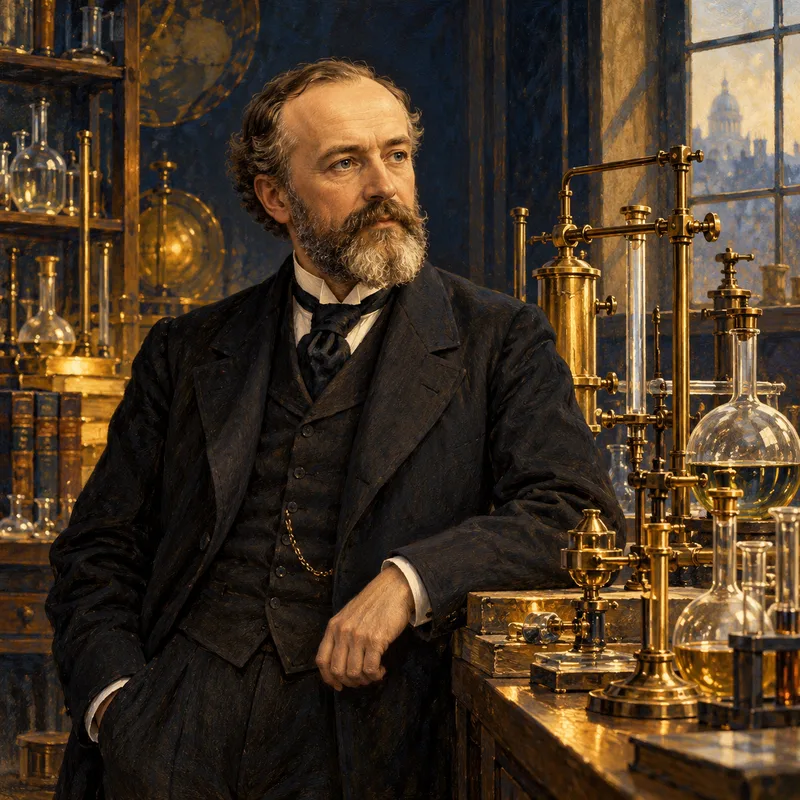
About the chemist
Henry Louis Le Chatelier
1850-1936 · France
Le Chatelier's principle