Biography · Chemist no. 30 of 350
Henry Moseley: The Brilliant Mind Lost Too Soon
Introduction
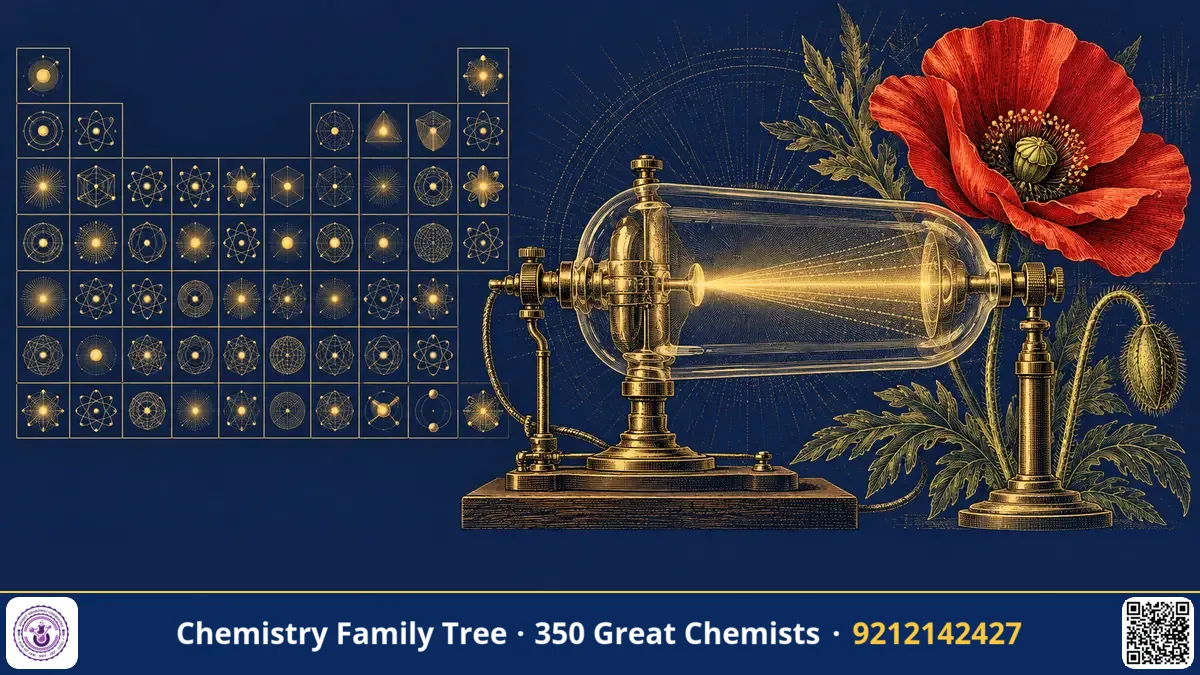
Henry Gwyn Jeffreys Moseley (1887-1915) was an English physicist who, in just two years of research, changed the periodic table forever. By measuring the X-ray spectra of elements he proved that each element is defined by its atomic number, which is the charge of its nucleus. He was killed by a sniper at Gallipoli in August 1915, aged 27. His legacy in one line: he turned the periodic table from a chart based on weight into a law based on nuclear charge, and his early death is remembered as one of the greatest losses of science in the First World War.
Early Life and Family
Moseley was born on 23 November 1887 in Weymouth, Dorset, England. His father, Henry Nottidge Moseley, was a naturalist and professor of anatomy at Oxford who had taken part in the famous Challenger scientific expedition of 1872-76. Young Henry's father died when he was only four years old, and the family moved to Oxford and later lived near other relatives. The boy grew up in a household that respected science and learning, and his mother, Amabel, encouraged his education. His maternal grandfather, John Gwyn Jeffreys, was a noted conchologist, so natural science ran in the family.
Education and Mentors
Moseley won a scholarship to Eton College, where he excelled in science and mathematics. He then went to Trinity College, Oxford, graduating in 1910 with a degree in physics. After Oxford, he made a decision that shaped his career. Instead of staying in the comfortable atmosphere of Oxford, he went to the University of Manchester to work with Ernest Rutherford. Rutherford's laboratory was at the centre of the revolution in atomic physics, and Moseley joined a group including Hans Geiger, Charles Galton Darwin (grandson of Charles Darwin) and Niels Bohr during his stay. He worked as a lecturer and researcher in Manchester from 1910 to 1913.
Career Timeline
| Year | Event |
|---|---|
| 1887 | Born in Weymouth, England (23 November) |
| 1906 | Enters Trinity College, Oxford, after Eton |
| 1910 | Graduates and joins Rutherford's laboratory in Manchester |
| 1913 | Begins X-ray spectra study of the elements; first paper published |
| 1914 | Second paper, covering more elements; returns to Oxford |
| 1914 | Joins the Royal Engineers at the outbreak of the First World War |
| 1915 | Serves in the Gallipoli campaign as a signals officer |
| 1915 | Killed in action at Suvla Bay, Gallipoli (10 August) |
Major Scientific Contributions
- Moseley's law: the square root of the frequency of characteristic X-rays is a linear function of atomic number: √ν = a(Z - b).
- Atomic number as the basis of the periodic table: he confirmed that the order of elements is determined by nuclear charge, resolving anomalies like Ar-K, Co-Ni and Te-I.
- Prediction of missing elements: he showed that the numbers 43, 61, 72 and 75 were unfilled. They correspond to technetium, promethium, hafnium and rhenium.
- Counting the lanthanides: he showed that there are exactly fifteen rare earth elements from lanthanum to lutetium.
- Early beta-ray cell: with Rutherford's group, he built an early device in which beta particles charged a sphere, sometimes described as a forerunner of the atomic battery.
The full explanation of the experiment is in the companion post on Moseley's law.
Awards, Honours and Nobel Prize
Moseley received no Nobel Prize. He was killed in 1915, and the prize is not given posthumously. Many scientists have said he would very probably have been honoured had he lived. The American physicist Robert Millikan described his death as one of the most hateful results of the war, and his work is regarded as a major step for the atomic model. The Moseley name is remembered in several ways: the Moseley law in every textbook, and a crater on the Moon named after him.
Personality, Struggles and Lesser-Known Facts
- Quiet determination. Moseley was known as intense, self-reliant and rather reserved. He worked long hours, often alone, building his apparatus by hand.
- Paying for his own research. After leaving Manchester in 1913 he went back to Oxford, where he worked in the laboratory space provided by Oxford and used his own resources to continue the X-ray studies.
- Voluntary service. When the war began he could have been used as a scientist, but he volunteered for the Royal Engineers, even though friends tried to dissuade him. He served as a signals officer.
- A lasting lesson. His death is often cited as one reason why Britain later tried to keep trained scientists out of front-line roles in later conflicts.
- Remarkable speed. His main discovery came in about eighteen months of work.
Legacy and Influence on Modern Chemistry
Moseley's work gave atomic number its meaning. Every modern periodic table follows his arrangement, and every chemistry student learns the modern periodic law. Techniques based on his law, X-ray fluorescence and energy-dispersive X-ray spectroscopy, are used to analyse materials in industry, forensic science, archaeology and space exploration. His predictions guided the hunt for missing elements, and the discoveries of hafnium (1923), rhenium (1925), technetium (1937) and promethium (1945) filled the gaps he had pointed out. His life also stands as a reminder of the human cost of war and of the potential that may be lost.
Lessons for Students
- A clean experiment beats a long argument. A straight-line plot settled a half-century debate.
- Measure systematically. He studied many elements in order, not just one or two.
- Use theory as a guide. Rutherford's atom and Bohr's model gave meaning to the data.
- Time is precious. Make the most of your years of learning.
- Value talent. Societies must protect their young scientists.
Quick Facts Box
- Born: 23 November 1887, Weymouth, England
- Died: 10 August 1915, Gallipoli (Suvla Bay), aged 27
- Nationality: British
- Field: Physics and X-ray spectroscopy
- Famous for: Moseley's law, atomic number
- Nobel Prize: None (died before consideration)
FAQ
Why is Moseley important in chemistry?
He proved that the atomic number, not the atomic weight, determines the position of an element in the periodic table.
Did Moseley win a Nobel Prize?
No. He died in 1915 and the Nobel Prize is not awarded after death. Many historians believe he would have been a strong candidate.
Where did Moseley do his work?
He worked mostly at the University of Manchester under Rutherford and then at Oxford.
How did Moseley die?
He was killed by a sniper at Gallipoli, Turkey, on 10 August 1915, while serving as a signals officer in the British army.
Published by ABC Chemistry — IIT-JAM | CSIR-NET | GATE Chemistry Coaching. Visit abcchemistry.com

About the chemist
Henry Moseley
1887-1915 · United Kingdom
Atomic number from X-ray spectra