The discovery, explained · Chemist no. 30 of 350
Moseley's Law: How Atomic Number Fixed the Periodic Table
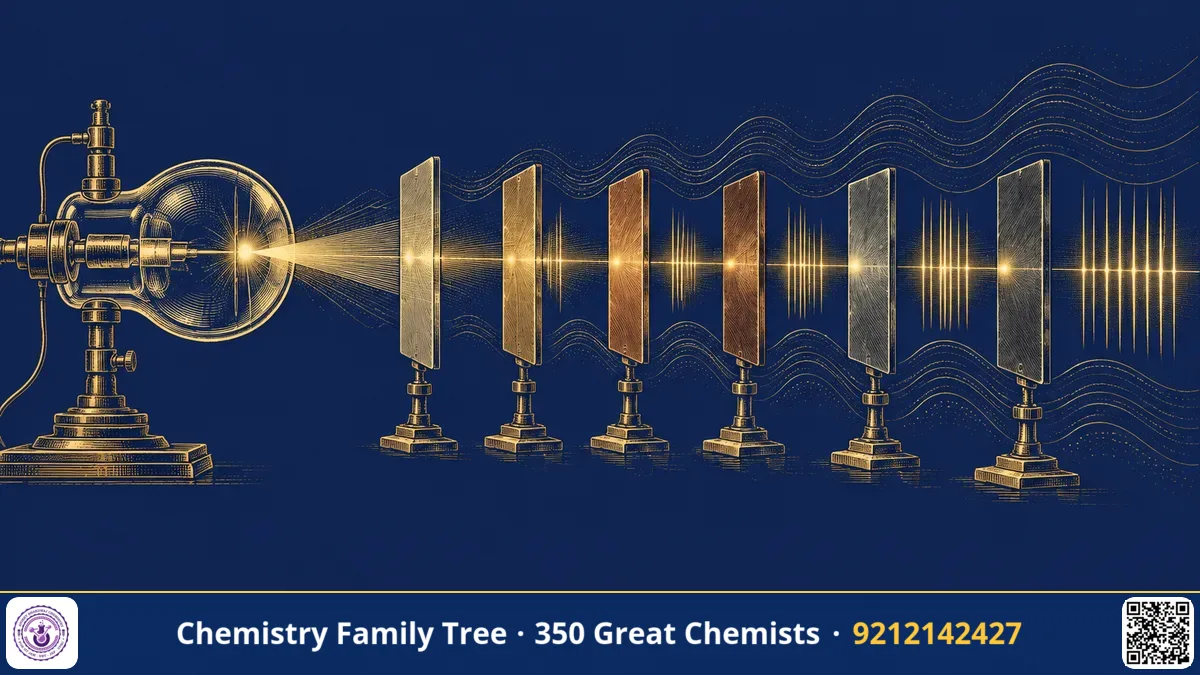
Before 1913, the periodic table was arranged by atomic weight, and chemists suspected that this was not quite right. Then a 25-year-old Englishman, Henry Gwyn Jeffreys Moseley, fired electrons at metal after metal, recorded the X-rays each one produced, and found a perfectly straight-line relation between the X-ray frequency and the position of the element in the table. The number that controlled everything was not mass but the atomic number, which we now know is the number of protons in the nucleus. Moseley's law turned the periodic table from a clever empirical chart into a physical truth, and it gave us the modern periodic law: the properties of elements are periodic functions of their atomic numbers. Sadly, Moseley died in the First World War at the age of 27, before he could receive the Nobel Prize that many believed was within his reach.
The Scientific Problem Before the Discovery
Dmitri Mendeleev had arranged elements by increasing atomic weight in 1869, with a few intelligent exceptions. He placed tellurium (127.6) before iodine (126.9) because chemical properties demanded it, even though the weights were in the wrong order. Similar reversals existed for argon and potassium, and for cobalt and nickel. If atomic weight was the controlling property, why did these pairs break the rule?
There were also uncertainties about the number of elements. Among the rare earth elements (lanthanides), chemists were not sure how many there were, because they are chemically so similar. Several claimed discoveries turned out to be mixtures. The periodic table needed a more fundamental number than atomic weight, one that could say exactly how many elements exist between hydrogen and uranium, and exactly where gaps remained.
Meanwhile, the physics of the atom was changing. In 1911 Ernest Rutherford proposed the nuclear atom with a small positive nucleus. In 1913 Antonius van den Broek suggested that the position of an element in the table equals the nuclear charge, and Niels Bohr published his model of the atom. It was an ideal moment for an experimental test.
The Discovery: Step by Step
Moseley worked in Rutherford's laboratory at Manchester and, with the help of C. G. Darwin, used the X-ray crystal spectroscopy technique developed by William Henry Bragg and William Lawrence Bragg. His approach was systematic:
- He placed samples of different elements as targets (anticathodes) inside an evacuated X-ray tube.
- Cathode rays (fast electrons) struck each target, knocking out inner-shell electrons and causing the element to emit characteristic X-rays.
- The X-rays were diffracted from a crystal such as potassium ferrocyanide, and the angles were measured on a photographic plate. Using Bragg's law, nλ = 2d sinθ, he converted the angle to a wavelength and then a frequency.
- He studied the strongest lines, called the K-alpha and L-alpha lines, for around forty elements, from aluminium to gold.
When he plotted the square root of the frequency against a series of whole numbers corresponding to the order of the elements, he obtained a straight line. The numbers were not atomic weights; they were the position numbers in the table, which he called the atomic number Z. This is Moseley's law:
√ν = a (Z - b)
Here ν is the frequency of the characteristic X-ray line, Z is the atomic number, and a and b are constants for a given series of lines. For the K-alpha line, b is approximately 1, so
√ν(Kα) = a (Z - 1), with a = √(3Rc/4) approximately
This agrees with the Bohr model, where R is the Rydberg constant and c is the speed of light. For K-alpha, the transition is from n = 2 to n = 1, and the factor 3/4 comes from (1 - 1/4). The "-1" represents screening of the nuclear charge by the other electron remaining in the K shell.
What Moseley's results showed
- Cobalt (Z = 27) comes before nickel (Z = 28), and argon (18) before potassium (19), and tellurium (52) before iodine (53), even though the atomic weights seemed reversed. The order of atomic number agreed with the chemistry.
- There were no gaps in the series between aluminium (13) and gold (79) except for places where elements were missing. Moseley identified the numbers 43, 61, 72 and 75 as then-unknown elements. They were later found as technetium, promethium, hafnium and rhenium.
- There were fifteen elements, from lanthanum (57) to lutetium (71), in the rare earth series. This settled the question of how many such elements could exist.
- The total number of elements from hydrogen (1) to uranium (92) was fixed at 92, and the number of elements still unknown could be counted.
The Chemistry Behind It
Origin of characteristic X-rays
When a high-energy electron removes an electron from the K shell (n = 1) of an atom, a vacancy forms. An electron from the L shell (n = 2) drops into it, and the energy difference is released as an X-ray photon, the K-alpha line. If the electron falls from the M shell (n = 3), the K-beta line is emitted. Since the energy depends on the nuclear charge as seen by the inner electrons, the frequency increases regularly with Z.
Link to the Bohr model
For a hydrogen-like species, the energy of level n is E = -13.6 Z² / n² eV. Hence the frequency of a transition scales as Z², and its square root is proportional to Z. Moseley's observation that √ν is linear in (Z - b) is a direct confirmation of this picture.
Modern periodic law
The modern periodic law, based on Moseley's work, says that the physical and chemical properties of elements are periodic functions of their atomic numbers. The older Mendeleev's periodic law referred to atomic weight. This distinction is a favourite exam question.
Bragg's law
Diffraction from the crystal planes follows nλ = 2d sinθ, where d is the interplanar spacing and θ is the glancing angle.
Applications Today
- X-ray fluorescence (XRF): instruments identify elements in a sample by measuring the characteristic X-ray energies, directly based on Moseley's law. XRF is used in metals, cement, geology, archaeology and art authentication.
- Electron microscopy: energy-dispersive X-ray analysis (EDX) in SEM and TEM shows which elements are present in tiny regions of a sample.
- Synthesis of new elements: to confirm a new superheavy element, scientists look for its characteristic X-rays and atomic number.
- Quality control and forensics: portable XRF checks gold purity, alloy composition and lead in paints and toys.
- India context: Indian cement, steel and mining laboratories, hallmarking centres for gold and ISRO and BARC facilities use X-ray based elemental analysis.
Exam Corner
- Moseley's law: √ν = a(Z - b). A plot of √ν against Z is a straight line.
- Atomic number, not atomic weight, is the fundamental basis of the modern periodic table.
- For K-alpha lines, the screening constant b is about 1; for L-alpha lines it is about 7.4.
- Moseley predicted that elements with Z = 43, 61, 72 and 75 existed; they are Tc, Pm, Hf and Re.
- Anomalous pairs: Ar-K, Co-Ni, Te-I are in the correct order of atomic number but reversed in atomic weight.
Common Misconceptions
- "Moseley discovered the proton." He did not. He showed that atomic number equals nuclear charge, which is the number of protons.
- "Moseley's law relates frequency directly to Z." It relates the square root of frequency linearly to Z.
- "Moseley won the Nobel Prize." He did not. He was killed in 1915, and the Nobel Prize is not awarded after death.
Quick Revision Box
- 1913-1914: Moseley's X-ray spectra study at Manchester and Oxford.
- Law: √ν = a(Z - b); straight line against Z.
- Atomic number = nuclear charge = number of protons.
- Gaps predicted at Z = 43, 61, 72, 75.
- Modern periodic law uses atomic number.
- Technique: X-ray tube, crystal diffraction, Bragg's law.
FAQ
What is the relation between X-ray frequency and atomic number?
The square root of the frequency of a characteristic X-ray line increases linearly with atomic number: √ν = a(Z - b).
Why is atomic number better than atomic weight?
Atomic number equals the number of protons, and it determines the electron configuration and hence the chemistry. Atomic weight is an average over isotopes and can be out of order.
How did Moseley know there were missing elements?
There were jumps in the atomic number series where no element had been measured, such as 43, 61, 72 and 75.
Did Moseley complete his work?
He had planned to extend his studies to elements lighter than aluminium and heavier than gold. He enlisted in the army in 1914 and died at Gallipoli in 1915.
Published by ABC Chemistry — IIT-JAM | CSIR-NET | GATE Chemistry Coaching. Visit abcchemistry.com

About the chemist
Henry Moseley
1887-1915 · United Kingdom
Atomic number from X-ray spectra