Biography · Chemist no. 59 of 350
Herbert C. Brown: From a Chicago Hardware Family to the Nobel Prize for Boron Chemistry
Herbert Charles Brown (1912-2004) was a British-born American chemist who made boron chemistry a central part of organic synthesis. He found new ways to reduce organic compounds with sodium borohydride, discovered hydroboration and developed organoboranes into versatile reagents. In 1979 he shared the Nobel Prize in Chemistry with Georg Wittig. He worked at Purdue University for more than half a century, and trained many students, including researchers from India and Japan. His life shows how persistence on a single theme can reshape a whole field.
Early Life and Family
Brown was born on 22 May 1912 in London, England, to Ukrainian-Jewish immigrant parents. His family name was Brovarnik, which was later anglicised to Brown. The family moved to the United States, to Chicago, when Herbert was about two years old. His father ran a hardware store. When Herbert was 14, his father died, and the family faced financial difficulties. Money became very tight, and Herbert had to think about how to continue his education. This was a difficult start, but it also taught him discipline.
Education and Mentors
Brown attended Crane Junior College in Chicago, and when that was closed for lack of funds during the Great Depression, he continued at Wright Junior College. He then transferred to the University of Chicago, where he completed his B.S. in 1936 and Ph.D. in 1938. His research supervisor was Hermann Irving Schlesinger, a pioneer of the chemistry of boron and aluminium hydrides. Brown became interested in boron hydrides after reading a book on the subject by Alfred Stock, which was given to him as a graduation present by his future wife, Sarah Baylen. They married in 1937. Brown remained with Schlesinger as a postdoctoral researcher and instructor before moving to Wayne University in Detroit in 1943.
Career Timeline
| Year | Event |
|---|---|
| 1912 | Born in London (22 May); family moved to Chicago in 1914 |
| 1936 | B.S., University of Chicago |
| 1938 | Ph.D., University of Chicago, under H. I. Schlesinger |
| 1940s | With Schlesinger, discovered sodium borohydride during wartime research |
| 1943 | Joined Wayne University, Detroit |
| 1947 | Moved to Purdue University, West Lafayette, Indiana |
| 1956 | Discovered hydroboration with B. C. Subba Rao |
| 1960s | Developed organoborane reagents such as disiamylborane, 9-BBN and chiral boranes |
| 1960s | Studied steric effects and the norbornyl cation controversy |
| 1979 | Nobel Prize in Chemistry, shared with Georg Wittig |
| 2004 | Died in Lafayette, Indiana (19 December) |
Major Scientific Contributions
1. Sodium borohydride
Working with Schlesinger on volatile uranium compounds for the war effort, Brown helped to discover sodium borohydride (NaBH4) and its reactions. It is a mild and convenient hydride donor:
4 R2C=O + NaBH4 + 4 H2O (or ROH) → 4 R2CH-OH + NaB(OH)4 type products
It is used to reduce aldehydes and ketones to alcohols and remains one of the most commonly used reagents in laboratories worldwide.
2. Hydroboration
The addition of B-H across C=C and C≡C bonds, followed by oxidation, gives anti-Markovnikov alcohols with syn stereochemistry. See our companion post for the full mechanism. It arose from an unexpected result in experiments with Subba Rao.
3. Organoboranes in synthesis
He converted organoboranes into alcohols, aldehydes, ketones, amines, halides, carboxylic acids and many other products, and developed chiral boranes like diisopinocampheylborane. His work provided the foundation for the later Suzuki coupling (Akira Suzuki was a postdoctoral researcher with Brown in 1963-65).
4. Steric effects and carbocation chemistry
Brown also studied how the size of groups affects reaction rates and equilibrium, introducing the ideas of F-strain (front strain), B-strain (back strain) and I-strain (internal strain). He was a vocal critic of the "non-classical" norbornyl cation proposed by Saul Winstein, and the debate lasted for decades.
Awards, Honours and Nobel Prize
In 1979 Brown shared the Nobel Prize in Chemistry with Georg Wittig "for their development of the use of boron- and phosphorus-containing compounds, respectively, into important reagents in organic synthesis". He also received the US National Medal of Science (1969) and the Priestley Medal (1981) of the American Chemical Society, among many other awards. He was a member of the US National Academy of Sciences and received numerous honorary degrees. Purdue University named a chemistry laboratory after him.
Personality, Struggles and Lesser-Known Facts
- A difficult youth: After his father's death in 1926, he had to work and study at the same time, and a lack of money forced him to attend junior colleges before reaching the University of Chicago.
- A book as a gift: The book on boron hydrides given to him by his future wife Sarah started his lifelong interest in boron.
- Indian connection: His postdoctoral fellow B. C. Subba Rao from India played a key part in the discovery of hydroboration in 1956, and many other Indian chemists worked in his group at Purdue.
- Persistent debater: He argued scientific points strongly, especially in the norbornyl cation controversy. His critics and supporters agree that the debate pushed experimental chemistry forward.
- Working to the end: He kept doing research and leading his group into his nineties, and he spent over fifty years at Purdue.
Legacy and Influence on Modern Chemistry
Hydroboration is now one of the first reactions that students learn after the basic addition reactions of alkenes. Boron reagents are used in nearly every organic laboratory, from NaBH4 reductions to Suzuki couplings, and drugs, agrochemicals and electronic materials are made using organoboron chemistry. Brown's work on chiral boranes was a forerunner of the modern field of asymmetric synthesis. He also demonstrated that a single element, studied deeply over a lifetime, can open many new fields.
Lessons for Students
- Stay with a subject: Brown spent a lifetime on boron chemistry and became the world expert.
- Watch for surprises: The discovery of hydroboration began with an unexpected result in a reduction experiment.
- Do not be discouraged by poverty: He studied at junior colleges and still reached the Nobel Prize.
- Value collaboration: Hydroboration was found with an Indian postdoctoral colleague, and many of his students carried his work forward.
Quick Facts Box
- Born: 22 May 1912, London, England
- Died: 19 December 2004, Lafayette, Indiana, USA
- Nationality: American (born in Britain)
- Field: Organic and organoboron chemistry
- Famous for: Sodium borohydride, hydroboration, organoboranes
- Nobel Prize: Chemistry 1979 (shared with Georg Wittig)
FAQ
Where did Herbert C. Brown work?
He worked at Wayne University from 1943 to 1947 and then at Purdue University from 1947 for the rest of his career.
What did Brown win the Nobel Prize for?
For developing boron compounds into important reagents in organic synthesis, shared with Georg Wittig, who was honoured for phosphorus compounds.
Who was Subba Rao?
B. C. Subba Rao was an Indian chemist who worked with Brown at Purdue as a postdoctoral fellow, and who co-discovered the hydroboration of alkenes in 1956.
How is Brown connected to the Suzuki reaction?
Akira Suzuki worked as a postdoctoral fellow with Brown in 1963-65 and later developed the palladium-catalysed coupling of organoboron compounds, for which he won the 2010 Nobel Prize.
Published by ABC Chemistry — IIT-JAM | CSIR-NET | GATE Chemistry Coaching. Visit abcchemistry.com
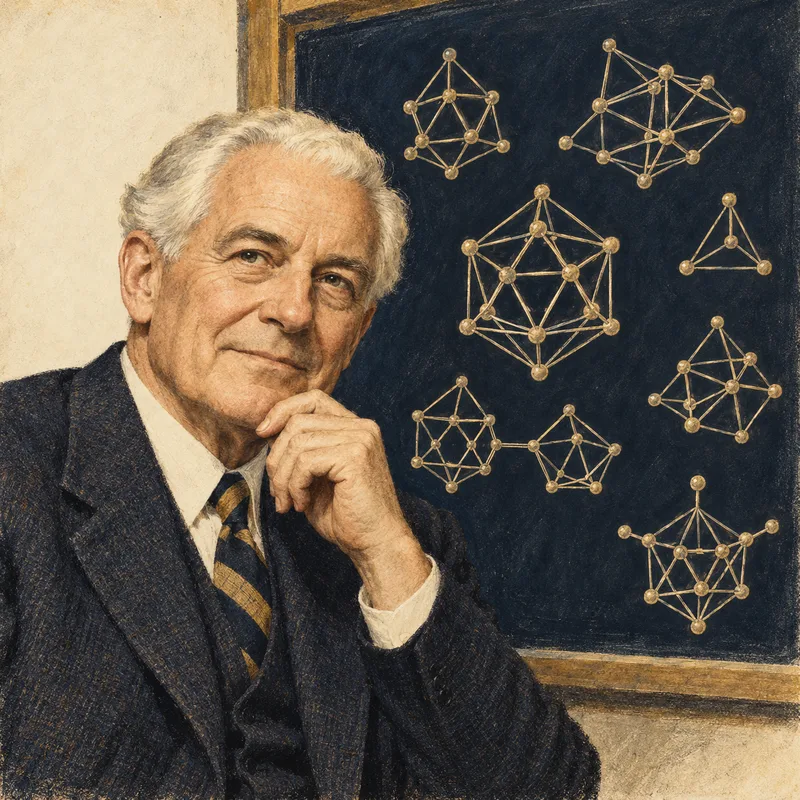
About the chemist
Herbert C. Brown
1912-2004 · United States · Nobel Chemistry 1979
Organoboranes; hydroboration