The discovery, explained · Chemist no. 59 of 350
Hydroboration-Oxidation: The Reaction That Gave Chemists Anti-Markovnikov Alcohols
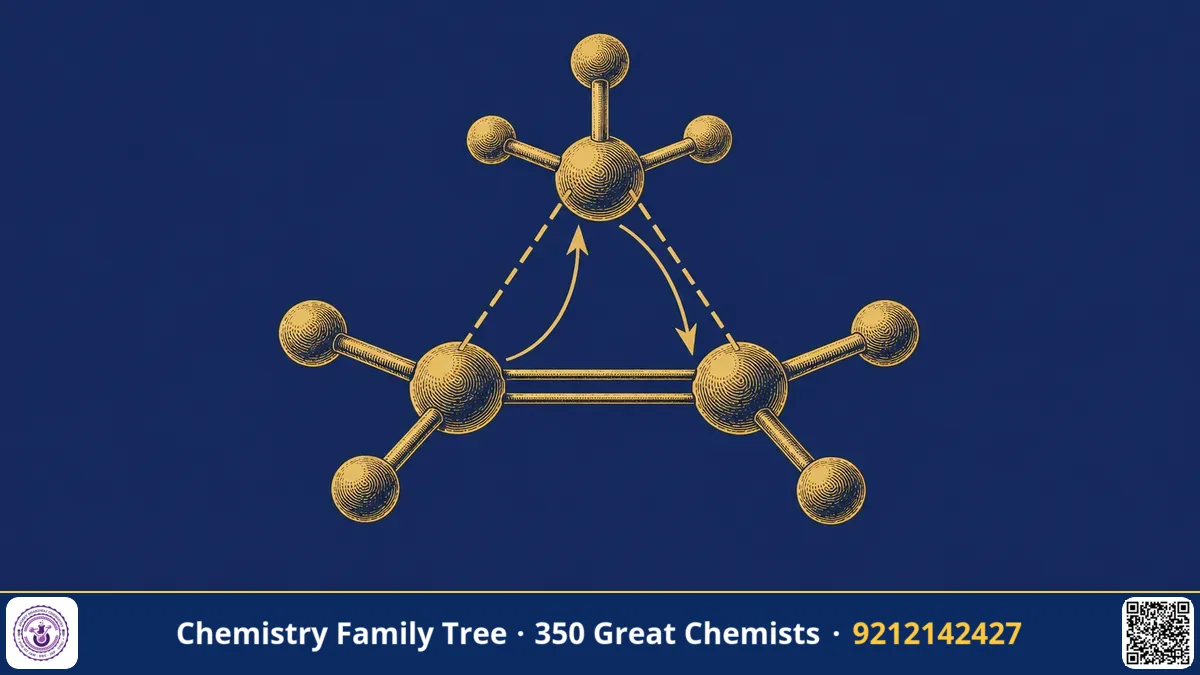
When you add water to propene using acid, you get propan-2-ol, following Markovnikov's rule. But what if you want propan-1-ol? For a long time, there was no simple, clean way to do this. In the 1950s, Herbert Charles Brown at Purdue University found the answer in boron chemistry: hydroboration-oxidation. In two easy steps, an alkene is converted to an alcohol with anti-Markovnikov orientation and syn stereochemistry, with no rearrangement. Brown shared the 1979 Nobel Prize in Chemistry with Georg Wittig for the use of boron and phosphorus compounds as reagents. For students, this reaction is among the most frequently asked topics in alkene chemistry in JAM, NET, GATE and board exams.
The Scientific Problem Before the Discovery
Acid-catalysed hydration of an alkene goes through a carbocation, so it follows Markovnikov's rule and often gives rearranged products. Oxymercuration-demercuration (a later method) also gives Markovnikov alcohols. The anti-Markovnikov addition of HBr was possible only through a radical chain with peroxides (Kharasch effect), but this did not work for water. Chemists needed a general method to place the OH on the less substituted carbon, with predictable stereochemistry.
Meanwhile, Brown had been working on boron hydrides since his student days. During the Second World War, he and his teacher H. I. Schlesinger discovered sodium borohydride (NaBH4), a mild reducing agent, while looking for volatile compounds of uranium. The chemistry of boron hydrides was ready for a new step.
The Discovery: Step by Step
- Sodium borohydride (1940s): Schlesinger and Brown prepared NaBH4, which reduces aldehydes and ketones to alcohols. Brown and co-workers later explored its reactions in depth.
- A surprise in 1956: Brown and his Indian postdoctoral fellow B. C. Subba Rao were studying the reduction of esters and other functional groups by sodium borohydride in diglyme with aluminium chloride, which generates diborane (B2H6). When they tried to reduce an ester containing a double bond, they found that the C=C bond was also consumed. Diborane had reacted rapidly with the alkene at room temperature.
- Understanding the reaction: They found that borane adds across the C=C bond of alkenes to form organoboranes, and that these could be oxidised by alkaline hydrogen peroxide to alcohols.
- Development: Brown and his group then spent years developing the field, creating new borane reagents and showing the use of organoboranes in synthesis.
The Chemistry Behind It
Step 1: Hydroboration
3 CH3CH=CH2 + BH3 → (CH3CH2CH2)3B (tripropylborane)
BH3 (usually as BH3·THF complex, because free borane exists as dimer B2H6) is a Lewis acid with an empty p orbital. The π electrons of the alkene attack boron while a hydride shifts to carbon at the same time in a cyclic, four-centre transition state. There is no carbocation intermediate, so no rearrangement occurs. The addition is syn: B and H add to the same face of the double bond.
Regiochemistry
Boron adds to the less hindered, less substituted carbon, because of both steric and electronic factors (the more substituted carbon bears more positive charge in the transition state, and so receives the hydride). Thus, in propene, B goes to C1 and H goes to C2. Because H (as hydride) is the part that ends up on the more substituted carbon and the OH replaces boron later, the overall result is anti-Markovnikov addition of water.
Step 2: Oxidation
(CH3CH2CH2)3B + 3 H2O2 + NaOH → 3 CH3CH2CH2OH + B(OH)3 (or borate)
The hydroperoxide anion HOO- attacks boron, and an alkyl group migrates from boron to oxygen with retention of configuration. After three such migrations and hydrolysis, the alcohol is released.
Overall stereochemistry: example
1-methylcyclopentene --(1) BH3·THF; (2) H2O2, NaOH--> trans-2-methylcyclopentanol
Hydrogen and boron add syn. Boron is replaced by OH with retention. So H and OH end up cis (syn), which means that the CH3 and OH groups are trans. The product is racemic trans-2-methylcyclopentanol.
Selective reagents
- Disiamylborane and 9-BBN (9-borabicyclo[3.3.1]nonane): bulky boranes that give higher selectivity for the terminal carbon. With terminal alkynes, they stop at the vinylborane stage, and oxidation gives aldehydes (anti-Markovnikov hydration of alkynes), while internal alkynes give ketones.
- Diisopinocampheylborane (Ipc2BH): a chiral borane made from α-pinene, used for asymmetric hydroboration. This work led to enantioselective synthesis of alcohols.
Other uses of organoboranes
Trialkylboranes can be converted to alkyl halides, amines, carboxylic acids (via carbonylation) and to new C-C bonds. Brown's former postdoctoral researcher Akira Suzuki later used organoboron compounds in the Suzuki cross-coupling, which won him the 2010 Nobel Prize.
Applications Today
- Pharmaceutical synthesis: Hydroboration is used to put hydroxyl groups at specific positions in drug intermediates, with predictable stereochemistry.
- Natural product synthesis: The reaction is used for steroid and terpene side chains.
- Suzuki-Miyaura coupling: Alkyl- and alkenylboranes made by hydroboration are used in the coupling to make biaryls and conjugated molecules for medicines, polymers and OLED materials.
- Hydrogen storage research: Sodium borohydride and related borohydrides are studied as hydrogen carriers and used in hydrogen-generation experiments and fuel-cell research.
- Industrial reductions: NaBH4 is used in industry for reductions and in paper pulp bleaching processes.
Exam Corner
- Hydroboration-oxidation of alkenes gives anti-Markovnikov alcohols, with syn addition of H and B and retention in the oxidation.
- No carbocation is formed, so no rearrangement occurs.
- Reagents: (1) BH3·THF or B2H6; (2) H2O2/NaOH.
- Terminal alkyne + R2BH (disiamylborane or 9-BBN), then H2O2/NaOH gives an aldehyde.
- NaBH4 reduces aldehydes and ketones but normally not esters, acids or amides under mild conditions.
Common Misconceptions
- "Hydroboration is a radical reaction." No, it is a concerted, polar four-centre addition.
- "Boron adds to the more substituted carbon." It goes to the less substituted carbon; the hydrogen goes to the more substituted one.
- "The stereochemistry is anti." The addition is syn, and OH replaces boron with retention.
Quick Revision Box
- Hydroboration-oxidation: Brown (with Subba Rao), 1956, Purdue University.
- Step 1: BH3·THF adds syn across C=C; Step 2: H2O2/NaOH replaces B with OH (retention).
- Overall: anti-Markovnikov, syn, no rearrangement.
- Bulky boranes (9-BBN, disiamylborane) improve regioselectivity; with alkynes give aldehydes.
- Brown shared the 1979 Nobel Prize in Chemistry with Georg Wittig.
FAQ
Why is hydroboration-oxidation anti-Markovnikov?
Boron, the electrophile, bonds to the less hindered carbon. When boron is later replaced by OH, the OH ends up on the less substituted carbon.
Why is hydrogen peroxide used with NaOH?
In basic solution, H2O2 forms HOO-, a strong nucleophile that attacks boron and triggers alkyl migration from B to O.
Did an Indian chemist take part in the discovery?
Yes. B. C. Subba Rao, a postdoctoral fellow working with Brown at Purdue, co-discovered hydroboration in 1956.
What is the difference between oxymercuration and hydroboration?
Oxymercuration-demercuration gives Markovnikov alcohols, whereas hydroboration-oxidation gives anti-Markovnikov alcohols.
Published by ABC Chemistry — IIT-JAM | CSIR-NET | GATE Chemistry Coaching. Visit abcchemistry.com
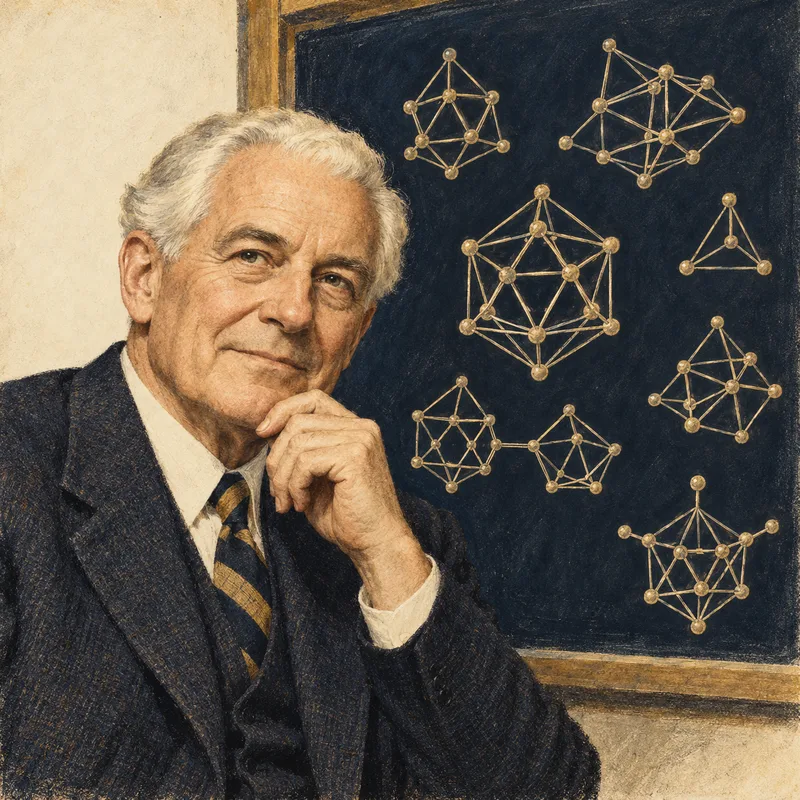
About the chemist
Herbert C. Brown
1912-2004 · United States · Nobel Chemistry 1979
Organoboranes; hydroboration