Biography · Chemist no. 152 of 350
Herbert Hauptman: The Mathematician Who Gave Crystallography Its Missing Phases
Introduction
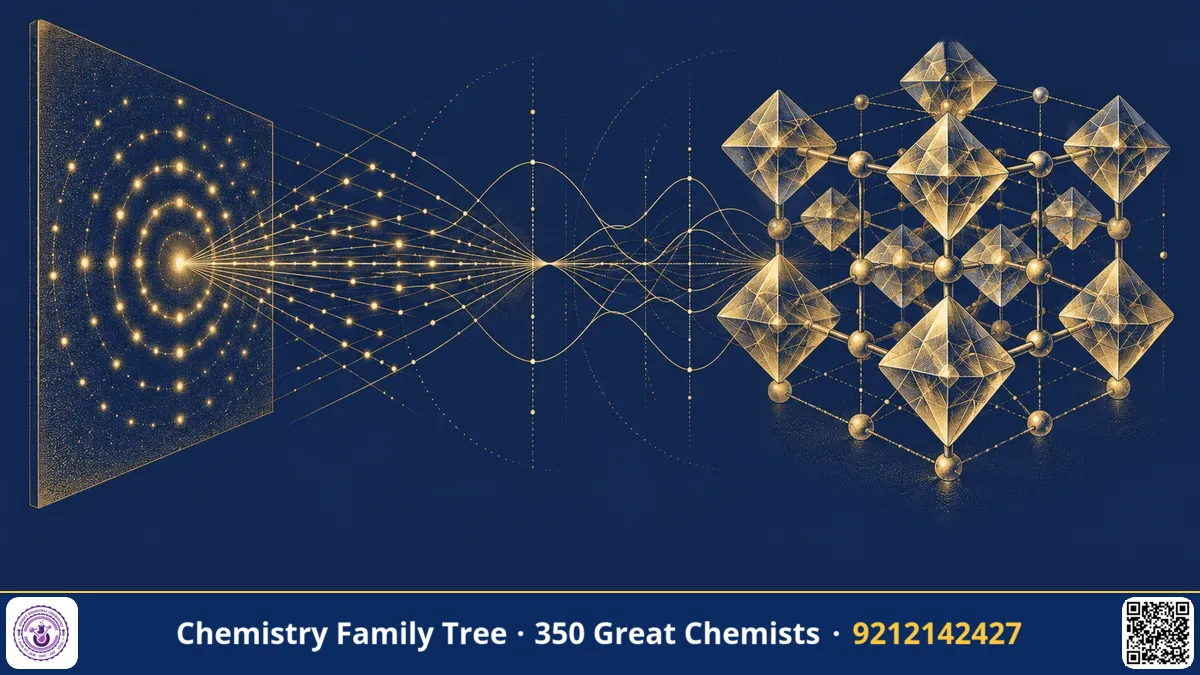
Herbert Aaron Hauptman (1917-2011) was an American mathematician who won the Nobel Prize in Chemistry in 1985. Working with Jerome Karle, he developed direct methods for solving the phase problem in X-ray crystallography, a mathematical breakthrough that allowed chemists to determine molecular structures routinely. In one line: Hauptman proved that mathematics can read the structure of a molecule from the intensities of diffracted X-rays.
Early Life and Family
Herbert Hauptman was born on 14 February 1917 in New York City, and grew up in the Bronx, in a Jewish family. The family was not wealthy, and the years of his youth included the Great Depression. From an early age, Hauptman was attracted to mathematics, and he enjoyed reading about science. His passion for mathematics and science would shape his entire career.
Education and Mentors
Hauptman studied at the City College of New York (CCNY), which offered free tuition and was a gateway for talented children of immigrant families. He obtained his bachelor's degree in mathematics in 1937. He went on to Columbia University, where he received a master's degree in mathematics in 1939. His career was interrupted by the Second World War, in which he served in the US Navy Air Force as a weather officer. After the war, he joined the Naval Research Laboratory in Washington, DC, where he met Jerome Karle, who was trained in physical chemistry. At the same time, he continued his studies at the University of Maryland, where he received his PhD in mathematics in 1955, and in a part-time programme, he deepened the mathematical foundation of his crystallographic work.
Career Timeline
| Year | Event |
|---|---|
| 1917 | Born in New York City on 14 February |
| 1937 | BS in mathematics, City College of New York |
| 1939 | MA in mathematics, Columbia University |
| 1940s | Serves in the US Navy during the Second World War |
| 1947 | Joins the Naval Research Laboratory, Washington, DC |
| 1953 | Publishes with Karle the monograph Solution of the Phase Problem I |
| 1955 | PhD in mathematics, University of Maryland |
| 1970 | Joins the Medical Foundation of Buffalo |
| 1985 | Nobel Prize in Chemistry (shared with Jerome Karle) |
| 1994 | The Foundation is renamed the Hauptman-Woodward Medical Research Institute |
| 2011 | Dies in Buffalo, New York on 23 October |
Major Scientific Contributions
Hauptman's central contribution is the probabilistic theory of direct methods: the discovery that the phases of structure factors are statistically determined by the magnitudes, and the derivation of formulas linking sets of reflections. He gave rigorous mathematical forms to the idea of structure invariants and seminvariants, developed formulas to estimate triple-phase invariants, and extended the theory to include anomalous dispersion. In later years, he worked with colleagues on the Shake-and-Bake algorithm, which made direct methods applicable to larger molecules, including small proteins. His book with Karle, Solution of the Phase Problem I: The Centrosymmetric Crystal, is regarded as a landmark. The mathematical details are explained in the companion discovery post.
Awards, Honours and Nobel Prize
- Nobel Prize in Chemistry, 1985, shared equally with Jerome Karle, for outstanding achievements in the development of direct methods for the determination of crystal structures.
- Member of the United States National Academy of Sciences.
- Honorary degrees from several universities, and honours from crystallographic societies.
- The Hauptman-Woodward Medical Research Institute in Buffalo bears his name.
Personality, Struggles and Lesser-Known Facts
- A mathematician among chemists. Many crystallographers doubted that the phase problem could be solved mathematically, and the idea that phases could be derived from intensities met scepticism for years.
- Slow acceptance. Direct methods were accepted widely only when computers became powerful enough in the 1960s and 1970s to carry out the calculations, after which they became the standard approach to small-molecule structure determination.
- Move to Buffalo. He left the Naval Research Laboratory in 1970 to join the Medical Foundation of Buffalo, where he could work on biological molecules, and he led the institute for many years.
- Family. He married Edith Citrynell in 1940, and they had two daughters.
- Working to the end. He continued to work and publish well into old age.
Legacy and Influence on Modern Chemistry
Direct methods are built into the standard programs of every crystallography laboratory in the world. Every time a chemist publishes a crystal structure of a new compound, there is a good chance it was solved by methods that grew from Hauptman and Karle's work. Together with Shake-and-Bake and later developments, it has influenced structure determination in biology. The Nobel Prize committee highlighted that the work greatly changed the speed of structure determination, from months or years to hours or days.
Lessons for Students
- Mathematics is a powerful tool for chemistry; learn it well.
- Do not accept a problem as impossible because others do.
- Be patient: acceptance may take years, until technology catches up.
- Seek good collaborators with complementary skills, as Hauptman did with Karle.
- A background of limited means need not limit your achievements.
Quick Facts Box
- Born: 14 February 1917, New York City, USA
- Died: 23 October 2011, Buffalo, New York, USA
- Nationality: American
- Field: Mathematics, X-ray crystallography
- Famous for: Direct methods for solving the phase problem
- Nobel: Chemistry, 1985 (shared with Jerome Karle)
FAQ
Was Hauptman a chemist?
He was a mathematician by training. His Nobel Prize was in Chemistry because his work solved a fundamental problem in structural chemistry.
With whom did he share the Nobel Prize?
Jerome Karle, his colleague at the Naval Research Laboratory.
Where did he spend his later career?
At the Medical Foundation of Buffalo, now called the Hauptman-Woodward Medical Research Institute.
What is the practical result of his work?
Crystal structures of new molecules can be determined quickly using direct methods, and these programs are used in laboratories worldwide.
Published by ABC Chemistry — IIT-JAM | CSIR-NET | GATE Chemistry Coaching. Visit abcchemistry.com
About the chemist
Herbert Hauptman
1917-2011 · United States · Nobel Chemistry 1985
Direct methods for crystal structures