The discovery, explained · Chemist no. 152 of 350
Herbert Hauptman: Solving the Phase Problem of Crystallography
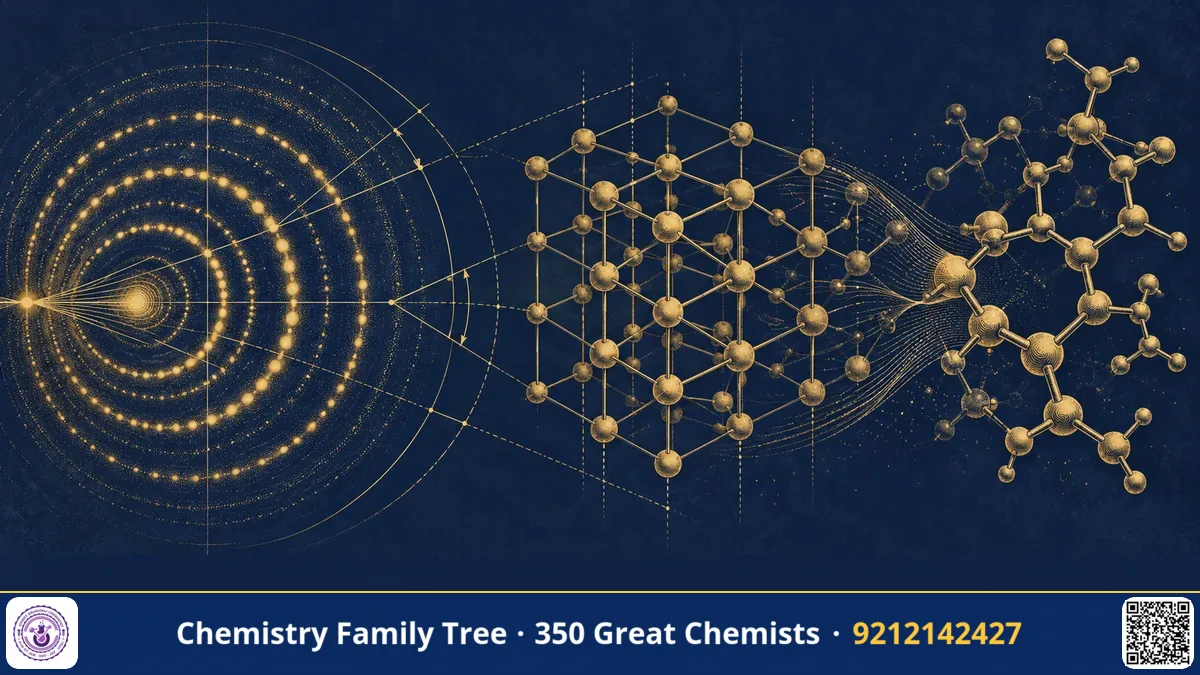
When X-rays pass through a crystal, they produce a pattern of spots. From the positions of the spots one can find the size of the unit cell; from their intensities one should be able to find where each atom sits. But there is a catch: the intensities alone are not enough, because the phases of the diffracted waves are lost during measurement. This is the famous phase problem, which for decades limited crystallography to simple molecules or those with heavy atoms. In the late 1940s and early 1950s, a mathematician, Herbert A. Hauptman (1917-2011), and a physical chemist, Jerome Karle, working at the US Naval Research Laboratory, showed that the phases are not independent. They are mathematically related to the intensities themselves, and can be found by direct methods. For this, they shared the 1985 Nobel Prize in Chemistry for their outstanding achievements in the development of direct methods for the determination of crystal structures.
The Scientific Problem Before the Discovery
X-rays are scattered by the electrons of atoms. The scattered waves from all the atoms in the unit cell interfere, and the result for each reflection (h,k,l) is a complex number called the structure factor, F(hkl), which has an amplitude |F| and a phase φ:
F(hkl) = Σ f_j exp[2πi(hx_j + ky_j + lz_j)] = |F| exp(iφ)
Here fj is the atomic scattering factor of atom j and (xj, yj, zj) its fractional coordinates. The electron density at any point in the cell is obtained by Fourier synthesis:
ρ(x,y,z) = (1/V) Σ F(hkl) exp[-2πi(hx + ky + lz)]
The detector measures only intensity, which is proportional to |F|2. The phase φ is lost. Without the phases, the electron density map cannot be calculated. Before direct methods, crystallographers used tricks such as the Patterson function (which uses |F|2 to give interatomic vectors), the heavy-atom method, and isomorphous replacement (used by Max Perutz for haemoglobin). These work, but need a heavy atom or a chemically modified crystal, and depend on skill and judgement.
The Discovery and Contributions
- Inequalities (1948-49). David Harker and John Kasper showed that for crystals with certain symmetry, the structure factor amplitudes obey inequalities that restrict the possible signs of some reflections. This was a first hint that phases could be derived from amplitudes.
- Probability relations. Hauptman and Karle, working at the Naval Research Laboratory in Washington, introduced probability theory into the problem. They defined a set of quantities called structure invariants and seminvariants - combinations of phases whose values do not depend on the choice of origin and so can be found from the measured intensities.
- The 1953 monograph. In their book "Solution of the Phase Problem I: The Centrosymmetric Crystal" (1953), they presented a rigorous mathematical framework showing how the phases of strong reflections can be estimated from the magnitudes.
- Developments through the years. Hauptman developed the probabilistic theory of structure invariants of higher order, the "neighbourhood" principle, and the use of anomalous dispersion in combination with direct methods. In the 1990s, he worked with colleagues on the "Shake-and-Bake" procedure, which alternates between phase refinement in reciprocal space and density modification in real space, allowing larger structures to be solved.
The Chemistry Behind It
Normalised structure factors
To compare reflections at different angles, the observed amplitudes are corrected for the fall-off of atomic scattering with angle, to give normalised structure factors, E(hkl). They represent the scattering as if the atoms were points. Their average squared value is unity:
|E(h)|² = |F(h)|² / (ε Σ f_j²) ⟨|E|²⟩ = 1
where ε is a symmetry-dependent factor. Large E values (greater than about 1.5) correspond to strong reflections, which have a large influence on the structure.
The triple-product (Sayre) relationship
For three reflections h, k and h - k, the triple phase relation is:
φ(h) + φ(-k) + φ(k-h) ≈ 0 (or φ(h) ≈ φ(k) + φ(h-k))
This relation is valid if all three E values are large. For centrosymmetric crystals the phases are only 0 or π, so the structure factors are real, with signs + or -, and the relation becomes:
S(h) ≈ S(k) · S(h-k) (sign relation, "Σ2 formula")
The probability that this sign relation is true increases with the size of the E values:
P+(h) = ½ + ½ tanh [ (σ3 / σ2^{3/2}) |E(h) E(k) E(h-k)| ]
where σn = Σ Zjn for the atoms in the cell. If the number of atoms is small, or the E values are large, the probability is close to 1. Intuitively, if reflections h and k are strong, the product of the two cosine waves has a strong component at h + k; if the reflection at h + k is also strong, its phase must be consistent with the others. David Sayre (1952) derived a related equation that expresses the structure factors in terms of squared electron density.
Tangent formula
For non-centrosymmetric crystals, Karle and Hauptman gave the tangent formula, which combines many triple-product relations to improve the phase:
tan φ(h) = Σ_k |E(k) E(h-k)| sin[φ(k) + φ(h-k)] / Σ_k |E(k) E(h-k)| cos[φ(k) + φ(h-k)]
One starts by assigning phases to a few reflections that fix the origin (and the enantiomorph), adds more assumed phases symbolically, and then spreads the phases using the formula. The result is checked by calculating an electron density map in which chemically sensible atoms should appear.
Limits
Direct methods work best for small and medium molecules (up to a few hundred atoms) with data to atomic resolution, about 1.2 angstrom or better. For proteins, techniques such as isomorphous replacement and anomalous scattering, or molecular replacement, are used, although direct methods are now used for locating the heavy atoms.
Applications Today
- Routine structure determination. Programs such as SHELX and SIR use direct methods, and a modern single-crystal diffractometer can give the structure of a new organic or inorganic compound in a few hours. Universities and research institutes in India, including IITs and IISc, use this for characterising new compounds.
- Drug discovery. The precise three-dimensional structures of drug molecules and polymorphs are determined by crystallography; in pharma, polymorphism has regulatory consequences.
- Materials chemistry. Metal-organic frameworks, zeolites and organometallic complexes are characterised by X-ray structures.
- Heavy-atom substructures in proteins. Methods derived from direct methods locate selenium or other atoms for phasing.
- Databases. The Cambridge Structural Database holds more than a million structures, most of them solved by direct methods.
Exam Corner
- The phase problem: X-ray detectors record intensity (proportional to |F|2), not phase.
- Direct methods derive phases from the intensities through probabilistic relations; they were developed by Hauptman and Karle and recognised by the 1985 Nobel Prize in Chemistry.
- Triple-product relation for a centrosymmetric crystal: S(h) ≈ S(k)S(h - k).
- Patterson function uses |F|2 with zero phases; it gives interatomic vectors and is used in the heavy-atom method.
- Bragg's law: nλ = 2d sin θ; centrosymmetric crystals have phases 0 or π only.
Common Misconceptions
- "Hauptman was a chemist." He was trained as a mathematician, and his Nobel Prize was in Chemistry, because his mathematics solved a central problem of chemistry.
- "Direct methods do not need any measured data." They require accurate intensities; they only avoid the need for heavy atoms or derivatives.
- "The phase problem is solved for all proteins by direct methods." It is solved routinely for small molecules; for large proteins other methods are used.
Quick Revision Box
- Phase problem: intensities are measured; phases are lost.
- Direct methods (Hauptman and Karle): use statistics of strong reflections to find phases.
- Triple-product relation: φ(h) ≈ φ(k) + φ(h - k) for large E values.
- Tangent formula extends this to non-centrosymmetric crystals.
- Best for small and medium molecules at atomic resolution.
- Nobel Prize in Chemistry, 1985, shared with Jerome Karle.
FAQ
What are direct methods?
They are mathematical procedures that estimate the phases of X-ray reflections directly from the measured intensities, using relationships between the strongest reflections.
Who shared the Nobel Prize with Hauptman?
Jerome Karle, a colleague at the US Naval Research Laboratory. They received the Nobel Prize in Chemistry in 1985.
Why is a mathematician a Nobel laureate in Chemistry?
The prize recognises the chemical importance of the work: direct methods made crystal structure determination possible for countless molecules.
What should I remember for exams?
Know what the phase problem is, the difference between direct, Patterson and heavy-atom methods, and the idea of the structure factor.
Published by ABC Chemistry — IIT-JAM | CSIR-NET | GATE Chemistry Coaching. Visit abcchemistry.com
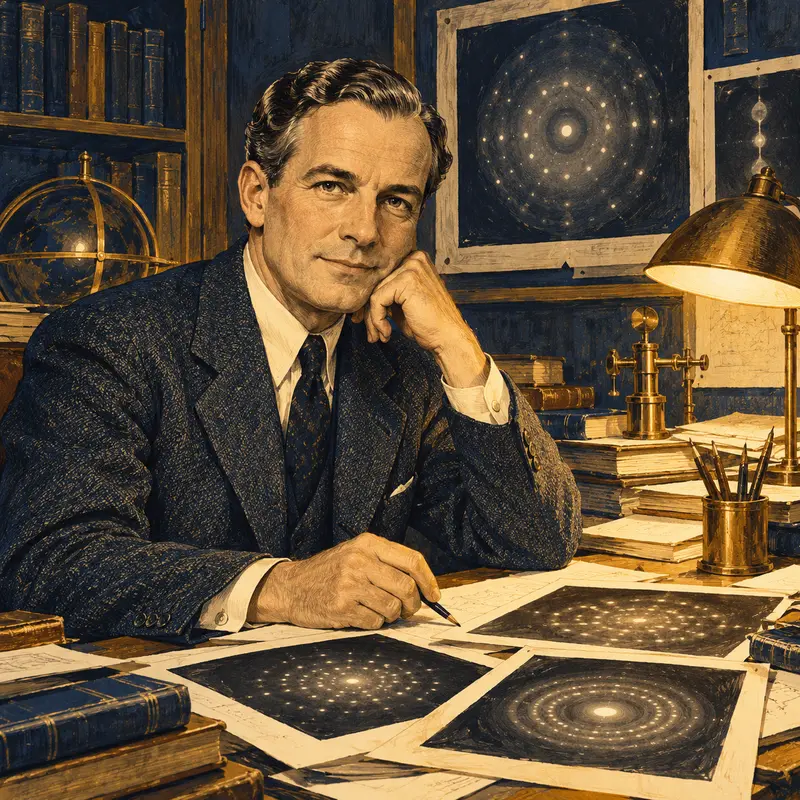
About the chemist
Herbert Hauptman
1917-2011 · United States · Nobel Chemistry 1985
Direct methods for crystal structures