Biography · Chemist no. 76 of 350
Hermann Staudinger: The Father of Polymer Chemistry
Hermann Staudinger (1881-1965) was a German organic chemist who proved that polymers are macromolecules, long chains of repeating units joined by covalent bonds. He faced years of criticism before the scientific world accepted his view. For this central insight he received the Nobel Prize in Chemistry in 1953. His legacy in one line: he gave chemists the concept that underlies all plastics, fibres and many biological materials.
Early Life and Family
Hermann Staudinger was born on 23 March 1881 in Worms, a city on the Rhine in Germany. His father, Franz Staudinger, was a teacher and philosopher who had an interest in social ideas and ethics. The young Hermann was interested in plants and botany, and he planned to study botany. His father, however, advised him to study chemistry first, because it would provide a better base for the study of nature. This advice set his path.
Education and Mentors
Staudinger studied chemistry at the universities of Halle, Darmstadt and Munich. He received his doctorate in 1903 from the University of Halle, working under Daniel Vorländer on malonic esters. He then moved on to habilitation at Strasbourg, where he worked with Johannes Thiele. In Strasbourg he made one of his earliest great discoveries, the ketenes, in 1905, when he prepared diphenylketene. This showed his gift for finding new classes of reactive compounds, which he would use throughout his career.
Career Timeline
| Year | Event |
|---|---|
| 1881 | Born in Worms, Germany |
| 1903 | Doctorate at the University of Halle |
| 1905 | Discovers ketenes |
| 1907 | Becomes professor at Karlsruhe Technical University |
| 1912 | Moves to ETH Zurich |
| 1919 | Develops the Staudinger azide-phosphine reaction |
| 1920 | Publishes the macromolecular hypothesis |
| 1926 | Becomes professor at the University of Freiburg |
| 1940 | Establishes a research institute for macromolecular chemistry in Freiburg |
| 1953 | Nobel Prize in Chemistry |
| 1965 | Dies in Freiburg |
Major Scientific Contributions
Staudinger's life's work has two parts. In the early years he made major contributions to organic chemistry: the discovery of ketenes, the study of reactive intermediates, the Staudinger reaction of azides with phosphines, and the Staudinger synthesis of β-lactams from ketenes and imines. From 1920 he focused on large molecules. He proposed that substances such as rubber, polystyrene and cellulose are macromolecules and tested the idea with chemical reactions, polymer-analogous transformations and viscosity measurements. He synthesised polymers of known structure and showed that their properties depended on chain length. In 1926 he moved to Freiburg and continued this work for the rest of his career. The key chemistry is described in our discovery post.
Awards, Honours and Nobel Prize
- Nobel Prize in Chemistry, 1953, "for his discoveries in the field of macromolecular chemistry". He received the prize alone, at the age of 72.
- Honorary doctorates from several universities.
- In 1947 he founded the journal Die Makromolekulare Chemie, which played an important role in the development of polymer science.
- The Hermann Staudinger Prize of the Gesellschaft Deutscher Chemiker is awarded for polymer research.
Personality, Struggles and Lesser-Known Facts
- A hard fight: For more than a decade, many leading chemists opposed his macromolecule idea. At a famous meeting in Düsseldorf in 1926, he faced strong criticism but continued to present his evidence.
- Stubborn but right, and sometimes wrong: Staudinger insisted that all macromolecules are rigid rods, which turned out to be incorrect, as most flexible chains form random coils. The basic idea of a long chain remained correct.
- Late recognition: The Nobel Prize came more than 30 years after his 1920 paper, when he was already 72.
- Difficult war years: After the move to Freiburg, the Second World War damaged his institute, which was affected by bombing of the city in 1944. He rebuilt it afterwards.
- Family: He married Dora Förster in 1906 and later, after her death, Magda Woit, who also worked as a scientist and collaborated with him on research and writing.
- Wide interests: His love of nature and botany, awakened in youth, stayed with him all his life.
Legacy and Influence on Modern Chemistry
Polymer science, the chemistry of plastics, rubbers, fibres and biomolecules, starts with Staudinger. Without the macromolecular concept, later advances such as nylon (Carothers), Ziegler-Natta polymerisation, and the understanding of proteins and DNA would have been much harder. Today the global polymer industry is worth hundreds of billions of dollars and affects every aspect of life. The Staudinger ligation, based on his azide-phosphine chemistry, has also become a tool for biochemists. For Indian students, the topics of degree of polymerisation, viscosity and molecular weight distribution are regular topics in CSIR-NET and GATE.
Lessons for Students
- A new idea may be rejected at first; support it with careful experiments from many angles.
- Be open to correcting parts of your own theory while keeping the core idea.
- Persistence matters because acceptance may take years.
- Learn organic chemistry well, because it provides the foundation for materials science.
Quick Facts Box
- Born: 23 March 1881, Worms, Germany
- Died: 8 September 1965, Freiburg, Germany
- Nationality: German
- Field: Organic and polymer chemistry
- Famous for: The macromolecule concept; ketenes; Staudinger reaction
- Nobel: Chemistry, 1953
FAQ
Why is Staudinger called the father of polymer chemistry?
Because he established that polymers are long covalently bonded macromolecules and developed methods to study them.
When did he win the Nobel Prize?
In 1953, more than three decades after his key paper in 1920.
Which other discoveries bear his name?
The Staudinger reaction of azides with phosphines, the Staudinger synthesis of β-lactams and the Staudinger ligation, which was developed later from his reaction.
Where did he work for most of his career?
At the University of Freiburg, after earlier positions at Karlsruhe and ETH Zurich.
Published by ABC Chemistry — IIT-JAM | CSIR-NET | GATE Chemistry Coaching. Visit abcchemistry.com
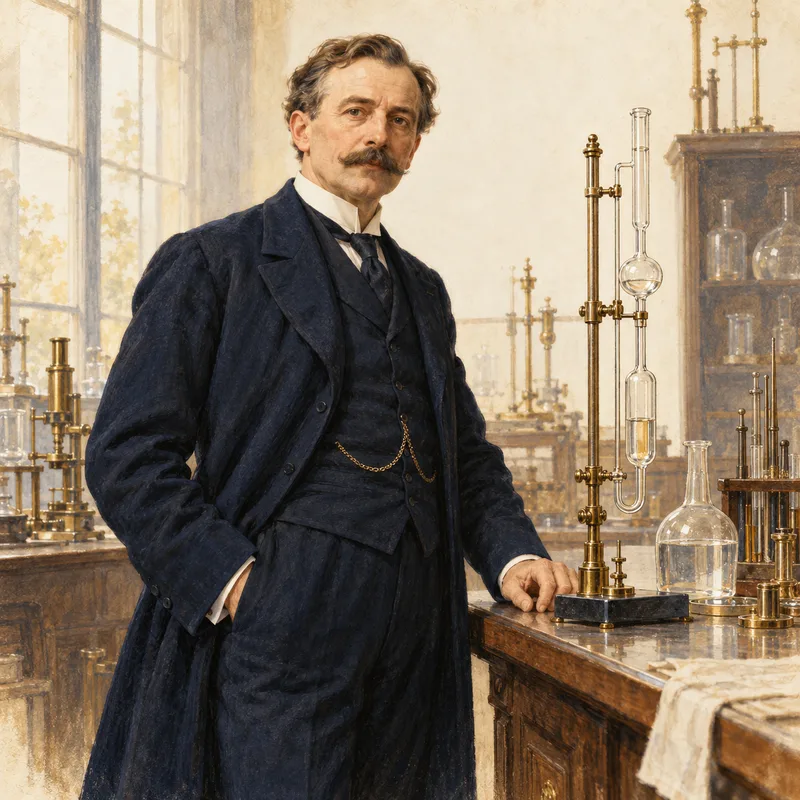
About the chemist
Hermann Staudinger
1881-1965 · Germany · Nobel Chemistry 1953
Macromolecular (polymer) theory