The discovery, explained · Chemist no. 76 of 350
Hermann Staudinger and the Macromolecule: The Idea That Created Polymer Science
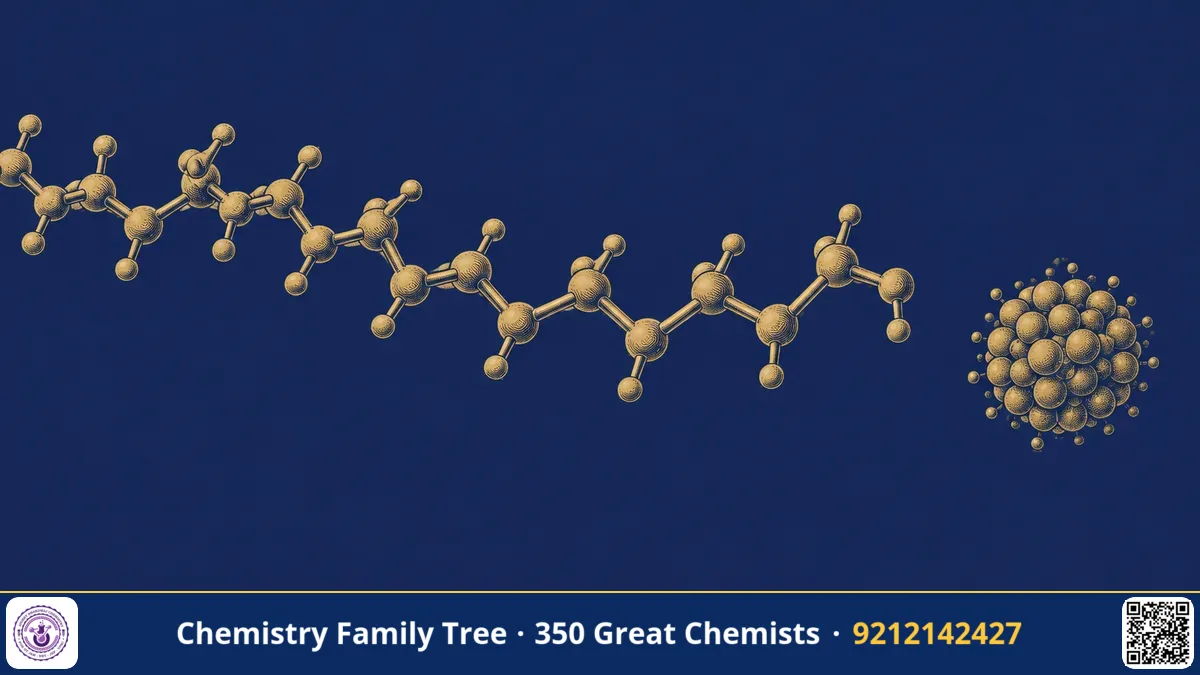
Plastic, rubber, nylon, cotton, silk, DNA and proteins all have something in common: they are made of very long molecules built from small repeating units. Today this is textbook knowledge, but a century ago most chemists refused to believe it. The German chemist Hermann Staudinger argued in 1920 that these substances are true macromolecules, in which thousands of atoms are held together by ordinary covalent bonds. He spent more than a decade proving his case against strong opposition. His victory created the science of polymers and earned him the Nobel Prize in Chemistry in 1953.
The Scientific Problem Before the Discovery
In the early twentieth century, chemists could not measure the molar mass of rubber, starch, cellulose or proteins by ordinary methods, because these materials did not form normal crystals and did not dissolve like simple salts. They behaved like colloids. The common explanation was the association theory: it said that such materials were made of small molecules (for example, isoprene units in rubber) held together in clusters by weak forces, like micelles in soap solution. According to this view, the high apparent molecular weight was just an effect of aggregation, and the molecules were not really large.
Important chemists such as Emil Fischer, who believed that molecules larger than a few thousand daltons could not exist, held that view. It was the dominant idea in organic chemistry, and a young man challenging it risked his reputation.
The Discovery: Step-by-Step
- The 1920 proposal. In a paper titled "Über Polymerisation", Staudinger proposed that polymers such as polystyrene and rubber consist of long chains of monomer units linked by normal covalent bonds.
- Hydrogenation of rubber. If rubber were an aggregate, then converting it into a different compound should destroy the aggregates. Staudinger hydrogenated natural rubber to a saturated product. The hydrogenated product still behaved as a colloid with a high molecular weight, which implied that the long chain itself was the unit, not a cluster of small molecules held by weak forces.
[–CH2–C(CH3)=CH–CH2–]n + n H2 → [–CH2–CH(CH3)–CH2–CH2–]n
- Polymer-analogous reactions. He showed that chemical changes of side groups on a polymer, such as converting polyvinyl acetate to polyvinyl alcohol, do not change the chain length. This showed that the chain has a stable backbone.
- Viscosity measurements. Staudinger found that the viscosity of a dilute polymer solution rises in a regular way with chain length. Using this relationship, he could estimate molar mass.
- Synthetic polymers of defined structure. He prepared polyoxymethylene from formaldehyde and polystyrene, and showed that their properties agreed with long chain molecules of defined repeating structure.
The Chemistry Behind It
A macromolecule is formed from a small molecule, the monomer, in a process called polymerisation. For example, styrene gives polystyrene:
n CH2=CH–C6H5 → [–CH2–CH(C6H5)–]n
The number of repeating units, n, is the degree of polymerisation, and the molar mass of the polymer is n times the monomer mass (plus the end groups). For polystyrene, the monomer mass is 104 g/mol, so n = 1000 gives a molar mass of about 104,000 g/mol.
Staudinger's viscosity law relates the specific viscosity of a dilute solution to molecular mass:
η_sp / c = K_m × M
Here η_sp is the specific viscosity, c is the concentration, M is the molar mass and K_m is a constant for a polymer series in a given solvent. Later work by Mark, Houwink and Sakurada modified the law into the Mark-Houwink equation, [η] = K M^a, where a depends on the polymer shape and solvent (about 0.5 for a compact random coil in a theta solvent and up to about 0.8 in a good solvent). The more general equation is the one used in modern work.
The key idea that Staudinger established is that colloidal properties of polymers arise from their large molecular size, not from association. This is why polymers have broad distributions of chain length, with number-average (Mn) and weight-average (Mw) molar masses, and the polydispersity index PDI = Mw/Mn.
Staudinger's earlier work also gave important organic chemistry. He discovered ketenes in 1905 (diphenylketene), and the Staudinger reaction between an organic azide and a phosphine, which forms an iminophosphorane:
R–N3 + PPh3 → R–N=PPh3 + N2
This reaction is now used in bioconjugation (the Staudinger ligation), and the Staudinger synthesis combines a ketene and an imine to give a β-lactam.
Applications Today
- Plastics and fibres: The design of polyethylene, PVC, polystyrene, nylon and polyester all rest on the macromolecular concept.
- Biochemistry: Understanding proteins, nucleic acids and polysaccharides as macromolecules builds on his ideas.
- Medicine: Drug delivery polymers, hydrogels and sutures.
- Analytical methods: Viscometry and gel permeation chromatography measure polymer molar mass.
- Chemical biology: The Staudinger ligation is used to label molecules in living systems.
Exam Corner
- Staudinger proposed that polymers are long chains held by covalent bonds (macromolecules), against the association theory.
- Degree of polymerisation DP = M(polymer) / M(repeat unit).
- Staudinger's viscosity relation: η_sp/c ∝ M; the general Mark-Houwink equation is [η] = K M^a.
- PDI = Mw/Mn ≥ 1; for a uniform polymer, it equals 1.
- Staudinger reaction: organic azide + triphenylphosphine gives an iminophosphorane and N2. He won the Nobel Prize in Chemistry in 1953.
Common Misconceptions
- "All molecules in a polymer sample have the same mass." Synthetic polymers are mixtures of chains of different lengths.
- "Staudinger invented plastic." He did not make the first plastics; he explained what they are at the molecular level.
- "Staudinger reaction and Staudinger synthesis are the same." They are different: one involves azides and phosphines, and the other a ketene plus an imine.
Quick Revision Box
- 1920: macromolecule hypothesis, "Über Polymerisation".
- Evidence: hydrogenated rubber stayed high in molar mass; polymer-analogous reactions.
- Viscosity law links solution viscosity to molar mass.
- DP = number of repeat units.
- Also discovered ketenes (1905) and the azide-phosphine Staudinger reaction.
- Nobel Prize in Chemistry 1953.
FAQ
What is a macromolecule?
A very large molecule, usually with a molar mass of thousands or millions, formed by joining many small units through covalent bonds.
Why did chemists oppose his idea?
They believed large molecules could not be stable, and the colloidal behaviour of rubber and starch seemed explained by aggregation of small molecules.
What is the degree of polymerisation?
The number of monomer units in the polymer chain.
What is the Staudinger ligation?
It is a reaction of an azide with a modified phosphine that forms a stable amide bond, used to label biomolecules.
Published by ABC Chemistry — IIT-JAM | CSIR-NET | GATE Chemistry Coaching. Visit abcchemistry.com
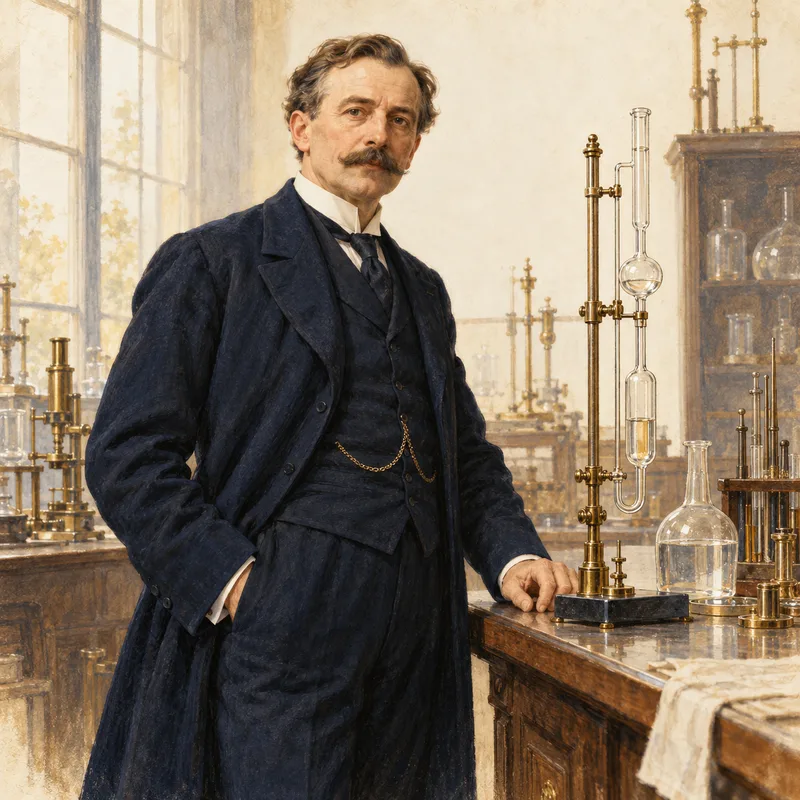
About the chemist
Hermann Staudinger
1881-1965 · Germany · Nobel Chemistry 1953
Macromolecular (polymer) theory