Biography · Chemist no. 174 of 350
Hideki Shirakawa: The Chemist Who Turned a Mistake into a New Field
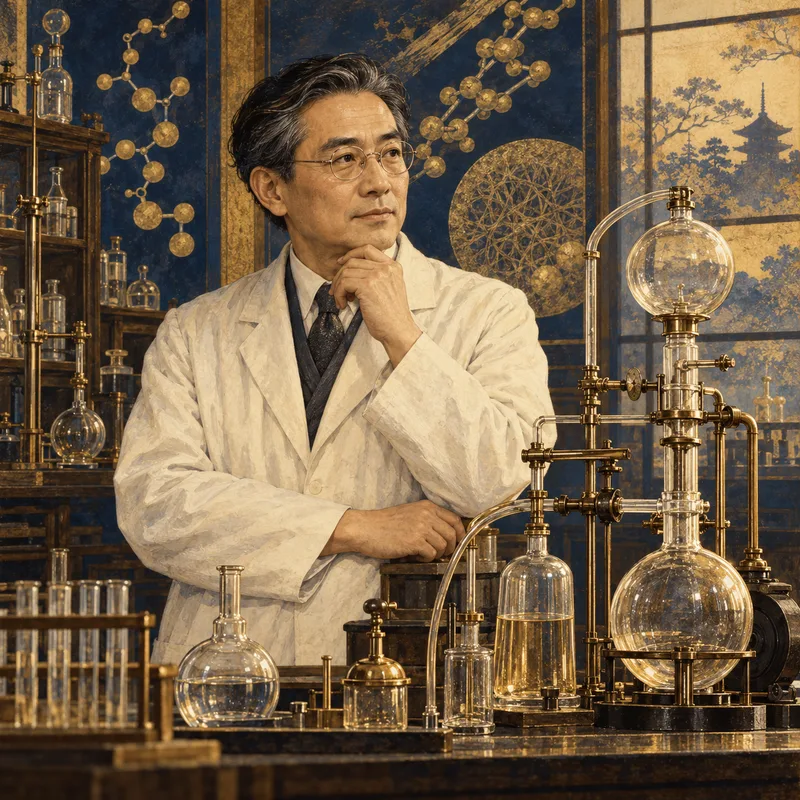
Hideki Shirakawa, born in 1936 in Tokyo, is a Japanese chemist best known for making the first silvery polyacetylene film and for showing, together with Alan MacDiarmid and Alan Heeger, that this plastic can be made to conduct electricity. The three shared the 2000 Nobel Prize in Chemistry. Shirakawa is a model of a patient and careful experimentalist who recognised the value of an unexpected result.
Early Life and Family
Hideki Shirakawa was born on 20 August 1936 in Tokyo, Japan. He spent his childhood in Takayama in the mountainous Gifu region in the centre of Japan, a region with forests and rivers. He has said that his interest in chemistry began in school, and that growing up in a small town with natural surroundings made him curious about the world. He grew up during and after the Second World War, a difficult time in Japan, with limited resources for education and research. He was a child in wartime and a student in the rebuilding of Japan.
Education and Mentors
Shirakawa studied chemistry at the Tokyo Institute of Technology and graduated in 1961. He remained at the institute for his graduate work and received his doctorate in 1966 for research on polymer chemistry, working with Professor Sakuji Ikeda, a polymer scientist who studied Ziegler–Natta-type polymerisation. His later work on polyacetylene came from this training. Soon after his doctorate, he became a research associate at the Tokyo Institute of Technology in the Research Laboratory of Resources Utilization, where he worked on polymerising acetylene.
Career Timeline
| Year | Event |
|---|---|
| 1936 | Born in Tokyo on 20 August |
| 1961 | Graduated from the Tokyo Institute of Technology |
| 1966 | Doctorate from the Tokyo Institute of Technology; began work as research associate |
| Late 1960s–early 1970s | Prepared polyacetylene film with a high concentration of Ziegler–Natta catalyst |
| 1976 | Met Alan MacDiarmid in Tokyo and was invited to the University of Pennsylvania |
| 1976–77 | Worked at Penn with MacDiarmid and Heeger; iodine-doped polyacetylene became conductive |
| 1979 | Moved to the University of Tsukuba as an associate professor and later professor |
| 2000 | Nobel Prize in Chemistry, shared with MacDiarmid and Heeger |
Major Scientific Contributions
- Polyacetylene film. He developed a way to prepare polyacetylene as a thin, flexible film with control over the cis/trans content by selecting the temperature.
- Isomerisation studies. He studied how cis-polyacetylene converts to trans on heating and how this affects colour and properties.
- Conducting polyacetylene. At Penn, in 1976–77, doping with iodine produced the first highly conducting organic polymer film.
- Helical polyacetylene. Later, Shirakawa and his group synthesised polyacetylene in a chiral nematic liquid crystal solvent, which gave helical fibrils. This is a topic of interest in advanced polymer and materials chemistry.
- Science promotion. He was also active in promoting chemistry and science education in Japan.
For the experimental details, equations and exam points, read the companion post on the discovery of the silvery polyacetylene film.
Awards, Honours and the Nobel Prize
The 2000 Nobel Prize in Chemistry was awarded jointly to Alan J. Heeger, Alan G. MacDiarmid and Hideki Shirakawa "for the discovery and development of conductive polymers". Shirakawa was the first of the three to make the key polymer. After the prize, he received the Order of Culture (Bunka Kunsho) in Japan, one of the highest honours for contributions to culture and science. He became a professor emeritus of the University of Tsukuba.
Personality, Struggles and Lesser-Known Facts
- The 1000-times mistake. The famous catalyst error is the central anecdote of his career. What is less known is that Shirakawa spent years of careful work in understanding why the film formed and how to control it.
- Chance meeting. The 1976 meeting with MacDiarmid in Tokyo happened at a seminar, where MacDiarmid noticed the silvery film. A short conversation led to an invitation and a Nobel Prize 24 years later.
- An odd curiosity. In the early years, polyacetylene film was seen by many chemists as an odd laboratory curiosity.
- Modest and kind. He is described by colleagues as humble, and often emphasises that the Nobel Prize is the result of teamwork and good luck as well as effort.
Legacy and Influence on Modern Chemistry
The silvery film opened the field of conducting polymers, and from it came OLED displays, polymer solar cells, flexible sensors and antistatic materials. Shirakawa's experiments in catalyst chemistry also show that polymer synthesis can lead to unexpected electronic materials. His work is part of syllabi on polymer chemistry, organic chemistry and materials science, where students learn Ziegler–Natta catalysis, cis–trans isomerism and conjugation together with the story of the film's discovery.
Lessons for Students
- Study unexpected results. A mistake can become a major discovery if you ask why.
- Learn the fundamentals. Shirakawa's training in polymerisation and catalysis let him interpret the strange film.
- Be open to collaboration. Meeting MacDiarmid made the difference.
- Persist with unfashionable topics. Polyacetylene was not a popular topic at first.
Quick Facts Box
- Born: 20 August 1936, Tokyo, Japan
- Died: Living (as of this writing)
- Nationality: Japanese
- Field: Polymer chemistry, materials chemistry
- Famous for: Silvery polyacetylene film and the discovery of conducting polymers
- Nobel: Chemistry, 2000 (shared with Alan MacDiarmid and Alan Heeger)
FAQ
Where did Shirakawa study?
At the Tokyo Institute of Technology, where he earned his bachelor's degree and doctorate.
Where did he work after the discovery?
At the University of Tsukuba in Japan, where he became a professor.
What was his key experiment?
Polymerisation of acetylene using a very high concentration of Ziegler–Natta catalyst to produce a silvery film.
Who invited him to the United States?
Alan MacDiarmid invited him to the University of Pennsylvania after seeing the film in Tokyo in 1976.
Published by ABC Chemistry — IIT-JAM | CSIR-NET | GATE Chemistry Coaching. Visit abcchemistry.com
About the chemist
Hideki Shirakawa
1936- · Japan · Nobel Chemistry 2000
Conductive polyacetylene