The discovery, explained · Chemist no. 174 of 350
Hideki Shirakawa and the Discovery of Silvery Polyacetylene Film
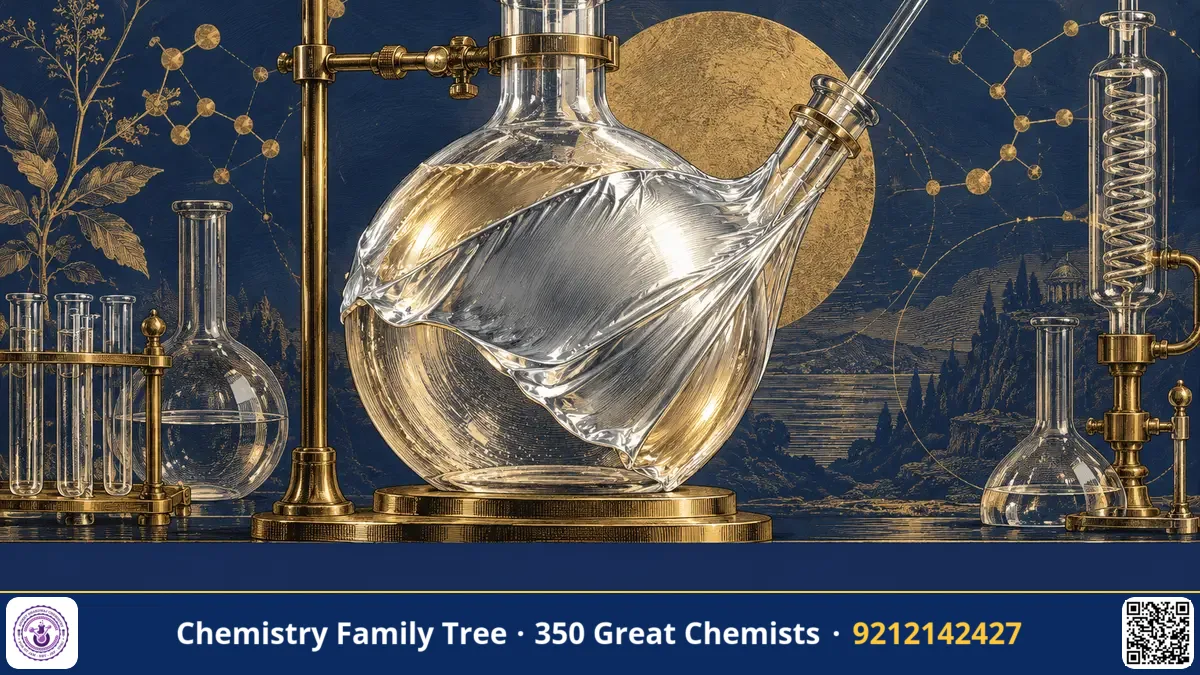
Many great discoveries start with a mistake. In the late 1960s or early 1970s (accounts differ), at the Tokyo Institute of Technology, a visiting researcher in the laboratory of Hideki Shirakawa added a thousand times too much catalyst to a polymerisation reaction of acetylene. Instead of the usual black powder, the flask gave a shiny, silvery film that looked like aluminium foil. Shirakawa recognised that this was a new form of polyacetylene, which could be prepared as a film with controlled structure. A few years later, when this film was doped with iodine in Pennsylvania, it became conductive. Shirakawa shared the 2000 Nobel Prize in Chemistry with Alan Heeger and Alan MacDiarmid.
The Scientific Problem Before the Discovery
Acetylene (ethyne, HC≡CH) can polymerise to give polyacetylene, –(CH=CH)n–. The polymer had been made earlier, in 1958 by Giulio Natta and co-workers, using a Ziegler–Natta catalyst, but it was a black, insoluble, infusible powder. It could not be moulded into a film, could not be dissolved, and could not be studied easily. Chemists thought of it as an interesting but useless material. Since it was intractable, its structure and properties, such as the question of whether the double bonds were cis or trans, were not well understood.
Shirakawa wanted to find the conditions that give a polymer of better quality, with a clear structure. Before this research, chemists had little reason to think that polyacetylene would conduct electricity, and conductivity was not the first aim.
The Discovery: Experiment Step by Step
- The catalyst. Shirakawa's group used a Ziegler–Natta catalyst, a combination of titanium tetrabutoxide, Ti(OBu)4, and triethylaluminium, Al(C2H5)3, in toluene solvent. Such catalysts were famous because Karl Ziegler and Giulio Natta had received the 1963 Nobel Prize in Chemistry for them.
- The mistake. A visiting researcher misread the amount, and used about 1000 times more catalyst than intended, as the story is told.
- Acetylene gas. Acetylene was introduced into the catalyst solution in a vessel under vacuum. Instead of a precipitate, a thin film formed on the surface of the catalyst solution, and it was silvery and flexible.
- Controlling the isomer. Shirakawa and his co-workers, Ikeda and others, found that the temperature of polymerisation decides the geometry. At low temperature, about −78 °C, the polymer is mainly cis-polyacetylene (a copper-coloured film). At room temperature and above, a mixture forms, and at around 150 °C or more the trans form dominates. Heating cis-polyacetylene converts it into trans-polyacetylene, the more stable isomer, with a silvery appearance.
- Conductivity. The undoped trans-polyacetylene film had a conductivity around 10−5 S/cm, and the cis form about 10−9 S/cm. Later, in Pennsylvania with MacDiarmid and Heeger, doping with iodine brought a conductivity increase of millions of times.
The Chemistry Behind It
Polymerisation mechanism
Ziegler–Natta polymerisation of acetylene proceeds by coordination and insertion. The monomer coordinates to a vacant site on titanium, and inserts into the Ti–C bond of the growing chain. The new carbon–carbon bond forms from two sp carbons that become sp2. In outline:
Ti–R + HC≡CH → Ti–CH=CH–R  (insertion)
Ti–CH=CH–R + HC≡CH → Ti–CH=CH–CH=CH–R  …
The insertion is mainly syn (cis addition), which gives the cis double bonds at low temperature. Heating causes isomerisation to trans by rotation around the C–C bonds in the chain.
Cis versus trans polyacetylene
| Property | cis-(CH)n | trans-(CH)n |
|---|---|---|
| Stability | Less stable | More stable (thermodynamic form) |
| Appearance | Copper-coloured | Silvery |
| Conductivity (undoped) | Very low | Higher, semiconductor |
| Ground state | Non-degenerate | Degenerate (two equivalent bond alternation patterns) |
The degenerate ground state of trans-polyacetylene is important: it allows solitons, which are boundaries between the two bond-alternation patterns, to move along the chain. This is a key concept in the Su–Schrieffer–Heeger model.
From insulator to conductor
The conjugated π system of trans-polyacetylene has alternating bond lengths, which create a band gap of about 1.4 eV. Doping with an oxidant such as I2 or AsF5 removes electrons, and doping with a reductant such as sodium adds them. The doped polymer then conducts. See our other posts on Heeger and MacDiarmid for the doping chemistry.
Applications Today
- Foundation of organic electronics: Though polyacetylene itself is unstable in air and rarely used, it is the model system for all conducting polymers.
- Derived materials: Polythiophene, polypyrrole, PEDOT and poly(phenylene vinylene) came from this concept and appear in OLED displays, solar cells and sensors.
- Catalysis research: The film-forming method inspired work on the polymerisation of alkynes and the synthesis of conjugated polymers with controlled structure.
- Liquid-crystalline polyacetylene: Shirakawa later studied helical polyacetylene made in chiral liquid crystals, a topic in advanced materials.
- India context: Students in India study the concept in polymer chemistry courses and in advanced materials labs at IITs and universities that work on conducting polymers.
Exam Corner
- Polyacetylene is made from HC≡CH using a Ziegler–Natta catalyst, Ti(OBu)4/AlEt3.
- Low-temperature polymerisation gives cis; heating converts it to the more stable trans isomer.
- Trans-polyacetylene has degenerate ground state, supporting solitons.
- Band gap of undoped trans-polyacetylene is about 1.4 eV, a semiconductor; conductivity increases greatly on doping.
- Shirakawa was at the Tokyo Institute of Technology and later the University of Tsukuba; he shared the 2000 Nobel Prize in Chemistry.
Common Misconceptions
- "Polyacetylene conducts because it is a polymer of acetylene." Un-doped polyacetylene is only a semiconductor. Doping is required for high conductivity.
- "Natta first made polyacetylene film." Natta made powder; the film form came from Shirakawa's method.
- "The film was an intentional experiment with high catalyst." The high catalyst concentration was a mistake, but Shirakawa's careful follow-up turned it into a discovery.
Quick Revision Box
- Polyacetylene = –(CH=CH)n–, from ethyne.
- Catalyst: Ziegler–Natta Ti(OBu)4 + AlEt3.
- Silvery film due to a catalyst concentration about 1000 times higher than intended.
- cis at low temperature; trans on heating, more stable.
- Trans form: degenerate ground state, solitons.
- Nobel Prize in Chemistry 2000 with Heeger and MacDiarmid.
FAQ
Why is the film silvery?
The trans-polyacetylene film has a conjugated structure with metallic lustre due to its dense, fibrillar morphology and electronic transitions.
Is polyacetylene used in commercial products?
Not much, because it is unstable in air. Its importance is as a model and a starting point for other conducting polymers.
What is the role of the Ziegler–Natta catalyst?
It coordinates and inserts acetylene molecules successively into a metal–carbon bond, building up the polymer chain.
What did Shirakawa do after the Nobel-winning work?
He continued to study polyacetylene, including its chiral and helical forms, at the University of Tsukuba.
Published by ABC Chemistry — IIT-JAM | CSIR-NET | GATE Chemistry Coaching. Visit abcchemistry.com
About the chemist
Hideki Shirakawa
1936- · Japan · Nobel Chemistry 2000
Conductive polyacetylene