Biography · Chemist no. 8 of 350
Sir Humphry Davy: From a Cornish Apprentice to President of the Royal Society
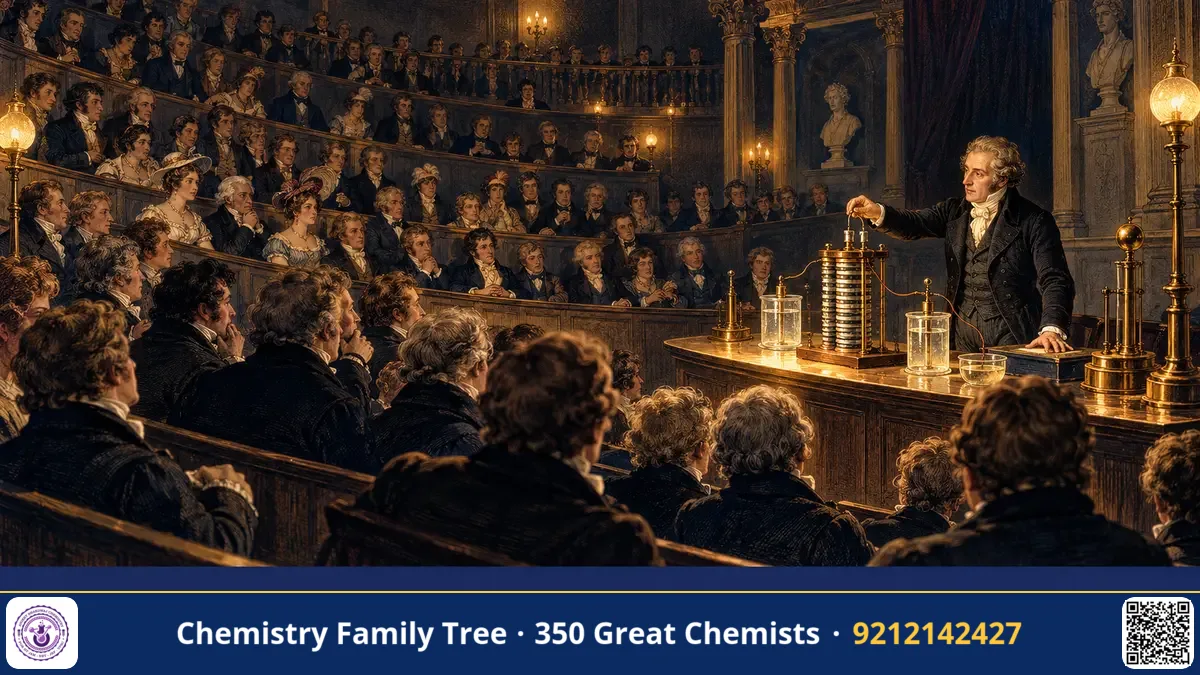
Sir Humphry Davy (1778-1829) was a British chemist and one of the most gifted lecturers of his age. Using electricity, he isolated potassium, sodium, calcium, magnesium, strontium and barium, proved that chlorine is an element, and invented the miners' safety lamp. He also discovered the young Michael Faraday's talent and gave him his first chance in science. His legacy in one line: he showed that electricity is a tool of chemistry and made science a public excitement.
Early Life and Family
Humphry Davy was born on 17 December 1778 in Penzance, Cornwall, in south-west England. His father, Robert Davy, was a woodcarver, and his mother was Grace Millett. Humphry was the eldest of five children. As a boy he enjoyed telling stories, writing verses and wandering the rocky Cornish coast, collecting minerals and observing nature. His father died in 1794, leaving the family in financial difficulty. Humphry took on responsibility for the support of his mother and younger brothers and sisters, and he remained attached to his family throughout his life.
Education and Mentors
- He studied at schools in Penzance and Truro, where he was known for his imagination but not for hard study.
- After his father's death, he was apprenticed to John Bingham Borlase, a surgeon and apothecary in Penzance. Here he began to read the works of Lavoisier and Nicholson and to carry out chemical experiments with simple home-made apparatus.
- He formed a friendship with Davies Giddy (later Davies Gilbert), a Cornish gentleman who allowed him to use his library and introduced him to Thomas Beddoes.
- In 1798, Beddoes appointed him as superintendent of the Pneumatic Institution in Bristol, which studied the medical effects of gases.
Career Timeline
| Year | Event |
|---|---|
| 1778 | Born in Penzance on 17 December |
| 1795 | Apprenticed to a surgeon-apothecary in Penzance |
| 1798 | Joins the Pneumatic Institution in Bristol |
| 1799-1800 | Experiments on nitrous oxide; publishes Researches, Chemical and Philosophical |
| 1801 | Appointed assistant lecturer at the Royal Institution, London |
| 1802 | Becomes professor of chemistry at the Royal Institution |
| 1803 | Elected Fellow of the Royal Society |
| 1807-1808 | Isolates potassium, sodium, calcium, strontium, barium and magnesium by electrolysis |
| 1810 | Shows chlorine is an element |
| 1812 | Knighted; marries Jane Apreece |
| 1813 | Appoints Michael Faraday as assistant; tours Europe with him until 1815 |
| 1815 | Invents the miners' safety lamp |
| 1818 | Made a baronet |
| 1820-1827 | President of the Royal Society |
| 1829 | Dies in Geneva on 29 May |
Major Scientific Contributions
Electrochemistry and new elements. By electrolysing molten compounds, Davy isolated the reactive metals potassium and sodium (1807), and then calcium, strontium, barium and magnesium (1808). Details of the experiments and equations are in our discovery post on Davy.
K⁺ + e⁻ → K (cathode)
Nature of chlorine and acids. By showing that chlorine contains no oxygen and that HCl is a hydrogen compound, he overturned Lavoisier's idea that oxygen is the acid-forming principle.
Nitrous oxide. At Bristol he studied N₂O, also called laughing gas, and noted that it relieves pain. He suggested that it might be useful in surgery, but the idea was not taken up for several decades.
Safety lamp. The Davy lamp (1815) greatly reduced explosions in coal mines. He refused to patent it, saying he wanted it to be freely used for the good of the miners.
Agricultural chemistry. His book Elements of Agricultural Chemistry (1813) taught farmers how soil, manure and plants are related to chemistry.
Diamond is carbon. During his European tour, Davy and Faraday burned a diamond using a large lens and found that it produced only carbon dioxide, supporting the belief that diamond is a form of carbon.
Awards, Honours and Nobel Prize
- Copley Medal of the Royal Society (1805).
- A prize from the French Institute, established by Napoleon, for his work on electricity (1807), awarded even though Britain and France were at war.
- Knighted in 1812 and made a baronet in 1818.
- Rumford Medal of the Royal Society (1816).
- President of the Royal Society, 1820-1827.
- No Nobel Prize, as the prizes began long after his death. The Davy Medal of the Royal Society, first awarded in 1877, is named in his honour.
Personality, Struggles and Lesser-Known Facts
- A star lecturer. His lectures at the Royal Institution, with flashing experiments and poetic language, drew large audiences, including fashionable ladies and gentlemen, and made science popular in London.
- Poet and chemist. Davy wrote poetry all his life and was a friend of the poets Samuel Taylor Coleridge and Robert Southey. Coleridge reportedly attended his lectures to enrich his stock of metaphors.
- Risky experiments. He inhaled various gases, including nitrous oxide, carbon monoxide and others, and was nearly poisoned more than once. In 1812 an explosion of nitrogen trichloride in his laboratory injured his eyes, and he hired Faraday as his secretary for a time.
- Faraday's start. Faraday, a bookbinder's apprentice, attended Davy's lectures, sent him a bound copy of his notes and was taken on as assistant. Later, relations between the two became more difficult. Davy is said to have called Faraday his greatest discovery.
- Travel in wartime. In 1813, with special permission from Napoleon's government, Davy toured France, Italy and other places with Lady Davy and Faraday, meeting famous scientists such as Ampère and Volta.
- Declining health. From about 1827 his health weakened after a stroke. He travelled to southern Europe, wrote reflective books, and died in Geneva at the age of 50.
Legacy and Influence on Modern Chemistry
Davy proved that electricity could pull apart compounds that chemistry alone could not. This created the field of electrochemistry. Faraday, his successor, turned this into quantitative laws. Industrial electrolysis for chlorine, caustic soda, aluminium and refined copper follows from these early experiments. The idea that acids are defined by hydrogen, not oxygen, led to later acid-base theories. His safety lamp saved thousands of lives, and his lecturing style set a model for public science communication that the Royal Institution still follows, including the Christmas Lectures started by Faraday.
Lessons for Students
- Use new tools boldly. The newly invented battery gave him a method that others did not try.
- Test accepted ideas. He examined chlorine and found that a respected theory was wrong.
- Science can serve people directly. His lamp protected miners, and he chose not to profit from it.
- Be careful in the laboratory. His injuries are a reminder that safety is essential.
- Help young talent. His support for Faraday changed the history of science.
Quick Facts Box
- Born: 17 December 1778, Penzance, Cornwall, England
- Died: 29 May 1829, Geneva, Switzerland
- Nationality: British (English)
- Field: Chemistry, electrochemistry
- Famous for: Isolating K, Na, Ca, Mg, Sr, Ba; chlorine as an element; the Davy safety lamp
- Nobel Prize: None (lived before 1901)
FAQ
Which elements did Humphry Davy discover?
He isolated potassium, sodium, calcium, strontium, barium and magnesium, prepared boron, and showed chlorine to be an element.
Who was Davy's assistant at the Royal Institution?
Michael Faraday, who joined in 1813 and later became one of the greatest scientists of all time.
Why did Davy not patent the safety lamp?
He wished that it would be freely available for the benefit of miners, and declined to make any profit from it.
What was Davy's connection with laughing gas?
At Bristol he studied nitrous oxide's effects, observed its pain-relieving properties and suggested it for surgery, although it was not widely used until the 1840s.
Published by ABC Chemistry — IIT-JAM | CSIR-NET | GATE Chemistry Coaching. Visit abcchemistry.com
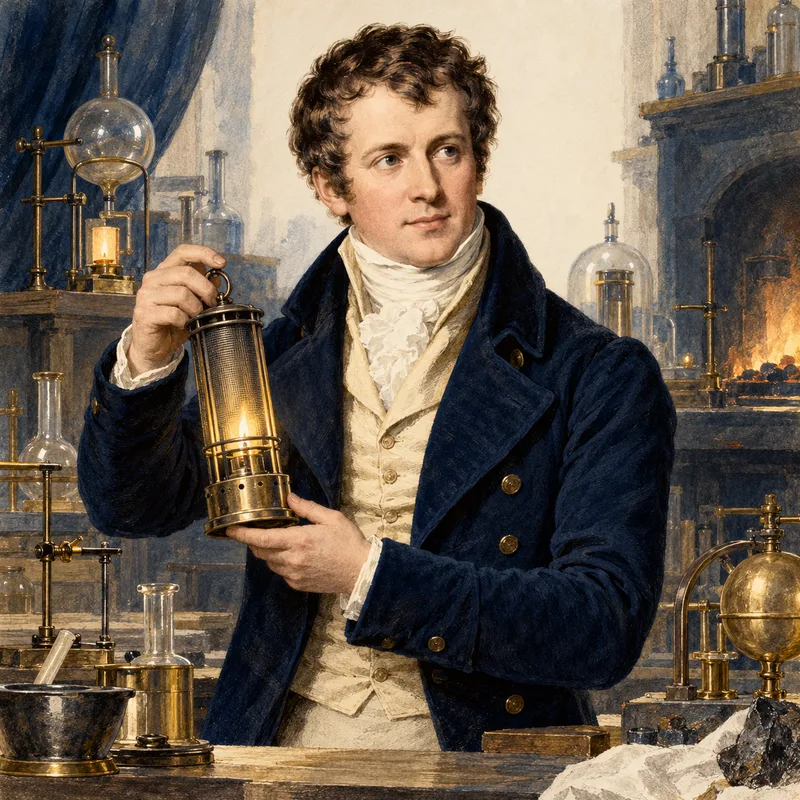
About the chemist
Humphry Davy
1778-1829 · United Kingdom
Electrochemistry; isolated sodium and potassium