The discovery, explained · Chemist no. 8 of 350
Humphry Davy and the Power of Electrolysis: How Sodium, Potassium and Chlorine Were Understood
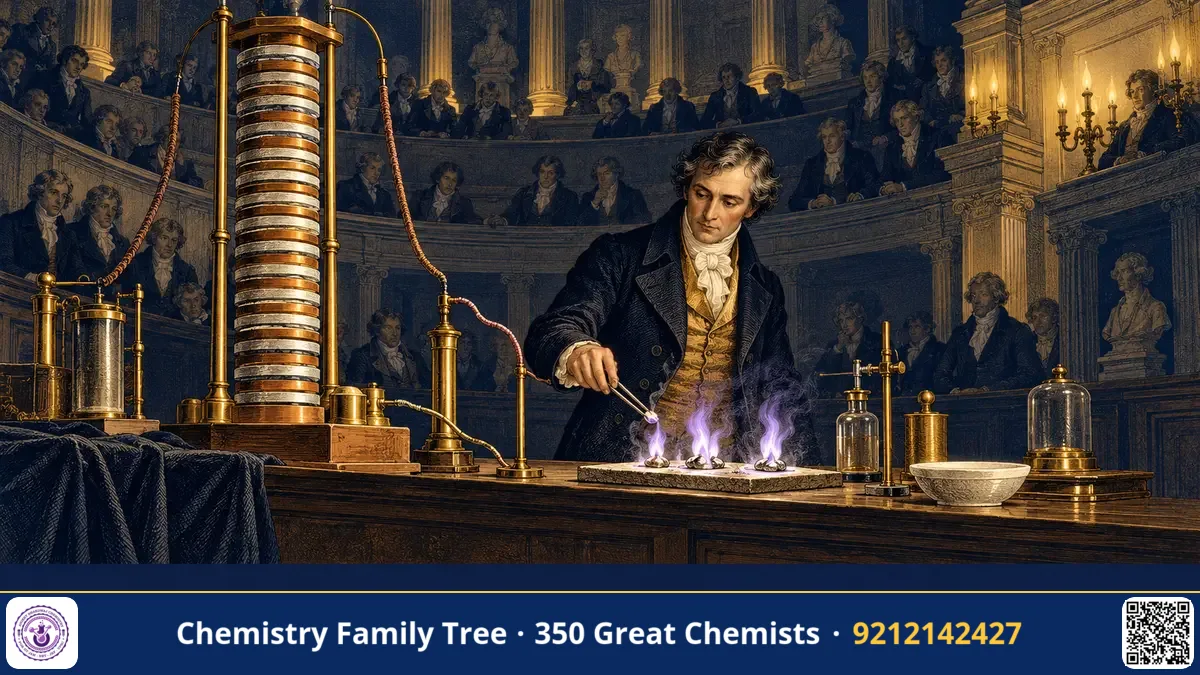
In October 1807, in a laboratory at the Royal Institution in London, a young chemist named Humphry Davy passed a strong electric current through molten potash and saw small silvery globules appear at the negative electrode. Some of the globules burst into flame with a lilac colour. He had isolated potassium, a metal that nobody had seen before. A few days later, he obtained sodium in the same way. In the following years he isolated other reactive metals, showed that chlorine is an element, and invented a safety lamp that saved miners' lives. This post explains his key ideas and what you need for exams.
The Scientific Problem Before the Discovery
Around 1800, Alessandro Volta invented the voltaic pile, the first battery, and soon after, William Nicholson and Anthony Carlisle used it to split water into hydrogen and oxygen. Lime, magnesia, potash and soda were known as "earths" and "alkalis", and chemists suspected that they were compounds of unknown metals, as Lavoisier had guessed. But no chemical method could break them down. Carbon, the usual reducing agent for iron oxide, was not strong enough, since these metals bind oxygen very strongly. At the same time, Lavoisier's belief that oxygen is present in all acids (hence the name "oxygen") and that "oxymuriatic acid" (chlorine) contained oxygen was still widely accepted. Davy, who believed that chemical affinity was electrical in nature, tested these ideas with the power of the battery.
The Discovery: Experiments Step by Step
- Early trials with solutions (1806-1807). When Davy passed a current through a water solution of potash, only hydrogen and oxygen were produced from the water, and no metal was obtained.
- Molten potash. He switched to slightly moist but fused (molten) potassium hydroxide, heated on a platinum spoon and connected to a very large battery. Small metallic globules formed at the cathode and burnt in air with a lilac flame. This was potassium, announced in the Bakerian Lecture of November 1807.
- Soda. Using the same method on caustic soda, he isolated sodium.
- Alkaline earths (1808). By combining electrolysis with other techniques, such as electrolysing moist earths mixed with mercury, he obtained calcium, strontium, barium and magnesium. He also prepared boron in 1808 by heating boric acid with potassium (Gay-Lussac and Thénard in France did the same at about the same time).
- Chlorine (1810). Carl Wilhelm Scheele had prepared "dephlogisticated marine acid" in 1774. Davy tested "oxymuriatic acid" extensively and could not obtain oxygen from it, even using strong heat and charcoal. In 1810 he concluded that it is an element and named it chlorine after the Greek word chloros, meaning pale green. This showed that hydrochloric acid (HCl) contains no oxygen.
- Iodine (1813-1814). Iodine was discovered by Bernard Courtois, but Davy was among the first to show that it is an element similar to chlorine.
Cathode:  K⁺ + e⁻ → K
Anode:    4OH⁻ → O₂ + 2H₂O + 4e⁻
2K + 2H₂O → 2KOH + H₂      (the metal reacts vigorously with water)
The Chemistry Behind It
Why electrolysis was necessary
Potassium and sodium are very strong reducing agents. Their standard electrode potentials are very negative: E° (K⁺/K) = −2.93 V and E° (Na⁺/Na) = −2.71 V. Such metals cannot be obtained by chemical reduction using carbon, so electrical energy is needed to force the reduction of the ions. The same idea applies today for aluminium, magnesium and sodium. Faraday later gave the quantitative laws of electrolysis.
Electrolysis of molten salts versus aqueous solutions
| Electrolyte | Cathode product | Reason |
|---|---|---|
| Molten NaCl | Na | Only Na⁺ present |
| Aqueous NaCl | H₂ gas | Water is reduced more easily than Na⁺ |
| Molten KOH | K | Only K⁺ available for reduction |
| Aqueous CuSO₄ | Cu | Cu²⁺ is reduced more easily than water |
Chlorine and the oxygen-acid theory
MnO₂ + 4HCl → MnCl₂ + Cl₂ + 2H₂O       (Scheele's method)
2NaCl(l) → 2Na + Cl₂                     (electrolysis of molten salt)
Davy's work showed that acidity does not depend on oxygen. Hydrohalic acids (HCl, HBr, HI) are acids without oxygen. Later, the idea shifted to hydrogen as the common element in acids, and still later to the Arrhenius and Brønsted-Lowry definitions.
The safety lamp (1815)
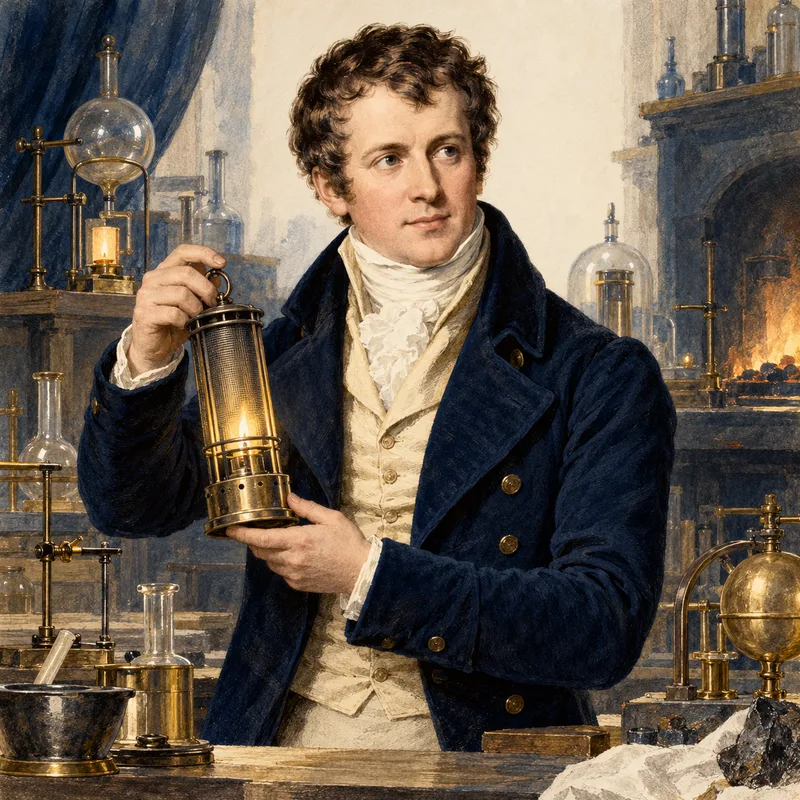
Methane in coal mines (firedamp) can explode when mixed with air: CH₄ + 2O₂ → CO₂ + 2H₂O. At the request of mine owners after a terrible disaster at Felling colliery, Davy designed a lamp in which the flame is surrounded by a fine iron wire gauze. The gauze conducts heat away so well that the temperature outside the gauze stays below the ignition temperature of methane, and the flame cannot ignite the gas around the lamp. A lamp whose flame grew taller or changed colour also warned miners about the presence of methane.
Applications Today
- Chlor-alkali industry. Electrolysis of brine produces chlorine, hydrogen and sodium hydroxide, which are basic chemicals for soap, paper, textiles and water treatment in India.
2NaCl + 2H₂O → 2NaOH + Cl₂ + H₂
- Extraction of metals. Sodium, magnesium and aluminium are extracted by electrolysis of molten salts or oxides.
- Electroplating and refining. Copper is purified by electrolysis, and objects are plated with nickel, chromium or silver.
- Potassium and sodium compounds. Potassium is essential for plant fertilisers. Sodium vapour lamps give an orange-yellow light used on roads.
- Chlorine for water treatment. Chlorination makes drinking water safe in cities and villages.
- Mine safety. The principle of the flame arrestor is still used in modern flameproof electrical equipment for mines.
Exam Corner
- Davy isolated K and Na (1807), Ca, Sr, Ba, Mg (1808), and showed chlorine is an element (1810).
- Highly electropositive metals (alkali, alkaline earth, Al) are extracted by electrolysis of the molten compounds.
- In electrolysis, reduction occurs at the cathode and oxidation at the anode. Cathode is negative in an electrolytic cell and positive in a galvanic cell.
- Faraday's first law: m = ZIt, where Z is the electrochemical equivalent; m = (M/nF) × Q.
- Alkali metals impart flame colours: Li crimson, Na golden yellow, K lilac (violet), Rb red-violet, Cs blue.
Common Misconceptions
- "Davy discovered chlorine." Scheele prepared the gas first in 1774. Davy proved that it is an element and named it.
- "All acids contain oxygen." This old belief of Lavoisier was disproved by HCl. Many acids, such as H₂S and HCN, contain no oxygen.
- "Electrolysis of any salt solution gives the metal." In water solutions, active metals like Na and K are not deposited because water is reduced instead.
Quick Revision Box
- 1807: Davy isolated potassium and sodium by electrolysis of molten KOH and NaOH.
- 1808: Ca, Sr, Ba, Mg isolated; boron prepared.
- 1810: Chlorine shown to be an element, name from Greek chloros.
- 1815: Davy safety lamp with wire gauze prevents methane explosions.
- E° (K⁺/K) = −2.93 V; E° (Na⁺/Na) = −2.71 V.
- Flame colours: K lilac, Na golden yellow.
FAQ
How did Davy isolate potassium?
He electrolysed molten potassium hydroxide using a powerful voltaic battery. Potassium metal formed at the negative electrode.
Why could Davy not use carbon to obtain sodium?
Sodium binds oxygen very strongly and is a powerful reducing agent, so carbon cannot reduce its compounds under ordinary conditions. Electrolysis supplies the extra energy needed.
How does the Davy lamp work?
The wire gauze around the flame conducts away heat and keeps the outside temperature below the ignition point of methane, so the lamp cannot ignite the explosive gas in the mine.
Why is chlorine named so?
The name comes from the Greek word chloros, meaning pale green or yellowish green, which is the colour of the gas.
Published by ABC Chemistry — IIT-JAM | CSIR-NET | GATE Chemistry Coaching. Visit abcchemistry.com
About the chemist
Humphry Davy
1778-1829 · United Kingdom
Electrochemistry; isolated sodium and potassium