Biography · Chemist no. 273 of 350
Ida Noddack (1896–1978): The Chemist Who Saw Fission First
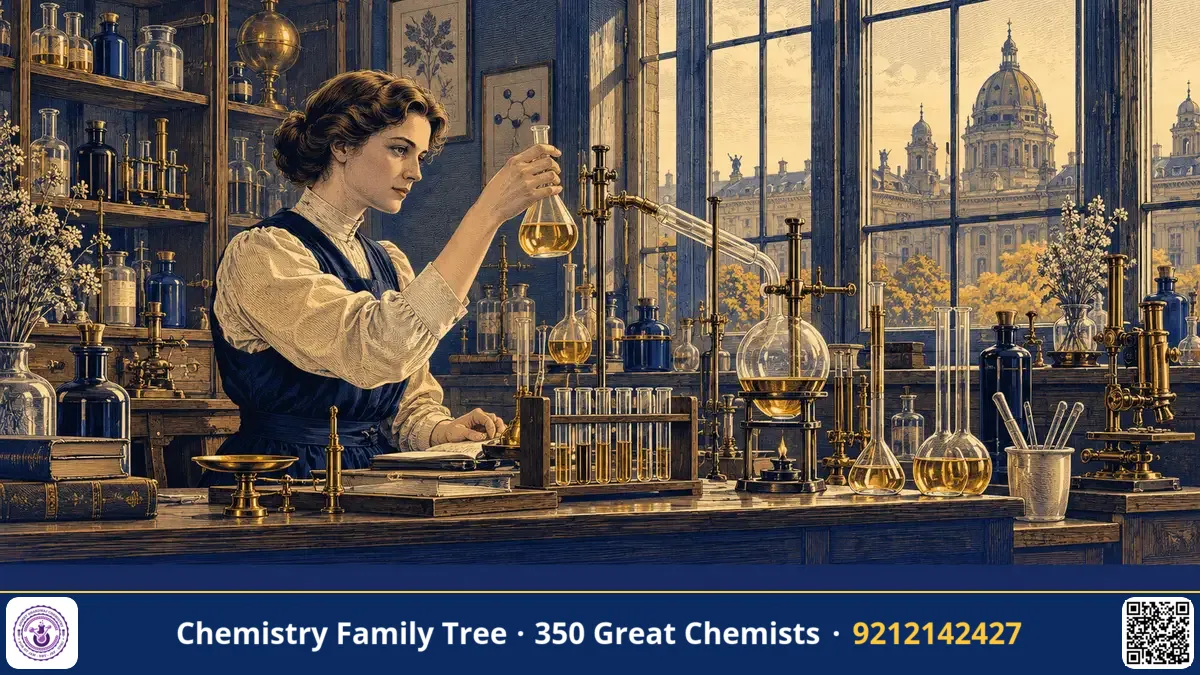
Ida Noddack, born Ida Eva Tacke, was a German chemist and one of the few women working in chemistry in the 1920s. She co-discovered the element rhenium in 1925 with Walter Noddack and Otto Berg, and in 1934 she suggested the possibility of nuclear fission, four years before it was found. Her scientific life was marked by real achievements, but also by controversy and by a lack of recognition that many historians now consider unfair.
Early Life and Family
Ida Tacke was born on 25 February 1896 in Lackhausen, near Wesel, in the Rhineland of Germany. Her father ran a varnish factory. Growing up with a family business that used chemistry may have influenced her interest in the subject. At that time, university education was only slowly opening to women in Germany, so her choice of chemistry was a bold decision.
Education and Mentors
She studied chemistry at the Technical University of Berlin (Technische Hochschule Berlin-Charlottenburg), where she took a degree in chemical engineering and completed her doctorate in 1921 with work on higher fatty acid anhydrides. After this, she worked in industry for a short period. Around 1922, she joined the Physikalisch-Technische Reichsanstalt in Berlin, where she met the chemist Walter Noddack, who headed a research group. He introduced her to the search for missing elements, and she became his partner in research. They married in 1926. Another colleague, Otto Berg, was a physicist and X-ray specialist from the Siemens company who contributed the spectroscopic knowledge.
Career Timeline
| Year | Event |
|---|---|
| 1896 | Born in Lackhausen, Germany (25 February). |
| 1921 | Doctorate in chemistry at the Technical University of Berlin. |
| 1925 | With Walter Noddack and Otto Berg, announces rhenium (and the unconfirmed masurium). |
| 1926 | Marries Walter Noddack. |
| 1928 | Obtains the first gram of rhenium from about 660 kg of molybdenite. |
| 1934 | Publishes a paper criticising Fermi's transuranic claims and suggesting that heavy nuclei could break into large fragments. |
| 1935 | Moves with Walter to the University of Freiburg. |
| 1941 | Moves to the University of Strasbourg (then under German administration). |
| 1956 | Works at the geochemistry research centre in Bamberg, Germany. |
| 1978 | Dies in Bad Neuenahr, Germany (24 September). |
Major Scientific Contributions
Rhenium. Using Moseley's law and X-ray spectroscopy, the team identified element 75 in minerals in 1925. The Noddacks then processed hundreds of kilograms of molybdenite to extract one gram, which proved the existence of the element and allowed its chemistry to be studied. See our discovery article for details.
Geochemistry and abundance of elements. The Noddacks also tried to estimate the abundance of the elements in the Earth's crust, in meteorites and in the cosmos, including the very rare ones. They believed that all elements are found in all minerals in at least trace amounts, an idea that was only partly right. Some of their abundance estimates later proved too high.
The 1934 fission idea. After Fermi announced the formation of elements beyond uranium by neutron bombardment, Ida wrote that Fermi had not shown that the products were really transuranic elements, because he had not compared them with all lighter elements. She wrote that nuclei may break up into several large fragments:
heavy nucleus + n → fragment A + fragment B + ... (isotopes of known lighter elements)
This was the idea of nuclear fission. She did not support it with experiment, and it was not taken up at the time. Her suggestion was recognised only after Hahn and Strassmann's results in 1938 and Meitner and Frisch's explanation of the process. Many chemistry teachers today use her case to show how an unpopular idea may be correct.
Awards, Honours and Nobel Prize
The Noddacks were nominated for the Nobel Prize in Chemistry several times for the discovery of rhenium, but they did not receive it. Ida and Walter jointly received the Liebig Medal of the German Chemical Society in 1931, and they also received the Scheele Medal in Sweden. The Noddacks were criticised by their peers because of the failed masurium claim, which probably damaged their chances. She was never given the Nobel Prize.
Personality, Struggles and Lesser-Known Facts
- Unpaid work. For years, she worked without a formal salaried position in Berlin, as the rules and customs of the time made it hard for married women to hold university posts.
- The masurium controversy. The Noddacks claimed to have found element 43 in 1925. Other laboratories could not reproduce the X-ray results. For decades, the Noddacks defended their claim, and it hurt their reputation. The general view today is that their evidence was not enough.
- Ignored on fission. Her 1934 paper was published in a German chemistry journal and her suggestion was not followed up by the nuclear physicists of the time. The episode has often been described as an example of how scientific communities can overlook ideas from outsiders.
- Difficult war years. Both Noddacks worked in Germany during the National Socialist period and moved to the University of Strasbourg in 1941 when it was under German control. After the war, they had to leave the city. These years remain a sensitive part of their history.
- A hometown honour. Rhenium's name came from the Rhine, her native region.
Legacy and Influence on Modern Chemistry
Rhenium is now essential for jet engine superalloys and for catalytic reforming of petroleum. Re–Os dating is a main method of dating ancient rocks. Rhenium chemistry, such as the Re≡Re bond in [Re₂Cl₈]²⁻, became a landmark of inorganic chemistry. Ida's fission suggestion has become a classic story in the history of nuclear science. Today, the contributions of women such as Ida Noddack, Lise Meitner and Marguerite Perey are more fully recognised in textbooks and in public lectures.
Lessons for Students
- Use the tools of physics (X-ray spectra) to solve chemical problems.
- Double-check big claims. The failed masurium discovery shows the cost of weak evidence.
- Do not dismiss unexpected ideas. A well-reasoned challenge can later prove right.
- Persistence matters: isolating one gram of rhenium took years and tonnes of ore.
Quick Facts
- Born: 25 February 1896, Lackhausen (Wesel), Germany.
- Died: 24 September 1978, Bad Neuenahr, Germany.
- Nationality: German.
- Field: Inorganic chemistry, geochemistry.
- Famous for: Co-discovery of rhenium (1925); 1934 proposal of nuclear fission.
- Nobel Prize: None (nominated several times).
FAQ
What was her maiden name?
Ida Tacke. She became Ida Noddack after marrying Walter Noddack in 1926.
Did she discover nuclear fission?
No, but she proposed the idea in 1934. Fission was shown experimentally in 1938 by Hahn and Strassmann and explained by Meitner and Frisch.
Which element did she discover?
Rhenium (Z = 75), along with Walter Noddack and Otto Berg.
What is masurium?
It was the Noddacks' name for element 43, which they claimed in 1925. The claim was not confirmed, and element 43 is now called technetium.
Published by ABC Chemistry — IIT-JAM | CSIR-NET | GATE Chemistry Coaching. Visit abcchemistry.com

About the chemist
Ida Noddack
1896-1978 · Germany
Co-discovered rhenium; nuclear fission proposal