The discovery, explained · Chemist no. 273 of 350
Ida Noddack and the Discovery of Rhenium: Finding a Needle in 660 Kilograms of Ore
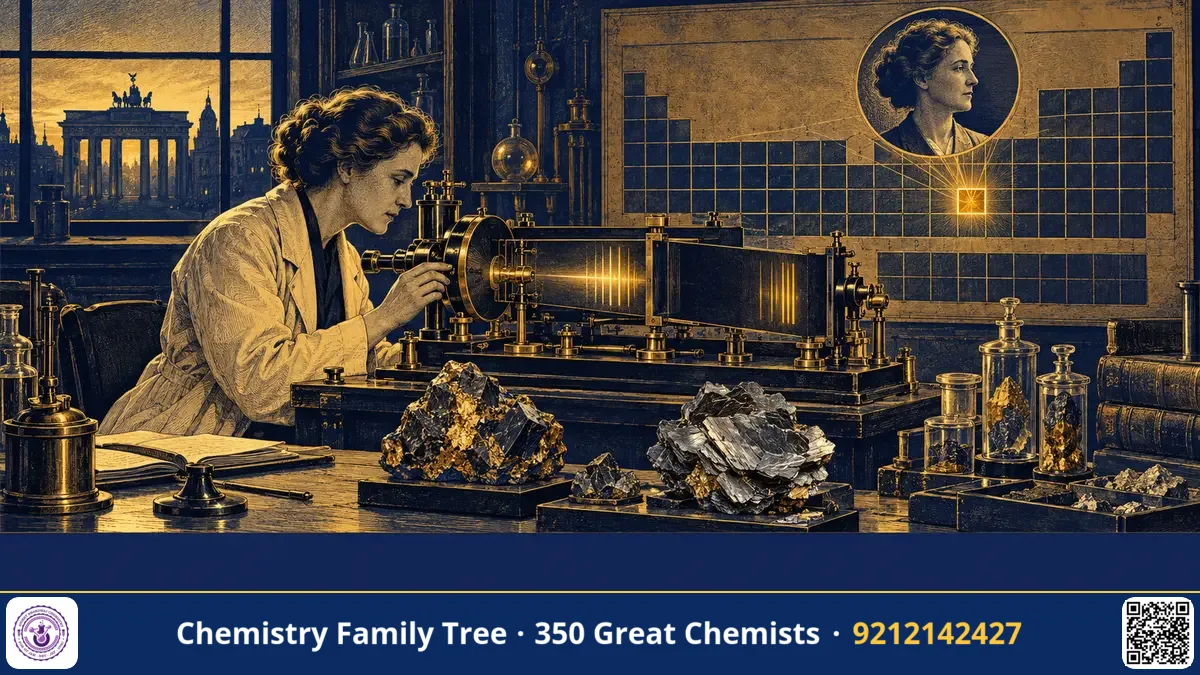
Rhenium (Re, atomic number 75) is one of the rarest elements in the Earth's crust, and it was the last stable element to be discovered. In 1925, the German chemists Ida Tacke (later Ida Noddack), Walter Noddack and Otto Berg announced it after searching through minerals with X-ray spectroscopy. Ida Noddack is also known for a brilliant idea in 1934: that a heavy nucleus bombarded with neutrons might break into several large fragments. Four years later, nuclear fission was discovered. Her story is important for students because it combines careful analytical chemistry with bold scientific thinking.
The Scientific Problem Before the Discovery
Mendeleev's table had gaps below manganese. These were called eka-manganese (element 43) and dvi-manganese (element 75). By the early 1920s, many elements had been found, but elements 43, 61, 72, 75, 85, 87 and some others were still unknown. The missing elements were expected to be very rare, and extracting them from ordinary ores by chemical tests alone was not possible.
Moseley's law (1913) provided a new tool. The frequency of the characteristic X-ray lines of an element depends on its atomic number Z:
√ν = a (Z − b)
This made it possible to identify an element by its X-ray spectrum even at very low concentrations, and to predict where the lines of a missing element should appear.
The Discovery: Step by Step
Walter Noddack and Ida Tacke worked in Berlin, at the Physikalisch-Technische Reichsanstalt and the Technical University, together with the X-ray expert Otto Berg of the Siemens company. They made a reasoned argument: elements with an odd atomic number are generally less abundant than neighbouring even ones, and elements 43 and 75 should accompany manganese in nature but also resemble the platinum metals. They therefore looked in platinum ores and in minerals rich in related elements such as columbite and gadolinite.
- Collecting minerals: They collected a very large number of minerals and ores, such as columbite, gadolinite and later molybdenite (MoS₂).
- Chemical enrichment: They concentrated the suspected element by chemical processing, removing the major components to leave a small residue.
- X-ray spectroscopy: In 1925, they recorded X-ray emission spectra of concentrated fractions and reported lines predicted for element 75, which they named rhenium after the river Rhine (Latin Rhenus). The name honoured Ida Tacke's native Rhineland.
- Proof by isolating metal: Spectral lines alone did not convince everyone. In 1928, they processed about 660 kg of Norwegian molybdenite and obtained about 1 gram of rhenium, finally showing that the element could be isolated and its properties measured.
They also announced element 43, masurium (named for Masuria, a region in East Prussia), in the same 1925 work. This claim could not be confirmed by other laboratories and is not accepted today. Element 43 was later made artificially in 1937 and named technetium. The rhenium discovery, in contrast, stands.
The Chemistry Behind It
Rhenium is a Group 7 transition metal below manganese and technetium, with the configuration [Xe] 4f¹⁴ 5d⁵ 6s². Key features for students:
- Melting point: About 3186 °C, the third highest of all elements, after tungsten and carbon. It is very dense (about 21 g/cm³).
- Oxidation states: From −1 up to +7. The +7 state is the most stable in water: Re₂O₇ (a yellow volatile oxide) dissolves in water to give perrhenic acid and the perrhenate ion, ReO₄⁻.
- Contrast with manganese: MnO₄⁻ is a strong oxidant, but ReO₄⁻ is a very weak oxidant. As we go down the group, higher oxidation states become more stable (a general trend in d-block elements).
- Metal–metal bonding: The ion [Re₂Cl₈]²⁻ contains a quadruple Re–Re bond (one σ, two π, and one δ bond), a result established in the 1960s by F. A. Cotton. This is a favourite topic in CSIR-NET inorganic chemistry.
4Re + 7O₂ → 2Re₂O₇
Re₂O₇ + H₂O → 2HReO₄
2NH₄ReO₄ + 7H₂ → 2Re + 2NH₃ + 8H₂O   (reduction of ammonium perrhenate)
Ida Noddack and fission (1934). After Enrico Fermi reported that neutron bombardment of uranium gave "transuranic" elements, Ida Noddack wrote that the chemical evidence did not exclude another possibility: that the nucleus might break into several large pieces which are isotopes of known lighter elements, not neighbours of the original. Her idea was not tested and was largely ignored. In 1938, Hahn and Strassmann found barium among the products and Meitner and Frisch explained the process as fission.
Applications Today
- Jet engines: Nickel superalloys with a few percent rhenium are used in turbine blades because of their strength at very high temperatures. This is the largest use.
- Petroleum catalysts: Platinum–rhenium catalysts are used in catalytic reforming to make high-octane petrol. Indian refineries use similar bimetallic catalysts.
- Thermocouples and filaments: Tungsten–rhenium alloys are used in thermocouples, X-ray tube targets and lamp filaments.
- Medicine: Radioisotopes ¹⁸⁶Re and ¹⁸⁸Re are studied for treating bone pain and some cancers.
- Dating: The Re–Os decay system (¹⁸⁷Re → ¹⁸⁷Os, very long half-life, about 4 × 10¹⁰ years) is used to date meteorites and ancient ores.
Exam Corner
- Rhenium (Z = 75) was discovered in 1925 by Ida Tacke, Walter Noddack and Otto Berg using X-ray spectroscopy; named after the Rhine.
- Moseley's law links the X-ray frequency with atomic number: √ν ∝ (Z − b).
- Re₂O₇ gives HReO₄; ReO₄⁻ is much less oxidising than MnO₄⁻.
- [Re₂Cl₈]²⁻ has a Re≡Re quadruple bond (σ² π⁴ δ²) and an eclipsed geometry.
- Pt–Re/Al₂O₃ is a reforming catalyst; Re has the third-highest melting point among the elements.
Common Misconceptions
- "The Noddacks discovered technetium." They claimed masurium, element 43, but the claim was not confirmed. Technetium was made in 1937 by Perrier and Segrè.
- "Ida Noddack discovered nuclear fission." She suggested the possibility in 1934, but did not do the experiments. Hahn, Strassmann, Meitner and Frisch established fission in 1938–39.
- "Rhenium was discovered by chemical tests alone." X-ray spectroscopy was the key tool.
Quick Revision Box
- Rhenium, Re, Z = 75, Group 7, last stable element discovered.
- Announced 1925 by Tacke (Noddack), Noddack and Berg; named for the Rhine.
- First 1 g obtained in 1928 from about 660 kg of molybdenite.
- Melting point about 3186 °C; oxidation states −1 to +7.
- [Re₂Cl₈]²⁻: quadruple bond.
- Uses: superalloys, Pt–Re reforming catalysts, thermocouples.
FAQ
Why is rhenium so rare?
Its average crust abundance is extremely low, and it does not form its own ores; it is found in traces in molybdenite and some copper ores.
What did Ida Noddack say about fission?
In 1934, she proposed that bombarding heavy nuclei with neutrons could break them into several large fragments. This was not followed up until 1938.
Did she win a Nobel Prize?
No. She was nominated several times for the discovery of rhenium, but she did not receive the prize.
How is rhenium obtained now?
Mainly as a by-product of roasting molybdenite from copper-molybdenum ores, collected as Re₂O₇ or ammonium perrhenate from flue dust.
Published by ABC Chemistry — IIT-JAM | CSIR-NET | GATE Chemistry Coaching. Visit abcchemistry.com

About the chemist
Ida Noddack
1896-1978 · Germany
Co-discovered rhenium; nuclear fission proposal