Biography · Chemist no. 146 of 350
Ilya Prigogine: The Scientist of Time and Complexity
Introduction
Ilya Prigogine (1917-2003) was a Russian-born Belgian physical chemist and thinker who changed the way we understand time, entropy and order. He built the thermodynamics of systems far from equilibrium and described how order can emerge spontaneously in nature. He received the Nobel Prize in Chemistry in 1977. In one line: Prigogine showed that disorder and irreversibility can be creative forces.
Early Life and Family
Ilya Prigogine was born on 25 January 1917 in Moscow, a few weeks before the Russian Revolution. His father, Roman, was a chemical engineer, and the family was Jewish. As the new Soviet state developed, the family left Russia in 1921 and lived for some years in Lithuania and Germany, and then settled in Belgium in 1929. The experience of leaving his homeland and growing up in several countries left a strong mark on him. As a boy, he was drawn to history, archaeology and music; he was a gifted pianist.
Education and Mentors
Prigogine studied at the Université Libre de Bruxelles (ULB). Although he initially intended to study history and archaeology, he enrolled in chemistry, where he took the courses of Théophile de Donder, a Belgian physicist and mathematician who developed the concept of chemical affinity as the driving force of chemical reaction. De Donder's thermodynamics of irreversible processes inspired him, and Prigogine later became his most famous student. He obtained his doctorate in 1941 and spent his career at ULB. Another influence was the work of Lars Onsager on reciprocal relations.
Career Timeline
| Year | Event |
|---|---|
| 1917 | Born in Moscow on 25 January |
| 1921 | Family leaves Russia |
| 1929 | Family settles in Belgium |
| 1941 | Doctorate, Université Libre de Bruxelles |
| 1945 | Theorem of minimum entropy production |
| 1949 | Becomes a Belgian citizen |
| 1959 | Director of the International Solvay Institutes in Brussels |
| 1967 | Founds a centre for statistical mechanics and thermodynamics at the University of Texas at Austin |
| 1977 | Nobel Prize in Chemistry |
| 1984 | Publishes Order Out of Chaos with Isabelle Stengers |
| 1989 | Made a viscount by the Belgian king |
| 2003 | Dies in Brussels on 28 May |
Major Scientific Contributions
Prigogine's major contributions are the entropy balance of open systems, the theorem of minimum entropy production for the linear regime, and the theory of dissipative structures in systems far from equilibrium. His group introduced the Brusselator model, which gave a mathematical way to study chemical oscillations. He also worked on the statistical mechanics of irreversible processes, aiming to explain how the arrow of time arises from reversible microscopic laws. Later in his career he wrote on the philosophy of science, arguing that science should include time, irreversibility and creativity, and that the world is not fully predictable. For the chemistry and equations in detail, read the companion discovery post.
Awards, Honours and Nobel Prize
- Nobel Prize in Chemistry, 1977, for his contributions to non-equilibrium thermodynamics, particularly the theory of dissipative structures. It was a sole award.
- Member of many academies, including foreign memberships of leading academies.
- Honorary degrees from numerous universities worldwide.
- Made a viscount (a Belgian title of nobility) in 1989.
- The Solvay Institutes and the Ilya Prigogine Center at the University of Texas at Austin continue his work.
Personality, Struggles and Lesser-Known Facts
- A musician and a lover of art. He was a skilled pianist, and he had a deep interest in art, particularly in the arts of ancient civilisations.
- Philosophical writer. His books Order Out of Chaos and The End of Certainty were meant for a general audience and generated much debate among scientists and philosophers.
- Two homes. He divided his time between Brussels and Austin, Texas, and led research groups on both sides of the Atlantic.
- A childhood in several countries. Having left Russia as a small child, he lived in more than one country before settling in Belgium, and became a Belgian citizen in 1949.
- Controversial ideas. His claims about time and irreversibility, and about the limits of determinism in physics, were discussed and criticised. Some physicists felt that his philosophical statements went beyond what had been proven.
Legacy and Influence on Modern Chemistry
The study of oscillating reactions, chemical waves and pattern formation is now a vibrant field. Concepts such as self-organisation, bifurcation and far-from-equilibrium thermodynamics have entered biology, ecology, economics and the study of complex systems. The Brussels school he created remains active. His efforts to join the natural sciences with philosophy encouraged students to think about the meaning of time.
Lessons for Students
- Ask deep questions; Prigogine started with the question of why time has a direction.
- Do not be afraid of crossing boundaries between chemistry, physics, biology and philosophy.
- Follow a good teacher; de Donder's ideas started his career.
- A hard early life can build resilience.
- Communicate ideas to the public, but remain careful about proof.
Quick Facts Box
- Born: 25 January 1917, Moscow, Russia
- Died: 28 May 2003, Brussels, Belgium
- Nationality: Belgian (Russian-born)
- Field: Physical chemistry, non-equilibrium thermodynamics
- Famous for: Dissipative structures, entropy production, Brusselator
- Nobel: Chemistry, 1977
FAQ
Was Prigogine Russian or Belgian?
He was born in Moscow but grew up in Belgium and became a Belgian citizen in 1949.
Who was his teacher?
Théophile de Donder at the Université Libre de Bruxelles.
What are his well-known books?
Order Out of Chaos (with Isabelle Stengers) and The End of Certainty are his best-known books for general readers.
Was his Nobel Prize in Physics?
No, it was in Chemistry, in 1977.
Published by ABC Chemistry — IIT-JAM | CSIR-NET | GATE Chemistry Coaching. Visit abcchemistry.com
About the chemist
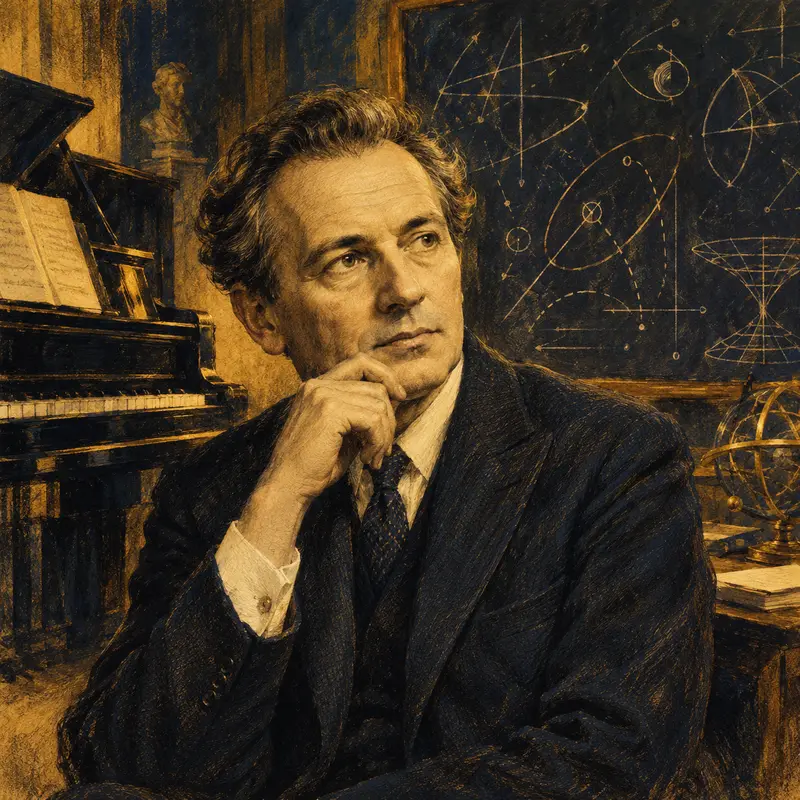
Ilya Prigogine
1917-2003 · Belgium · Nobel Chemistry 1977
Dissipative structures, nonequilibrium thermodynamics