The discovery, explained · Chemist no. 146 of 350
Ilya Prigogine: How Order Can Arise from Disorder
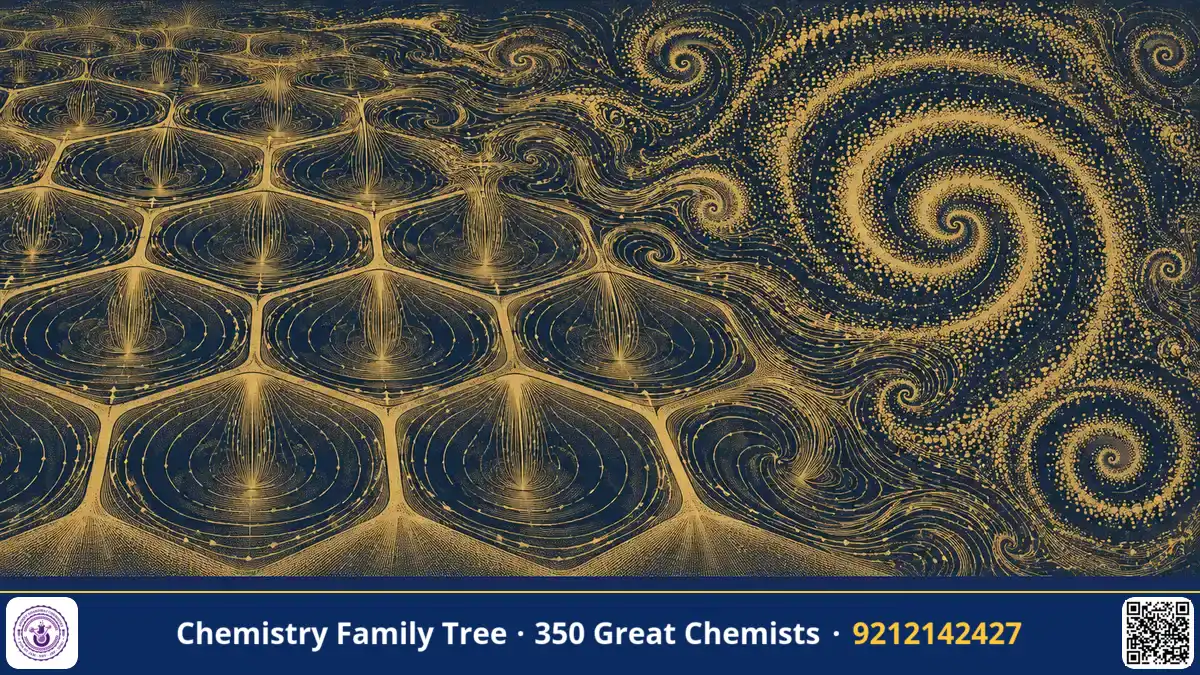
The second law of thermodynamics says that the entropy of an isolated system never decreases, and so many people imagine that nature always moves towards disorder. Yet a living cell, a snowflake, a hurricane and a flickering chemical clock all show remarkable order. Ilya Prigogine (1917-2003) explained how this is possible. He extended thermodynamics from equilibrium to systems that are far from equilibrium and exchange matter and energy with their surroundings. He showed that under such conditions, ordered patterns - which he called dissipative structures - can form spontaneously and be maintained by a flow of energy. He received the 1977 Nobel Prize in Chemistry for his contributions to non-equilibrium thermodynamics, particularly the theory of dissipative structures.
The Scientific Problem Before the Discovery
Classical thermodynamics deals with equilibrium. It tells us which reactions are spontaneous (ΔG < 0) and where equilibrium lies, but it says nothing about rates or time. For small deviations from equilibrium, Lars Onsager had shown in 1931 that fluxes are linearly related to forces, with symmetric coefficients: Ji = Σ Lik Xk, Lik = Lki. This was the Onsager reciprocal relations, which won him the 1968 Nobel Prize in Chemistry.
But the real world is mostly far from equilibrium. Living organisms, flames, weather and oscillating reactions are not close to equilibrium, and linear theory could not account for them. In addition, biologists puzzled over a seeming conflict between the second law and the growth of order in evolution and development. Chemists had also discovered strange chemical oscillations, like the Belousov-Zhabotinsky reaction in the 1950s, which many believed to violate thermodynamics because concentrations rise and fall periodically instead of moving smoothly to equilibrium.
The Discovery and Contributions
- Entropy balance for open systems. Working with his teacher Théophile de Donder in Brussels, Prigogine split the entropy change of a system into two parts - the entropy exchanged with the surroundings and the entropy produced inside by irreversible processes.
- Minimum entropy production (1945). He proved that, in the linear regime near equilibrium, a system with fixed boundary conditions evolves to a steady state in which the rate of entropy production is a minimum.
- Far from equilibrium. In the 1950s-60s, he and his Brussels school showed that when the system is driven far enough from equilibrium, the steady state can become unstable. At a critical value of a control parameter, a bifurcation occurs and a new structured state appears.
- Dissipative structures. He named these self-organised states dissipative structures because they form and persist by dissipating energy and producing entropy.
- The Brusselator. To study chemical oscillations mathematically, the Brussels group, with René Lefever, proposed a simple model reaction scheme with autocatalysis, later called the Brusselator.
The Chemistry Behind It
Entropy balance
dS = deS + diS
diS ≥ 0 (always, second law)
deS may be positive, zero or negative
For an isolated system deS = 0, so entropy can only increase. For an open system the exchange term can be negative: the system can export entropy to its surroundings. If deS is negative and large enough, the total entropy of the system can stay constant or even fall, which allows order to be maintained. A living cell takes in low-entropy food and sunlight-derived energy and releases heat and waste with higher entropy, so the total entropy of the universe increases, as the second law demands.
The rate of entropy production
For irreversible processes, the entropy production per unit time is the sum of products of flows and forces: σ = Σ Jk Xk ≥ 0. For a chemical reaction, the force is the affinity divided by temperature (A/T) and the flow is the reaction rate.
The Brusselator
A → X
2X + Y → 3X     (autocatalytic step)
B + X → Y + D
X → E
A and B are reactants kept at constant concentration by feeding the reactor, D and E are products removed, and X and Y are intermediates. The steady state is X = A, Y = B/A. This steady state becomes unstable and gives sustained oscillations when B > 1 + A². The model shows that three ingredients are needed: an open system far from equilibrium, autocatalysis (positive feedback) and a nonlinear kinetics step.
Bifurcation and fluctuations
Near a bifurcation point, small random fluctuations get amplified, and the system chooses one of several possible new states. That is why Prigogine spoke of "order through fluctuations". In the Bénard experiment, a liquid heated from below shows hexagonal convection cells above a critical temperature gradient. In the Belousov-Zhabotinsky reaction, a mixture containing bromate, malonic acid and a metal-ion catalyst like cerium or ferroin shows colour oscillations and spiral waves.
Applications Today
- Chemical oscillators. Oscillating reactions like Belousov-Zhabotinsky are a favourite classroom demonstration of non-equilibrium chemistry.
- Biology. Glycolytic oscillations, the cell cycle, circadian rhythms, heartbeat and the pattern of animal coats are modelled with reaction-diffusion systems, and Alan Turing's earlier theory of morphogenesis connects with this field.
- Atmospheric and climate science. Weather patterns and ocean currents can be seen as dissipative structures.
- Materials science. Self-assembly and pattern formation, crystal growth patterns and electrochemical oscillations use these ideas.
- Engineering and social sciences. Concepts of self-organisation and complexity were applied to traffic flow, urban growth and ecology.
Exam Corner
- Entropy balance: dS = deS + diS, with diS ≥ 0 always.
- Near equilibrium (linear regime), steady state has minimum entropy production (Prigogine's theorem); Onsager relations Lik = Lki apply.
- Dissipative structures need an open system, far from equilibrium, with nonlinear (autocatalytic) steps.
- Brusselator oscillates when B > 1 + A².
- Prigogine was awarded the Nobel Prize in Chemistry in 1977, not Physics.
Common Misconceptions
- "Self-organisation violates the second law." It does not; entropy produced inside is positive, and the entropy exported to the surroundings ensures the total increases.
- "Minimum entropy production holds everywhere." It holds only in the linear regime near equilibrium. Far from equilibrium it need not apply.
- "Oscillating reactions never reach equilibrium, so they break thermodynamics." They are in an open system or in a closed system that is still moving towards equilibrium slowly; the oscillation is a transient with decreasing free energy.
Quick Revision Box
- Nobel Prize in Chemistry, 1977: non-equilibrium thermodynamics, dissipative structures.
- dS = deS + diS; diS ≥ 0.
- Linear regime: minimum entropy production, Onsager reciprocity.
- Dissipative structures: open, far from equilibrium, nonlinear.
- Brusselator: A → X; 2X + Y → 3X; B + X → Y + D; X → E.
- Examples: Bénard cells, Belousov-Zhabotinsky reaction.
FAQ
What is a dissipative structure?
It is an ordered state that arises in an open system far from equilibrium and is maintained by a continuous flow of energy or matter.
What is the Brusselator?
It is a simple theoretical model of an autocatalytic reaction scheme proposed by the Brussels school to show how chemical oscillations and patterns can arise.
Is Prigogine's Nobel Prize in Physics?
No. It was in Chemistry, in 1977, and it was awarded to him alone.
Why does this matter for physical chemistry exams?
Entropy, irreversibility, open and closed systems, oscillating reactions and the second law are repeatedly tested in JAM, NET and GATE.
Published by ABC Chemistry — IIT-JAM | CSIR-NET | GATE Chemistry Coaching. Visit abcchemistry.com
About the chemist
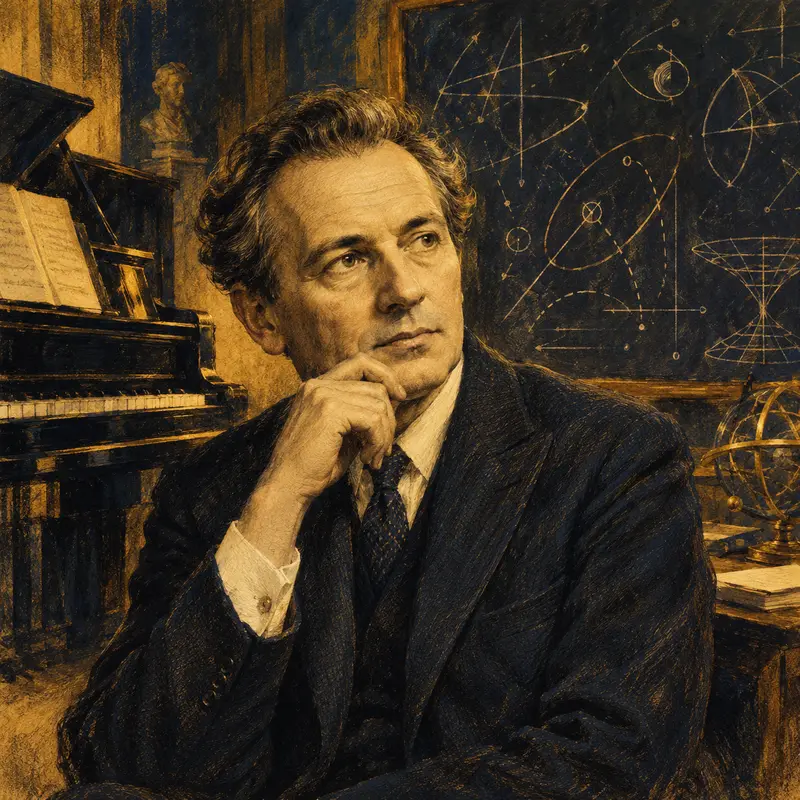
Ilya Prigogine
1917-2003 · Belgium · Nobel Chemistry 1977
Dissipative structures, nonequilibrium thermodynamics