The discovery, explained · Chemist no. 38 of 350
Artificial Radioactivity: The Discovery of Irène and Frédéric Joliot-Curie
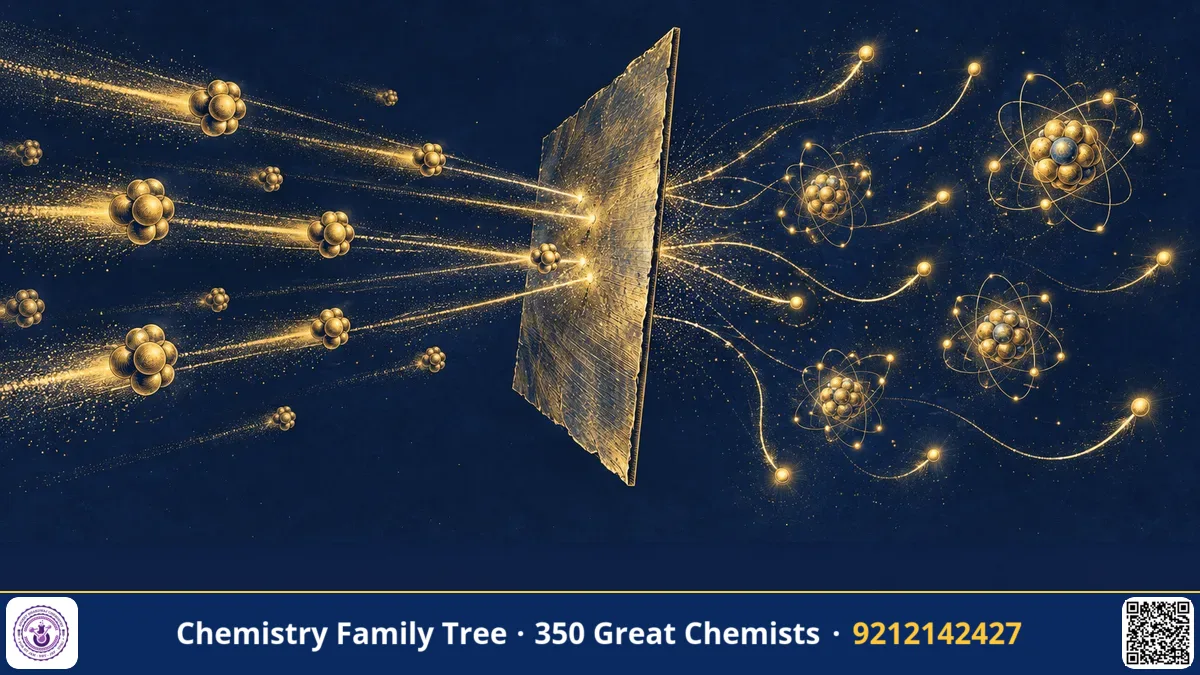
Before 1934, radioactivity was something that only a few heavy elements, such as uranium, thorium and radium, possessed naturally. Then, in the Radium Institute in Paris, Irène Joliot-Curie and her husband Frédéric Joliot discovered that ordinary, stable elements can be made radioactive in the laboratory. They bombarded aluminium foil with alpha particles and found that it continued to emit radiation after the source had been removed. They had created a new, unstable isotope, phosphorus-30. This discovery of artificial radioactivity earned the couple the 1935 Nobel Prize in Chemistry, "in recognition of their synthesis of new radioactive elements". It opened the door to radioisotopes for medicine, agriculture, industry and research.
The Scientific Problem Before the Discovery
By the early 1930s physics was moving fast. Rutherford had shown in 1919 that nitrogen can be transmuted to oxygen by alpha particles. Chadwick discovered the neutron in 1932, after the Joliot-Curies themselves had observed, but misinterpreted, a penetrating radiation from beryllium bombarded by alpha particles. They had thought it was gamma radiation; Chadwick correctly identified neutrons. In 1932 Carl Anderson discovered the positron, the positively charged twin of the electron.
Scientists knew that nuclear reactions produce new nuclei, but all the products seen so far were stable isotopes. Would it be possible to make a nucleus that is unstable and decays later, just like natural radioactive elements? The Joliot-Curies had access to the strongest polonium source in the world, prepared from the radium supply at the Radium Institute, which Irène's mother, Marie Curie, had built up. They also had a deep knowledge of radiochemistry. They were therefore well placed to find out.
The Discovery: Step by Step
- The source of alpha particles. They used a strong sample of polonium-210, which emits alpha particles of high energy.
- The targets. Thin foils of light elements, such as aluminium, boron and magnesium, were placed close to the polonium source.
- The detectors. They used a Geiger-Müller counter to detect radiation and a Wilson cloud chamber to view the tracks of particles.
- The surprise. When they removed the polonium source, the counter kept clicking. The activity from the aluminium foil decayed exponentially with a half-life of about three minutes. The radiation consisted of positrons, not electrons.
- The chemistry. To show that the radioactivity belonged to a new isotope of a different element, not to the aluminium itself, Frédéric Joliot carried out a quick chemical separation. They dissolved the irradiated aluminium in hydrochloric acid. The radioactive product escaped as a gas, and it behaved chemically like phosphorus: it formed phosphine (PH₃). The radioactive element was therefore phosphorus.
They announced the result in January 1934 in a short note to the French Academy of Sciences. The nuclear reaction and decay are:
²⁷₁₃Al + ⁴₂He → ³⁰₁₅P + ¹₀n
³⁰₁₅P → ³⁰₁₄Si + ⁰₊₁e (positron) + neutrino      t½ ≈ 2.5 minutes
Ordinary phosphorus is phosphorus-31, the only stable isotope. Phosphorus-30 has one neutron fewer, which makes it unstable. It reaches stability by converting a proton into a neutron, with the emission of a positron.
They found similar reactions for other light elements:
¹⁰₅B + ⁴₂He → ¹³₇N + ¹₀n          ¹³₇N → ¹³₆C + ⁰₊₁e      t½ ≈ 10 minutes
²⁴₁₂Mg + ⁴₂He → ²⁷₁₄Si + ¹₀n      ²⁷₁₄Si → ²⁷₁₃Al + ⁰₊₁e
Marie Curie, then near the end of her life, is said to have seen the radioactive vials. She died in July 1934, a few months later. Within weeks, Enrico Fermi in Rome began to produce many new radioactive isotopes using neutrons.
The Chemistry Behind It
Why are some nuclei unstable?
Nuclear stability depends on the ratio of neutrons to protons (n/p). Light stable nuclei have n/p close to 1, and heavy ones have higher values. Nuclei with too few neutrons (below the belt of stability) decay by positron emission or electron capture. Nuclei with too many neutrons decay by beta-minus emission.
Types of beta decay
| Process | Change in nucleus | Effect on Z |
|---|---|---|
| Beta-minus (β⁻) | Neutron → proton + electron + antineutrino | Increases by 1 |
| Positron emission (β⁺) | Proton → neutron + positron + neutrino | Decreases by 1 |
| Electron capture | Proton + electron → neutron + neutrino | Decreases by 1 |
In all cases the mass number A is unchanged.
Decay law and half-life
N = N₀ e^(-λt) t½ = 0.693/λ Activity A = λN
For phosphorus-30 with a half-life of 2.5 minutes, after 10 minutes (four half-lives) only 1/16 of the original activity is left.
Positron annihilation
A positron meets an electron and both are annihilated, giving two gamma photons of 511 keV each, moving in opposite directions. This is the basis of PET imaging.
Radioactive tracers
Because a radioactive isotope behaves chemically like the stable isotope of the same element, it can be used as a tracer. Its radiation reveals where the element goes in a plant, an animal or a chemical reaction.
Applications Today
- Medical diagnosis: PET scans use positron-emitting isotopes such as fluorine-18 (in fluorodeoxyglucose) to detect cancer and brain disorders. Phosphorus-30 was the first positron emitter ever made.
- Radiotherapy: iodine-131 for thyroid, phosphorus-32 for blood disorders in the past, and cobalt-60 for external beam therapy.
- Agriculture: phosphorus-32 is used to study how plants take up fertiliser, helping to design better fertiliser use in Indian agriculture.
- Industry: radioactive tracers detect leaks in pipelines, measure wear in engines and check weld quality by radiography.
- Dating and research: carbon-14 is produced naturally and used in archaeology; many research isotopes are made in reactors and cyclotrons.
- India context: The Bhabha Atomic Research Centre and the Board of Radiation and Isotope Technology supply radioisotopes to Indian hospitals and industry.
Exam Corner
- Artificial radioactivity was discovered in 1934 by Irène Joliot-Curie and Frédéric Joliot; they got the 1935 Nobel Prize in Chemistry.
- Key reaction: ²⁷Al(α, n)³⁰P; ³⁰P decays by positron emission to ³⁰Si.
- Positron emission: A unchanged, Z decreases by 1. Beta-minus: A unchanged, Z increases by 1.
- Nuclei above the belt of stability (high n/p) emit β⁻; those below (low n/p) emit β⁺ or capture an electron.
- First-order decay: t½ = 0.693/λ. Fraction left after n half-lives = (1/2)ⁿ.
Common Misconceptions
- "Radioactivity is only natural." Thousands of radioisotopes have been made artificially.
- "A positron is the same as a proton." A positron has the mass of an electron and a positive charge.
- "The radioactive aluminium emits positrons." The positrons come from phosphorus-30, not from aluminium.
Quick Revision Box
- 1934: Irène and Frédéric Joliot-Curie create phosphorus-30 from aluminium and alpha particles.
- Al-27 + He-4 → P-30 + n; P-30 → Si-30 + positron.
- Half-life of P-30 is about 2.5 minutes.
- Positron emission lowers Z by 1; mass number is unchanged.
- Positron-electron annihilation gives two 511 keV photons.
- Nobel Prize in Chemistry 1935.
FAQ
What is artificial radioactivity?
It is radioactivity in an isotope that does not occur naturally in significant amounts and is created by a nuclear reaction, such as bombardment with alpha particles, neutrons or protons.
Why did the aluminium foil stay radioactive?
Some aluminium nuclei captured an alpha particle and ejected a neutron, becoming unstable phosphorus-30, which decays slowly.
Did the Joliot-Curies find neutrons?
They observed the effect of neutrons from beryllium in 1932 but interpreted the radiation as gamma rays. James Chadwick identified neutrons and received the 1935 Nobel Prize in Physics.
How is this discovery used in hospitals?
Positron-emitting isotopes made in cyclotrons are used for PET scans, and many other radioisotopes are used for diagnosis and therapy.
Published by ABC Chemistry — IIT-JAM | CSIR-NET | GATE Chemistry Coaching. Visit abcchemistry.com
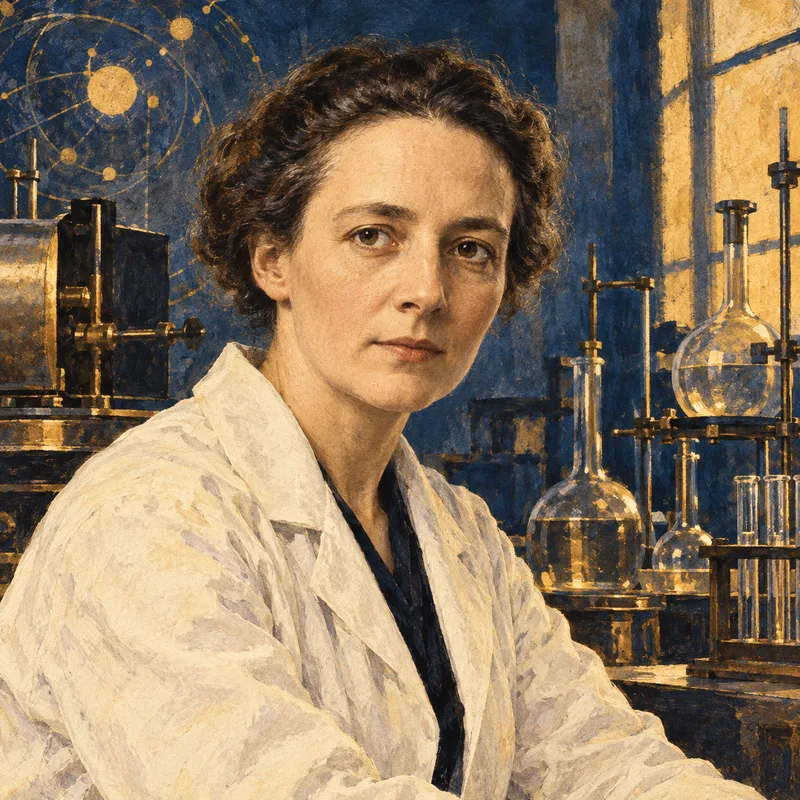
About the chemist
Irène Joliot-Curie
1897-1956 · France · Nobel Chemistry 1935
Artificial radioactivity