Biography · Chemist no. 38 of 350
Irène Joliot-Curie: Second Generation of a Scientific Dynasty
Introduction
Irène Joliot-Curie (1897-1956) was a French chemist and physicist, the elder daughter of Marie and Pierre Curie. Together with her husband Frédéric Joliot, she discovered artificial radioactivity in 1934 and received the 1935 Nobel Prize in Chemistry. She was also a political figure, a defender of women's rights, a government minister and one of the founders of French atomic energy. Her legacy in one line: she continued her mother's work and showed that stable elements can be made radioactive, which created the field of radioisotopes.
Early Life and Family
Irène Curie was born on 12 September 1897 in Paris, France. Her father Pierre Curie, a physicist, died in a road accident in 1906, when she was nine years old. Her mother, Marie Curie, discovered polonium and radium and received two Nobel Prizes. Her younger sister Ève became a writer and journalist, and wrote a well-known biography of Marie Curie. After Pierre's death, Irène's paternal grandfather, Dr Eugène Curie, lived with the family and helped to raise the girls. He encouraged their curiosity and taught them about nature and politics.
Marie Curie was determined that her daughter should receive an unusual education. When Irène was a girl, Marie joined a group of leading scientists, including Paul Langevin and Jean Perrin, who taught their children in turn at home in a kind of cooperative school. Irène studied mathematics, physics, chemistry and languages in small classes. She then completed her school education at the Collège Sévigné in Paris.
Education and Mentors
Irène began her studies at the Sorbonne in 1914 but her studies were interrupted by the First World War. Despite her youth, she joined her mother in building mobile X-ray units, nicknamed "little Curies", that were taken to the front to help surgeons locate bullets and shrapnel in wounded soldiers. She worked as a radiographer and trained other women technicians, even though she was still a teenager. After the war she finished her degree and began research at the Radium Institute under her mother. She obtained her doctorate in 1925 with a thesis on the alpha rays of polonium. In the laboratory, she trained as a chemist and physicist, learning precise radiochemical techniques. In 1925 she met a young assistant, Frédéric Joliot, who later became her husband.
Career Timeline
| Year | Event |
|---|---|
| 1897 | Born in Paris (12 September) |
| 1914-18 | Works with her mother on mobile X-ray units in the First World War |
| 1925 | Doctorate on alpha rays of polonium |
| 1926 | Marries Frédéric Joliot (October) |
| 1932 | Observes, with Joliot, the penetrating radiation from beryllium (later identified as neutrons by Chadwick) |
| 1934 | Discovers artificial radioactivity with Frédéric Joliot (January) |
| 1935 | Wins the Nobel Prize in Chemistry with Frédéric Joliot |
| 1936 | Appointed Under-Secretary of State for Scientific Research in the French government |
| 1937 | Becomes professor at the Sorbonne |
| 1937-38 | Works with Pavle Savić on neutron-irradiated uranium, a step on the road to fission |
| 1946 | Becomes director of the Radium Institute; member of the French Atomic Energy Commission |
| 1956 | Dies in Paris (17 March) |
Major Scientific Contributions
- Artificial radioactivity (1934): creation of phosphorus-30 from aluminium by alpha particle bombardment, the first artificially made radioactive isotope and a positron emitter.
- Early neutron experiments (1932): with Joliot, she observed a strange radiation from beryllium that Chadwick later explained as neutrons.
- Positron studies: the pair carried out experiments on the creation of electron-positron pairs and annihilation, supporting Dirac's theory.
- Uranium work (1937-38): with Savić, she found a radioactive product from irradiated uranium with properties that looked like lanthanum. This puzzling result drew the attention of Hahn and Strassmann and contributed to the discovery of fission in 1938.
- Alpha-ray and polonium studies: her doctoral work remained a base for later research on the radioactive decay of polonium.
For the detailed equations, read the companion post on artificial radioactivity.
Awards, Honours and Nobel Prize
- Nobel Prize in Chemistry, 1935, shared with Frédéric Joliot, for their synthesis of new radioactive elements. Irène and her mother thus became the first mother-daughter pair of Nobel laureates.
- Honorary doctorates and memberships of foreign academies, and many schools and streets named after her in France and elsewhere.
Personality, Struggles and Lesser-Known Facts
- Quiet and direct. She had a reserved, serious personality, like her mother, with little interest in social display. People described her as honest and sometimes blunt.
- A minister before women could vote. In 1936 she was appointed by the government of Léon Blum to a post in the Ministry of National Education, years before French women gained the right to vote in 1944. She resigned after a few months but made her point.
- Lifelong political commitment. She supported women's rights and anti-fascist causes in the 1930s, and later also peace movements.
- Working with a spouse. She and Frédéric combined her careful chemistry with his creative physics. Their children, Hélène Langevin-Joliot and Pierre Joliot, also became scientists.
- Setbacks. Her left-wing political views brought her difficulties in the early Cold War period, and she left the French Atomic Energy Commission around 1950-51 after political disagreements.
- Illness. Like her mother, she spent years in contact with radioactive materials in a time when safety rules were weak. She developed leukaemia and died in 1956 at the age of 58.
Legacy and Influence on Modern Chemistry
The discovery of artificial radioactivity led within a few years to the production of hundreds of radioisotopes, for use in medicine, agriculture, industry and basic research. The PET scanner, radioactive tracers, radiotherapy and radiocarbon calibration all trace back to the idea that nuclear reactions can make new unstable nuclei. As the first director of the new French Atomic Energy Commission, together with Joliot, she also helped to launch France's nuclear programme. As one of the few women to win a Nobel Prize in science in her time, she became a role model for many girls who choose chemistry and physics. In India as well, the Atomic Energy programme drew on the same radiochemical principles.
Lessons for Students
- Persevere through setbacks. Even a famous name did not protect her from obstacles.
- Look carefully at unexpected results. A foil that kept clicking after the source was removed led to a Nobel Prize.
- Chemistry and physics belong together. The quick chemical test for phosphorus proved the new isotope.
- Practise safety. The early radiation workers paid a high price for lack of protection.
- Use your voice. Science and social responsibility can go together.
Quick Facts Box
- Born: 12 September 1897, Paris, France
- Died: 17 March 1956, Paris, France
- Nationality: French
- Field: Nuclear chemistry and physics
- Famous for: Artificial radioactivity (with Frédéric Joliot)
- Nobel Prize: Chemistry, 1935 (shared with Frédéric Joliot)
FAQ
Who was Irène Joliot-Curie's mother?
Marie Curie, who won Nobel Prizes in Physics (1903) and Chemistry (1911).
What did Irène Joliot-Curie discover?
With her husband she discovered that stable elements can be turned into radioactive isotopes, for example aluminium into phosphorus-30.
Why did she win the Nobel Prize in Chemistry?
For the synthesis of new radioactive elements, a breakthrough made in 1934.
How did Irène Joliot-Curie die?
She died of leukaemia in 1956, which is generally linked to her long exposure to radiation during her work.
Published by ABC Chemistry — IIT-JAM | CSIR-NET | GATE Chemistry Coaching. Visit abcchemistry.com
About the chemist
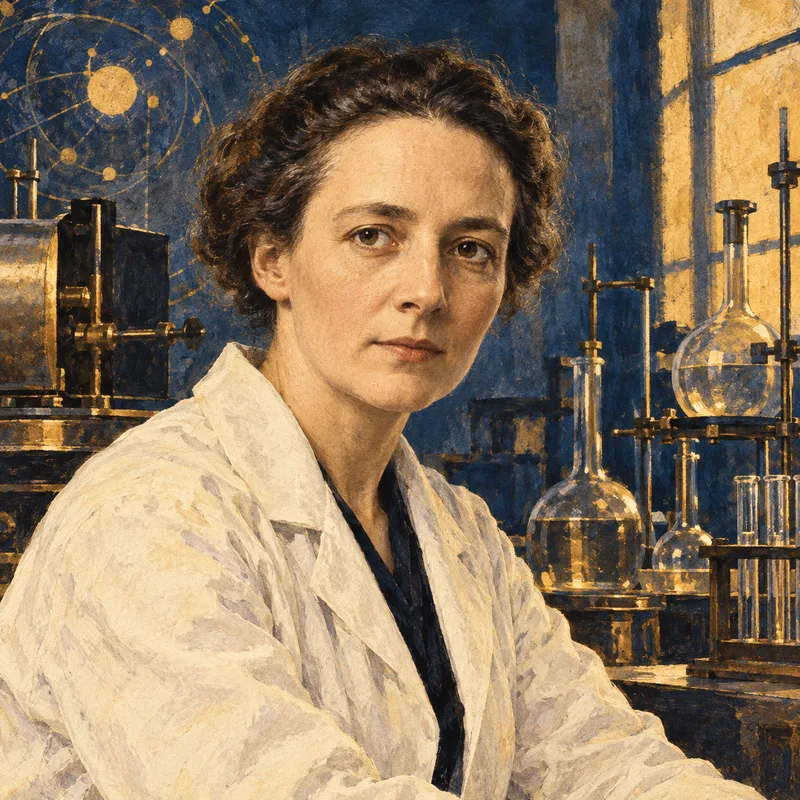
Irène Joliot-Curie
1897-1956 · France · Nobel Chemistry 1935
Artificial radioactivity