The discovery, explained · Chemist no. 19 of 350
Irving Langmuir and the Monolayer: The Science of Surfaces
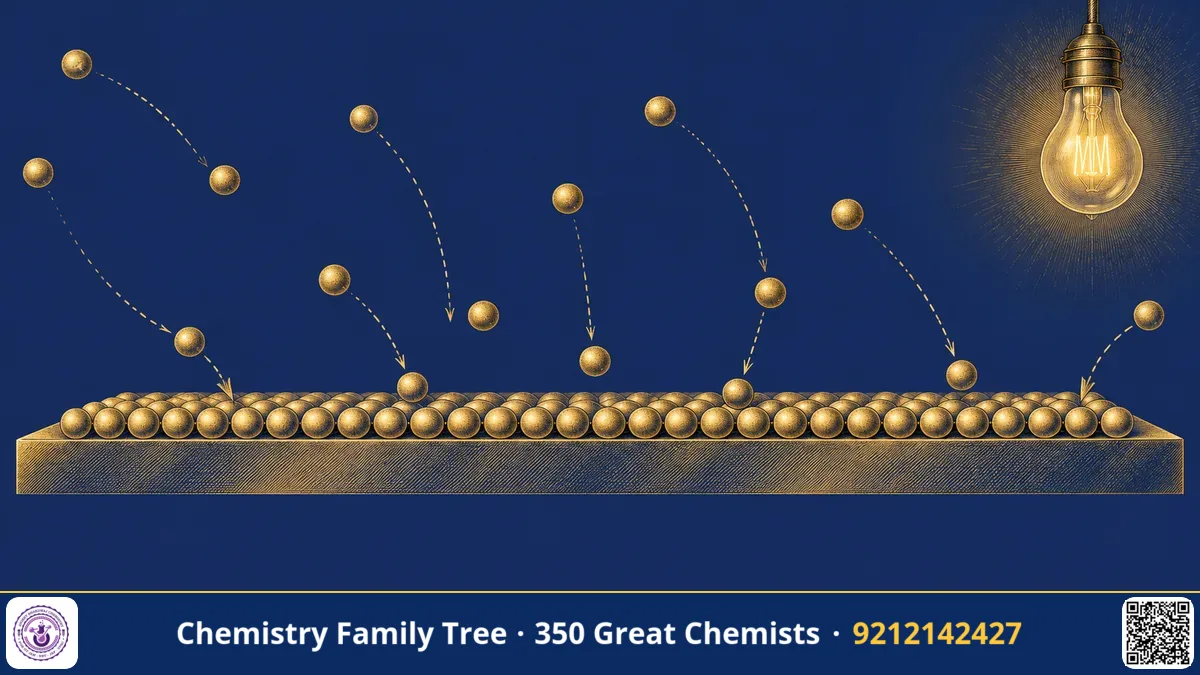
Why does a gas stick to charcoal? How does a catalyst speed up a reaction? Why does a thin film of oil spread on water? All of these questions concern what happens at a surface, and the American chemist Irving Langmuir did more than anyone to answer them. In 1916 he proposed a simple, clear model of adsorption, now called the Langmuir adsorption isotherm. In 1932 he received the Nobel Prize in Chemistry "for his discoveries and investigations in surface chemistry". His work connects light bulbs, catalysts, soap films and even weather modification, and the Langmuir isotherm is a standard question for every physical chemistry examination.
The Scientific Problem Before the Discovery
By the early twentieth century, chemists knew that solids can take up gases on their surfaces, a process called adsorption. Charcoal could remove colours and gases, and finely divided platinum helped reactions. The empirical relation of Freundlich described the data:
x/m = k P1/n
Here x/m is the mass of gas adsorbed per unit mass of adsorbent and P is pressure. This works over a limited range, but it does not explain why adsorption levels off at high pressure, and it gives no physical picture of the surface. Further, scientists did not agree on whether the adsorbed layer was one molecule thick or many layers thick.
Langmuir was working at the General Electric Research Laboratory, and his problems were practical. He studied why tungsten filaments in lamps blackened the glass, how residual gases attacked the metal, and how gases behave when they touch a hot filament in a vacuum. These studies gave him very careful experimental knowledge of surfaces.
The Discovery: The Langmuir Model
In 1916 Langmuir published his theory of adsorption on solids, based on a small number of clear assumptions:
- The surface has a fixed number of identical adsorption sites.
- Each site can hold only one gas molecule, so adsorption is limited to a monolayer.
- There is no interaction between adsorbed molecules, so the energy of adsorption is the same for every site.
- Adsorption is a dynamic equilibrium: molecules constantly stick and leave.
At equilibrium, the rate of adsorption equals the rate of desorption. If θ is the fraction of sites covered:
ka P (1 − θ) = kd θ
Solving for θ with K = ka/kd gives the Langmuir isotherm:
θ = KP / (1 + KP)
This can be written for the amount adsorbed as x/m = (x/m)max × KP/(1 + KP), and in linear form as P/(x/m) = 1/(K(x/m)max) + P/(x/m)max. A plot of P/(x/m) against P is a straight line, from which both constants are found.
The Chemistry Behind It
The isotherm has two limiting forms, which students should know well:
| Pressure range | Limit | Result |
|---|---|---|
| Low pressure (KP << 1) | θ ≈ KP | Adsorption directly proportional to pressure (first order) |
| Intermediate | Full expression | Curve bending towards saturation |
| High pressure (KP >> 1) | θ → 1 | Surface saturated; amount adsorbed independent of pressure (zero order) |
This explains why the rate of a surface-catalysed reaction can be first order at low pressure and zero order at high pressure. In the Langmuir–Hinshelwood mechanism, two reactants adsorb on the surface and react there, a model developed from Langmuir's ideas. Take, for example, the decomposition of ammonia on tungsten, which is zero order since the surface is saturated.
Physisorption and chemisorption. Langmuir's model fits chemisorption best, where a strong chemical bond forms and only one layer is possible (ΔH about −40 to −400 kJ/mol). Physisorption, held by weak van der Waals forces (ΔH about −20 to −40 kJ/mol), can form multiple layers, and this is described by the BET isotherm of Brunauer, Emmett and Teller (1938), which extends Langmuir's idea.
Monolayers on water. Langmuir also studied insoluble films of fatty acids on water. He showed that molecules such as stearic acid, C₁₇H₃₅COOH, stand upright with the polar –COOH head in water and the long hydrocarbon tail pointing up. By compressing a film in a trough, he found the cross-sectional area of a molecule. With Katharine Blodgett he showed how to transfer such films layer by layer onto solid slides, giving the Langmuir–Blodgett films now used in nanotechnology.
Applications Today
- Catalysis: the Haber process, catalytic converters in cars, hydrogenation of oils with nickel, and many other industrial processes depend on adsorption on solids. Catalytic converters are mandatory in Indian vehicles under Bharat Stage emission norms.
- Water and air purification: activated charcoal in water filters and gas masks removes impurities by adsorption.
- Lighting: Langmuir's gas-filled tungsten lamp, using nitrogen or argon in place of vacuum, made incandescent bulbs brighter and longer-lasting.
- Sensors and thin films: Langmuir–Blodgett films are used in biosensors, coatings and molecular electronics.
- Surface area measurement: adsorption isotherms, including BET, are used to measure the surface area of catalysts, drugs and cement.
- Cloud seeding: Langmuir and his colleagues Vincent Schaefer and Bernard Vonnegut studied how dry ice and silver iodide particles can start ice crystal growth in clouds, in the 1940s.
Exam Corner
- Langmuir isotherm: θ = KP/(1 + KP); monolayer adsorption on a uniform surface with no interaction between adsorbate molecules.
- At low pressure the adsorption is proportional to P; at high pressure, it becomes independent of P (saturation).
- Freundlich: x/m = kP1/n; the log plot of x/m against P is linear with slope 1/n.
- Chemisorption is irreversible, specific, forms a monolayer and increases with temperature at first; physisorption is reversible, non-specific, multilayer and decreases with increasing temperature.
- Langmuir coined the terms "covalence" and "isoelectronic" (as "isosteric") in his bonding work, and introduced the word "plasma" for ionised gas.
Common Misconceptions
- "Adsorption and absorption are the same." Adsorption occurs on the surface; absorption occurs throughout the bulk.
- "The Langmuir isotherm works for all systems." It assumes an ideal, uniform surface. Real surfaces are heterogeneous, and multilayers form at high pressures.
- "Adsorption is endothermic." It is exothermic, since the system loses freedom (ΔS is negative), so ΔH must be negative for it to occur spontaneously.
Quick Revision Box
- Langmuir isotherm proposed in 1916; Nobel Prize in Chemistry in 1932.
- Assumptions: identical sites, monolayer, no lateral interaction, dynamic equilibrium.
- θ = KP/(1 + KP); linear plot of P/(x/m) against P.
- Low P: first order; high P: zero order.
- Multilayer extension: BET isotherm.
- Langmuir–Blodgett films: monolayers transferred from water to a solid.
FAQ
What does the constant K represent in the Langmuir isotherm?
It is the ratio of the rate constants of adsorption and desorption, and measures how strongly the gas binds to the surface. It depends on temperature.
Why does the isotherm level off?
Because all the available sites become filled. Once the monolayer is complete, more pressure cannot increase adsorption.
How is the Langmuir isotherm related to catalysis?
It describes how reactants cover a catalyst surface and helps to explain the change of reaction order with pressure.
Is Langmuir the same as Lewis?
No. Langmuir developed and popularised Lewis's electron-pair ideas in 1919, but his main fame is in surface chemistry.
Published by ABC Chemistry — IIT-JAM | CSIR-NET | GATE Chemistry Coaching. Visit abcchemistry.com

About the chemist
Irving Langmuir
1881-1957 · United States · Nobel Chemistry 1932
Surface chemistry; adsorption isotherm