Biography · Chemist no. 19 of 350
Irving Langmuir: The Industrial Scientist Who Explored Surfaces and the Sky
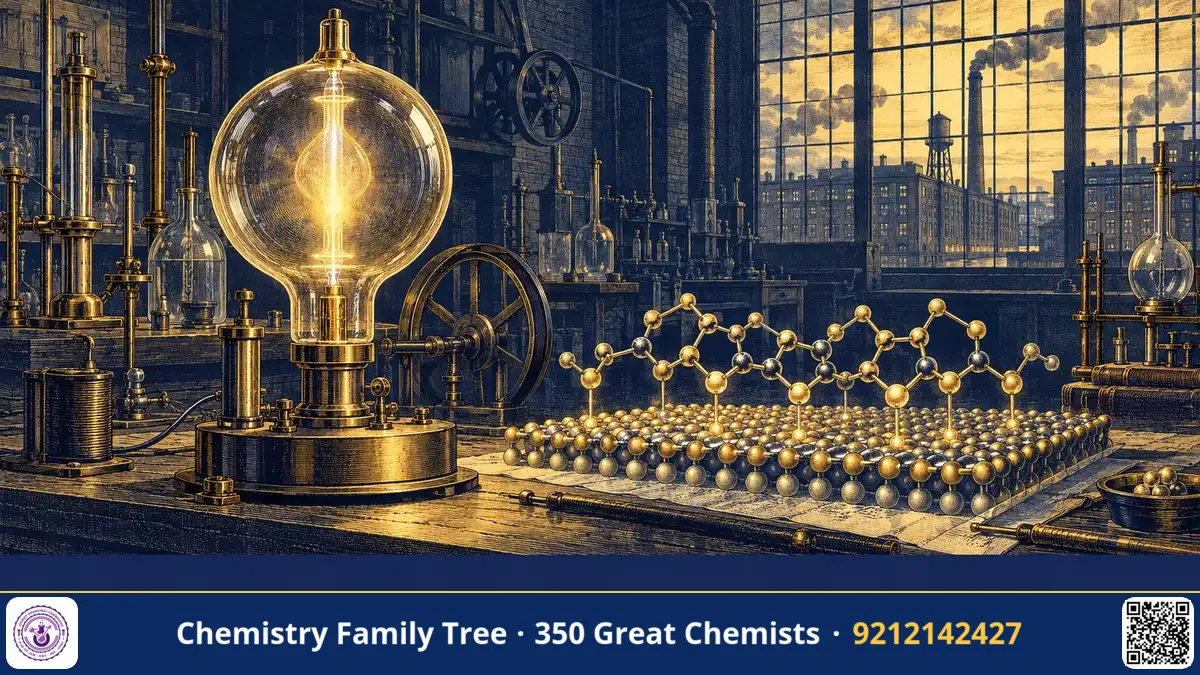
Irving Langmuir (1881–1957) was an American chemist and physicist who spent most of his career at the General Electric Research Laboratory. He won the 1932 Nobel Prize in Chemistry for his work on surface chemistry, and his name is attached to the Langmuir adsorption isotherm, the Langmuir–Blodgett film, the Langmuir probe and many other tools of science. He proved that industry can be a home for deep, curiosity-driven research. His legacy lives in light bulbs, catalysts, thin films and the study of plasma.
Early Life and Family
Irving Langmuir was born on 31 January 1881 in Brooklyn, New York, the third of four sons in his family. His father, Charles Langmuir, worked for an insurance company, and his mother, Sadie, was a homemaker. The family travelled to Europe for some years, and Irving attended school in Paris for a time, learning French and German. He developed a lifelong curiosity about nature, influenced by his older brother Arthur, who was a chemist, and he was encouraged to observe and to make careful notes.
Langmuir married Marion Mersereau in 1912. They adopted two children, Kenneth and Barbara. He was a keen outdoorsman who enjoyed mountaineering, skiing and flying, and he learned to pilot an aeroplane.
Education and Mentors
He studied metallurgical engineering at the Columbia School of Mines in New York and graduated in 1903. He then went to Germany to study at the University of Göttingen, where his doctoral adviser was Walther Nernst, the thermodynamicist. Langmuir received his doctorate in 1906 with a thesis on the dissociation of gases near a hot platinum wire. This work drew his interest to reactions on hot surfaces and in gases at low pressures, a theme which stayed with him all his life. After returning to the United States, he taught chemistry at the Stevens Institute of Technology in Hoboken, New Jersey, for three years.
Career Timeline
| Year | Event |
|---|---|
| 1881 | Born in Brooklyn, New York, 31 January |
| 1903 | Graduates from Columbia School of Mines |
| 1906 | Doctorate from Göttingen under Walther Nernst |
| 1906–1909 | Instructor at Stevens Institute of Technology |
| 1909 | Joins the General Electric Research Laboratory in Schenectady |
| 1913 | Develops the gas-filled tungsten lamp |
| 1916 | Publishes his theory of adsorption on solids |
| 1919 | Extends the electron-pair and octet ideas of G. N. Lewis |
| 1928 | Introduces the word "plasma" for ionised gas |
| 1932 | Awarded the Nobel Prize in Chemistry |
| 1946–1947 | Cloud seeding experiments with Schaefer and Vonnegut |
| 1957 | Dies at Woods Hole, Massachusetts, 16 August |
Major Scientific Contributions
- Gas-filled incandescent lamp. Filling the bulb with an inert gas such as nitrogen or argon slowed the evaporation of the tungsten filament, and coiling the filament improved efficiency.
- Adsorption theory. The Langmuir isotherm, based on monolayer coverage, as explained in our discovery post.
- Monolayer films. Studies of fatty acid films on water, which established that molecules in them stand upright, and the later work with Katharine Blodgett on multilayer films.
- High vacuum technology. He developed the high-vacuum condensation pump and studied electron emission, including the Child–Langmuir law for space-charge-limited current.
- Atomic hydrogen. He studied dissociation of H₂ into atoms at high temperature, which was applied to atomic hydrogen welding.
- Chemical bonding. In 1919 he popularised and extended the shared-pair and octet ideas of G. N. Lewis. He is credited with the word "covalence".
- Plasma physics. He used the term "plasma" and developed the Langmuir probe, a method for measuring the properties of ionised gases.
Awards, Honours and Nobel Prize
Langmuir received the Nobel Prize in Chemistry in 1932 "for his discoveries and investigations in surface chemistry". He was the first industrial scientist to win the chemistry prize. His other honours included the Perkin Medal of the American section of the Society of Chemical Industry, the Franklin Medal, the Faraday Medal, and many honorary degrees. He served as President of the American Chemical Society in 1929 and of the American Association for the Advancement of Science. The American Chemical Society has since named an award in his honour, the Irving Langmuir Prize in Chemical Physics.
Personality, Struggles and Lesser-Known Facts
- Freedom to explore. When Langmuir joined General Electric, he thought he would stay for a short time. He remained because the laboratory's director, Willis Whitney, allowed researchers to follow their curiosity, and Langmuir often said that he did not separate pure and applied science.
- An outdoor life. He enjoyed climbing mountains, skiing and flying aeroplanes, and kept a keen eye on nature. In later years he studied clouds and the weather.
- A famous lecture on "pathological science". In 1953 he gave a talk on how scientists can fool themselves, for example by seeing effects that are barely above the noise level. It is still quoted today as a warning to researchers.
- Disputes about credit. His 1919 papers on electron-pair bonding led to a long argument with G. N. Lewis about priority. Both men made important contributions.
- Weather modification. In his later years, Langmuir became strongly enthusiastic about cloud seeding, and some critics felt that he claimed more success than the evidence supported. It remains a debated area of science.
Legacy and Influence on Modern Chemistry
Surface science is today a huge field, with applications from semiconductor chips to fuel cells. The Langmuir isotherm remains the starting point of every adsorption course. Langmuir–Blodgett techniques are used to build organised molecular films, and the Langmuir probe is a standard tool in plasma physics. The work of Gerhard Ertl, who won the Nobel Prize in Chemistry in 2007 for the study of chemical processes on solid surfaces, follows directly from Langmuir's tradition. His life also supports a belief in basic research within industry, which later laboratories at Bell and other companies followed.
Lessons for Students
- Practical problems can lead to deep science. A blackening light bulb led to a Nobel Prize.
- Be honest about error. Langmuir's lecture on pathological science teaches us to doubt our own results.
- Work across fields. He used chemistry, physics and engineering together.
- Credit your collaborators, such as Katharine Blodgett, who developed the multilayer film technique.
Quick Facts Box
- Born: 31 January 1881, Brooklyn, New York, USA
- Died: 16 August 1957, Woods Hole, Massachusetts, USA
- Nationality: American
- Field: Surface chemistry, physical chemistry, plasma physics
- Famous for: Langmuir adsorption isotherm, gas-filled lamp, monolayers, plasma
- Nobel: Chemistry, 1932
FAQ
Where did Langmuir work?
Most of his career was at the General Electric Research Laboratory in Schenectady, New York, which he joined in 1909.
What is a Langmuir probe?
It is a small electrode placed in a plasma. By measuring current against voltage, scientists can find the plasma's density and temperature.
Who was Katharine Blodgett?
She was a General Electric scientist who worked with Langmuir and developed methods for depositing monolayer films onto solid surfaces, which led to non-reflective glass coatings.
Was Langmuir a teacher?
He taught for three years at Stevens Institute, and later gave many lectures, but he is mainly remembered as a research scientist in industry.
Published by ABC Chemistry — IIT-JAM | CSIR-NET | GATE Chemistry Coaching. Visit abcchemistry.com
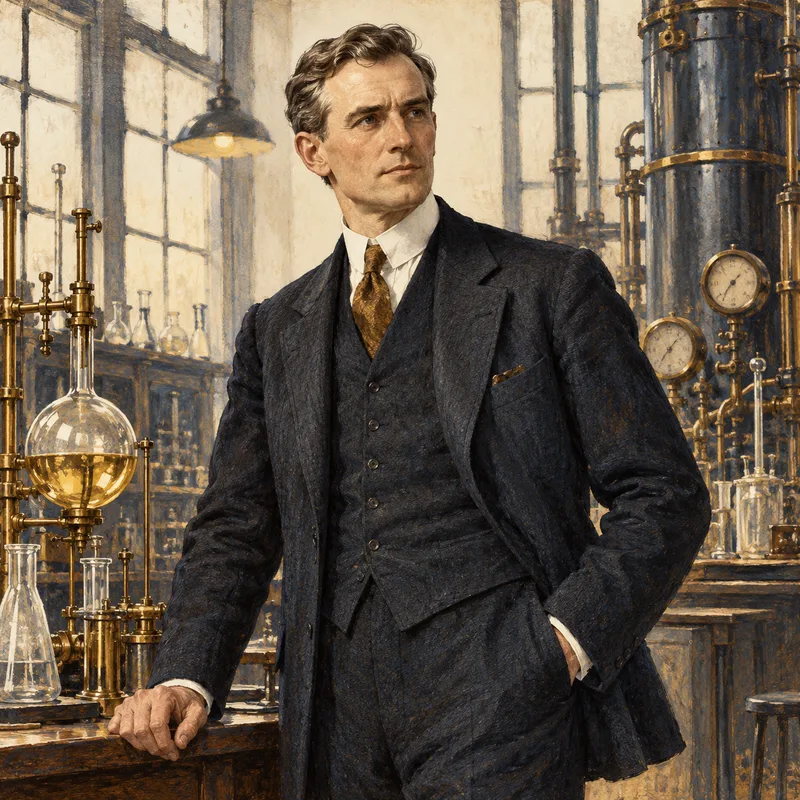
About the chemist
Irving Langmuir
1881-1957 · United States · Nobel Chemistry 1932
Surface chemistry; adsorption isotherm