The discovery, explained · Chemist no. 309 of 350
Izaak Kolthoff: Turning Analytical Chemistry into a Science
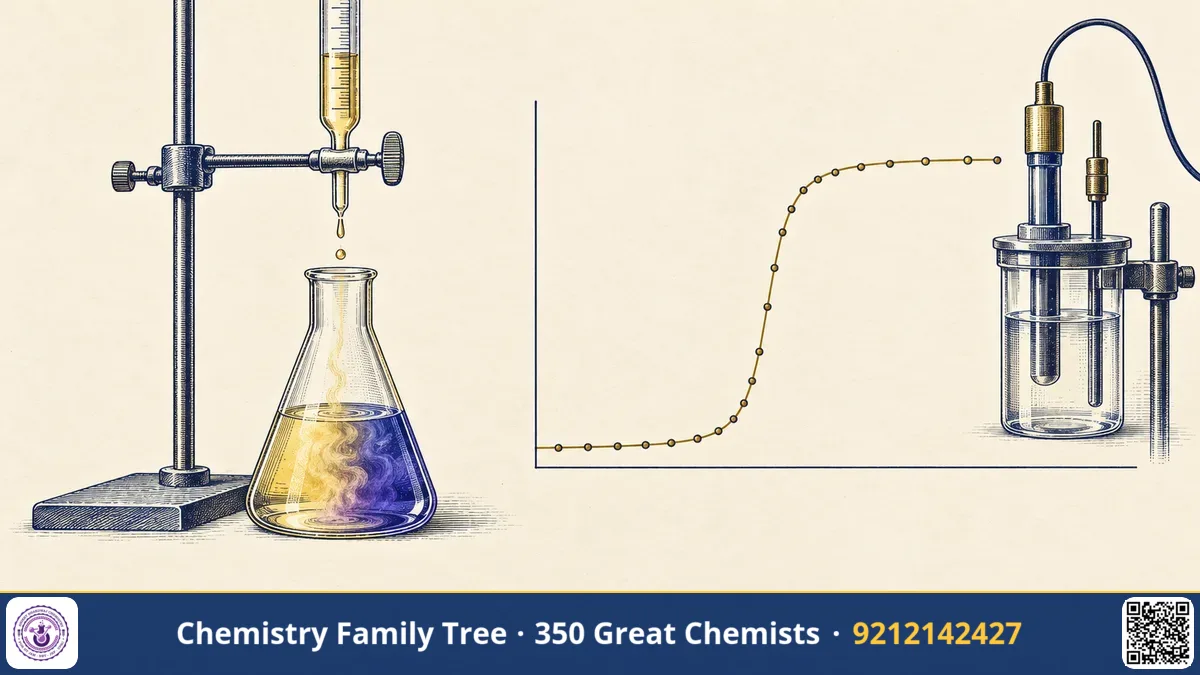
When you titrate a strong acid against a strong base and choose phenolphthalein, or when you plot a polarogram and read the half-wave potential, you are using ideas that Izaak Maurits Kolthoff helped turn into a rigorous science. Before the twentieth century, analytical chemistry was often treated as a collection of recipes. Kolthoff, a Dutch-born chemist who later worked at the University of Minnesota, asked "why" each step works. He studied indicators, acid-base equilibria in water and non-aqueous solvents, the growth and purity of precipitates, electroanalytical methods such as potentiometry and polarography, and even synthetic rubber. For this reason he is often called the "father of modern analytical chemistry".
The Scientific Problem Before the Discovery
In the early 1900s, analytical methods such as gravimetric analysis and volumetric (titrimetric) analysis were widely used in industry and in laboratories. But the explanations were weak. Questions included:
- How do indicators change colour, and why does each one work only in a certain pH range?
- Why do precipitates carry down impurities (coprecipitation), and how can one get a pure precipitate?
- How can one follow a titration when there is no indicator, or the solution is coloured?
- How can very small amounts of metal ions be measured?
The mathematical language of ionic equilibria (Ostwald's dilution law, Nernst equation, Debye–Hückel theory) was available, but it had not yet been systematically applied to the practical problems of analysis. This was the gap that Kolthoff filled.
The Discoveries: Step by Step
1. Theory of acid-base indicators and titration curves
Kolthoff explained indicators as weak acids or bases whose acid and base forms have different colours. For an indicator HIn:
HIn ⇌ H⁺ + In⁻
pH = pKin + log ([In⁻]/[HIn])
The colour change is visible roughly when the ratio [In⁻]/[HIn] goes from 1/10 to 10/1, so the useful range is pH = pKin ± 1. He showed how to choose an indicator by plotting the titration curve, a graph of pH against volume of titrant. The pH changes sharply near the equivalence point, and the indicator range must lie within this steep region:
| Titration | pH at equivalence | Suitable indicator |
|---|---|---|
| Strong acid with strong base | 7 | Methyl orange, methyl red, phenolphthalein |
| Weak acid with strong base (CH₃COOH with NaOH) | above 7 (about 8.7) | Phenolphthalein (8.3–10) |
| Weak base with strong acid (NH₃ with HCl) | below 7 (about 5) | Methyl orange (3.1–4.4) or methyl red |
| Weak acid with weak base | near 7, no sharp change | None sharp; use instrumental methods |
He also worked on buffers and the measurement of pH with the hydrogen and glass electrodes, using the relation pH = pKa + log([A⁻]/[HA]), the Henderson–Hasselbalch equation.
2. Precipitation, ageing and coprecipitation
Kolthoff studied how precipitates form, how their particle size depends on supersaturation, and how impurities are carried down. The key practical ideas were:
- Von Weimarn ratio: relative supersaturation = (Q − S)/S. Low supersaturation favours large, pure crystals; high supersaturation gives tiny colloidal particles.
- Digestion (ageing) and Ostwald ripening: small particles dissolve and re-deposit on larger ones, producing purer, more filterable crystals.
- Coprecipitation: surface adsorption, occlusion and mixed-crystal formation. Washing and reprecipitation reduce errors.
- Precipitation from homogeneous solution: generating the precipitating agent slowly in the solution (for example, urea hydrolysis to raise pH) to obtain dense precipitates.
3. Electroanalytical methods: potentiometry and polarography
Kolthoff used electrode potentials to follow titrations, so that endpoints could be found even in coloured solutions. The potential follows the Nernst equation:
E = E° + (0.0592 / n) log ([Ox]/[Red]) at 25 °C
In the 1930s, he became interested in the polarography developed by Jaroslav Heyrovský, who won the Nobel Prize in Chemistry in 1959. In this method, a dropping mercury electrode is used and the current is measured as the voltage is changed. The resulting S-shaped curve gives the half-wave potential E½, which identifies the ion, and the limiting diffusion current, which is proportional to concentration (Ilkovič equation: i_d = 607 n D^½ m^⅔ t^⅙ C). Kolthoff and James Lingane wrote the classic book "Polarography" (1941), which made the method widely known in the English-speaking world.
4. Non-aqueous solvents and polymer chemistry
Kolthoff also studied acids and bases in non-aqueous solvents such as acetic acid and acetonitrile, which makes it possible to titrate very weak bases such as amines using perchloric acid in glacial acetic acid. During the Second World War, he led research at Minnesota on emulsion polymerisation, helping to develop the "cold rubber" process for synthetic styrene–butadiene rubber (GR-S), which was important when natural rubber supplies were cut off.
The Chemistry Behind It
The central message is that analytical procedures are applications of equilibrium and kinetics. For a precipitate, the solubility product Ksp = [Mⁿ⁺]ᵐ[Xᵐ⁻]ⁿ sets the limit, while the conditions of precipitation set purity. For a titration, the equivalence-point pH is given by the hydrolysis of the salt formed. For a weak acid titrated with strong base at the equivalence point:
pH = 7 + ½ pKa + ½ log C (C = concentration of the salt)
For instrumental methods, the signal (colour, current, potential) is converted into concentration using a calibration based on physical laws.
Applications Today
- Pharmaceutical quality control: Non-aqueous titrations of amine drugs, as in Indian Pharmacopoeia assays, and potentiometric titrations.
- Environmental monitoring: Voltammetric methods, the descendants of polarography, such as anodic stripping voltammetry, detect lead, cadmium and arsenic in drinking water at very low levels.
- Industry: Gravimetric methods for sulphate, chloride and nickel; titrations for hardness of water with EDTA.
- Medicine: Blood pH and electrolyte analysis use ion-selective electrodes.
- Rubber and plastics: Emulsion polymerisation is still used for tyres, latex and paints.
Exam Corner: 5 Likely Points
- Indicator range = pKin ± 1; phenolphthalein for weak acid vs strong base, methyl orange for weak base vs strong acid.
- Large crystals form at low relative supersaturation (Von Weimarn); digestion improves purity and filterability.
- Coprecipitation types: surface adsorption, occlusion, inclusion (mixed crystals).
- Polarography: dropping mercury electrode, E½ is qualitative, diffusion current id is quantitative (Ilkovič); supporting electrolyte removes migration current; oxygen is removed by N₂ purging.
- Non-aqueous titrations use solvents such as glacial acetic acid to enhance the basicity of weak bases.
Common Misconceptions
- "The endpoint and the equivalence point are the same." The equivalence point is theoretical; the endpoint is the observed signal. The difference is the titration error.
- "A bigger pH jump needs a stronger indicator." The indicator must match the pH of the jump; strength is not the key.
- "Polarography is obsolete." The classical form is rarely used, but modern voltammetry and sensors use the same principles.
Quick Revision Box
- Kolthoff made analytical chemistry theory-based: indicators, titration curves, precipitation, electroanalysis.
- Indicator range: pH = pKin ± 1.
- Von Weimarn: relative supersaturation (Q − S)/S controls particle size.
- Polarography: E½ identifies, id is proportional to concentration.
- Book "Polarography" with Lingane (1941); Heyrovský won the 1959 Nobel Prize in Chemistry.
- Helped develop GR-S synthetic rubber in the Second World War.
FAQ
Why is Kolthoff called the father of modern analytical chemistry?
He placed analytical methods on a firm theoretical footing and trained a large school of students and co-workers who led the field.
What is the half-wave potential?
It is the potential at which the current is half of the limiting diffusion current. It is characteristic of the reducing species and is almost independent of concentration.
Why do we use a supporting electrolyte in polarography?
It carries most of the current and eliminates the migration of the analyte ions, leaving diffusion as the only transport process.
How does Kolthoff's work help in Indian exams?
Titration curves, indicator selection, precipitation conditions and polarography are standard topics in analytical chemistry for JAM, NET and GATE.
Published by ABC Chemistry — IIT-JAM | CSIR-NET | GATE Chemistry Coaching. Visit abcchemistry.com
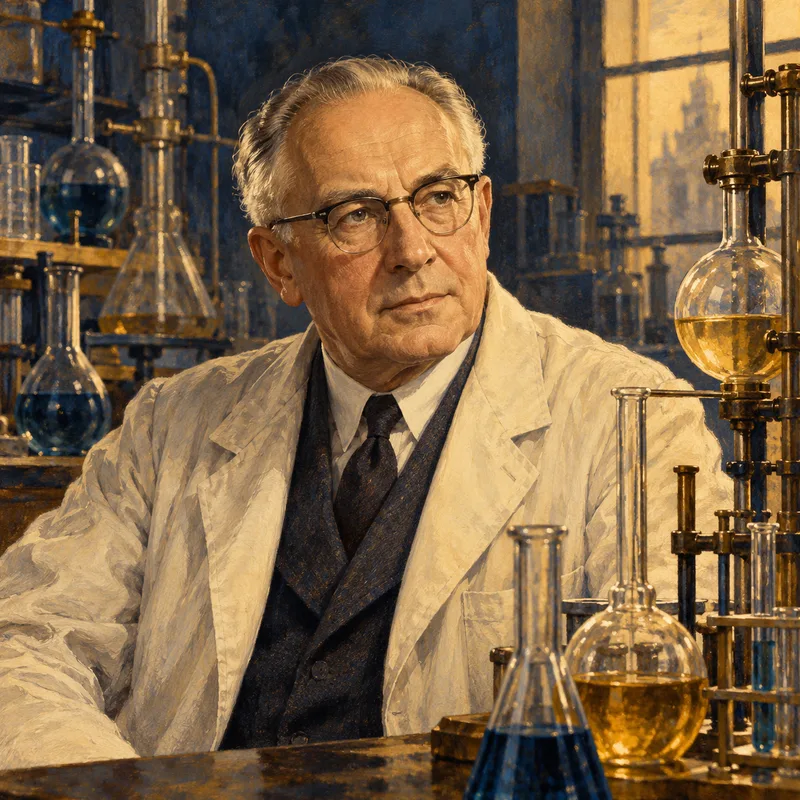
About the chemist
Izaak Kolthoff
1894-1993 · Netherlands
Founder of modern analytical chemistry; potentiometry