Biography · Chemist no. 309 of 350
Izaak Maurits Kolthoff (1894–1993): The Man Who Made Analytical Chemistry a Science
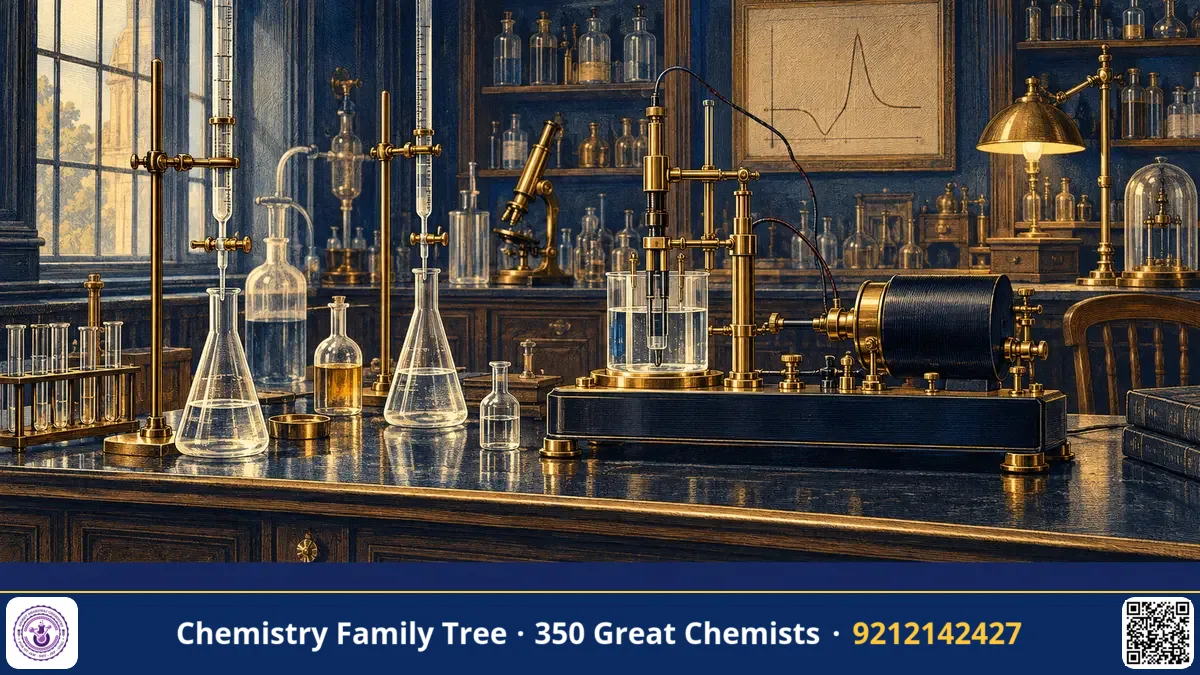
Izaak Maurits Kolthoff was a Dutch-born American chemist who lived to the age of 99 and who shaped analytical chemistry for most of the twentieth century. Through his research, his textbooks and his many students, he turned a craft of recipes into a field built on thermodynamics, kinetics and electrochemistry. His legacy in one line: he showed that every analytical method can be understood, improved and trusted because we know why it works.
Early Life and Family
Kolthoff was born on 11 February 1894 in Almelo, a town in the east of the Netherlands. He grew up in a Dutch family at a time when the Netherlands had a strong tradition in physical chemistry, thanks to van 't Hoff, Bakhuis Roozeboom and others. He was a diligent student with an interest in chemistry from his school years. Details of his family are not widely documented and are not repeated here.
Education and Mentors
Kolthoff studied pharmacy and chemistry at the University of Utrecht, where he earned his doctorate in 1918. His thesis was on the theory of acid-base indicators, which became one of the topics of his life. He stayed at Utrecht as a teacher and researcher after his doctorate. His Dutch education, with its strong physical-chemical foundation, shaped his belief that analytical chemistry should be based on solid theory.
Career Timeline
| Year | Event |
|---|---|
| 1894 | Born in Almelo, the Netherlands |
| 1918 | Doctorate at Utrecht University |
| 1920s | Teaches and researches at Utrecht; writes analytical texts |
| 1927 | Moves to the University of Minnesota, USA, as professor of analytical chemistry |
| 1941 | Publishes "Polarography" with James J. Lingane |
| 1940s | Leads wartime research on emulsion polymerisation and synthetic rubber |
| 1993 | Dies in Minnesota, aged 99 |
Major Scientific Contributions
Indicators and acid-base theory. His doctoral work and later studies explained indicator colour changes, optimum ranges and titration curves, including those in non-aqueous solvents. He also worked on the measurement of pH and on buffer solutions.
Precipitation and coprecipitation. He demonstrated how crystal size, purity and filterability depend on conditions such as supersaturation, temperature and ageing. His ideas on adsorption and occlusion are still used to teach gravimetric analysis.
Electroanalytical chemistry. He promoted potentiometric titration, conductometric methods and, together with Lingane, polarography, which was invented by the Czech chemist Jaroslav Heyrovský. His book "Polarography" educated a generation. The detailed chemistry is covered in the companion discovery article.
Synthetic rubber. During the Second World War, the supply of natural rubber to the Allies was threatened. Kolthoff's group at Minnesota worked on the emulsion polymerisation of styrene and butadiene and on the use of redox initiators, helping to make a low-temperature ("cold rubber") process practical. This was a notable example of an analytical chemist applying his skills to polymer science.
Books and training. He wrote or co-wrote many books, including "Volumetric Analysis" and, with E. B. Sandell, "Textbook of Quantitative Inorganic Analysis", which was used around the world for many years, along with texts on electrochemistry and acid-base titrations. He trained dozens of PhD students who held leading positions in universities and industry.
Awards, Honours and Nobel Prize
Kolthoff did not receive a Nobel Prize, but he was honoured many times, and he is regarded as one of the greatest analytical chemists of all time. He received honorary degrees and awards from scientific societies in the United States and Europe, and he was a member of national academies. Because the exact names and years cannot be verified from memory, they are not listed here. The most visible honour is that analytical chemists regularly refer to him as the "father of modern analytical chemistry".
Personality, Struggles and Lesser-Known Facts
- A long life. He lived to be 99 years old and was part of analytical chemistry for most of the twentieth century.
- Move across the ocean. His move to the United States in 1927 took him away from the Dutch scientific community he knew well, but he soon created a new school in Minnesota.
- Demanding but devoted teacher. Former students describe him as a hard-working mentor who expected high standards and who followed the careers of his students closely.
- Wartime contribution. The synthetic rubber programme gave a theoretical chemist a practical role in the Allied war effort.
- Bridge between Europe and America. He helped introduce European ideas, such as polarography and Debye–Hückel theory, into American analytical teaching.
Legacy and Influence on Modern Chemistry
Many of the leading US analytical chemists of the following generation were his students or colleagues, including James Lingane and Philip Elving, and they spread his approach across universities. Techniques such as stripping voltammetry, ion-selective electrodes and modern titrators trace their roots to the theoretical discipline he built. Every time a student draws a titration curve and chooses an indicator based on pH range, he or she follows a method he helped define. In India, analytical chemistry in the M.Sc. syllabus and in pharmaceutical quality control rests on this foundation.
Lessons for Students
- Ask why. Understand the reason behind every step in an experiment.
- Combine theory with practice. Kolthoff linked equilibrium theory with the bench.
- Write clearly. His books spread his ideas worldwide.
- Be willing to change fields. An analytical chemist helped make synthetic rubber.
Quick Facts Box
- Born: 11 February 1894, Almelo, Netherlands
- Died: 1993, Minnesota, USA
- Nationality: Dutch-born, later American
- Field: Analytical and physical chemistry
- Famous for: Theory of indicators and titrations, precipitation, polarography textbook, synthetic rubber research
- Nobel: None
FAQ
Why is Kolthoff important to analytical chemistry students?
Because the theory of titrations, indicators, precipitation and electroanalysis that you study was largely shaped by his research and textbooks.
Did Kolthoff invent polarography?
No. Jaroslav Heyrovský invented it and won the Nobel Prize in Chemistry in 1959. Kolthoff and Lingane were major promoters and authors of the standard text in English.
Which university did he work at for most of his career?
He worked at the University of Minnesota, where he had been a professor since 1927.
What was his role in the Second World War?
He led research on emulsion polymerisation that helped create synthetic rubber when natural rubber was in short supply.
Published by ABC Chemistry — IIT-JAM | CSIR-NET | GATE Chemistry Coaching. Visit abcchemistry.com
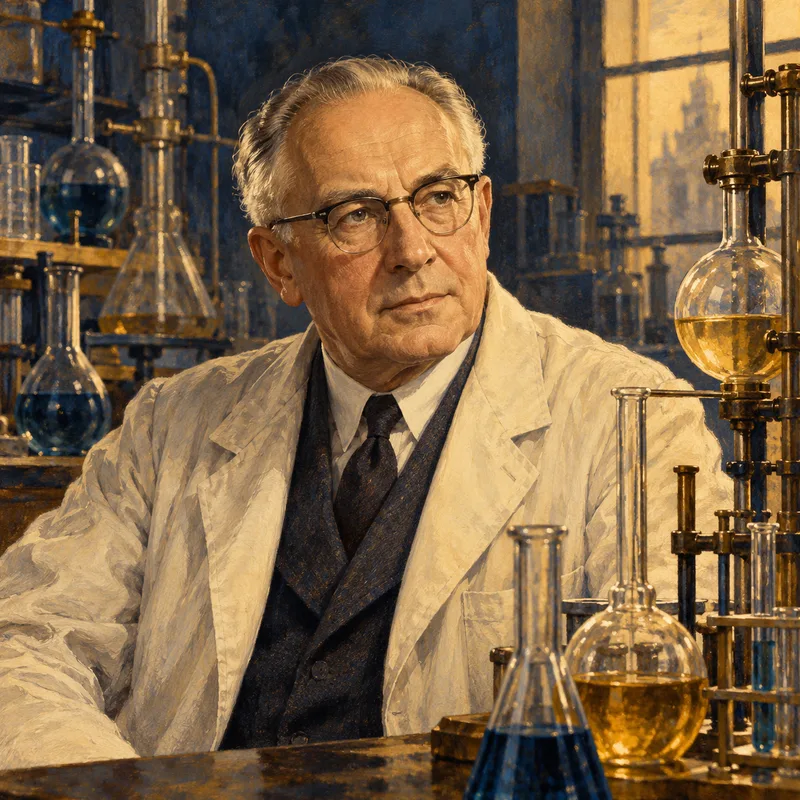
About the chemist
Izaak Kolthoff
1894-1993 · Netherlands
Founder of modern analytical chemistry; potentiometry