Biography · Chemist no. 231 of 350
Jabir ibn Hayyan: The Life, the Legend and the Legacy of "Geber"
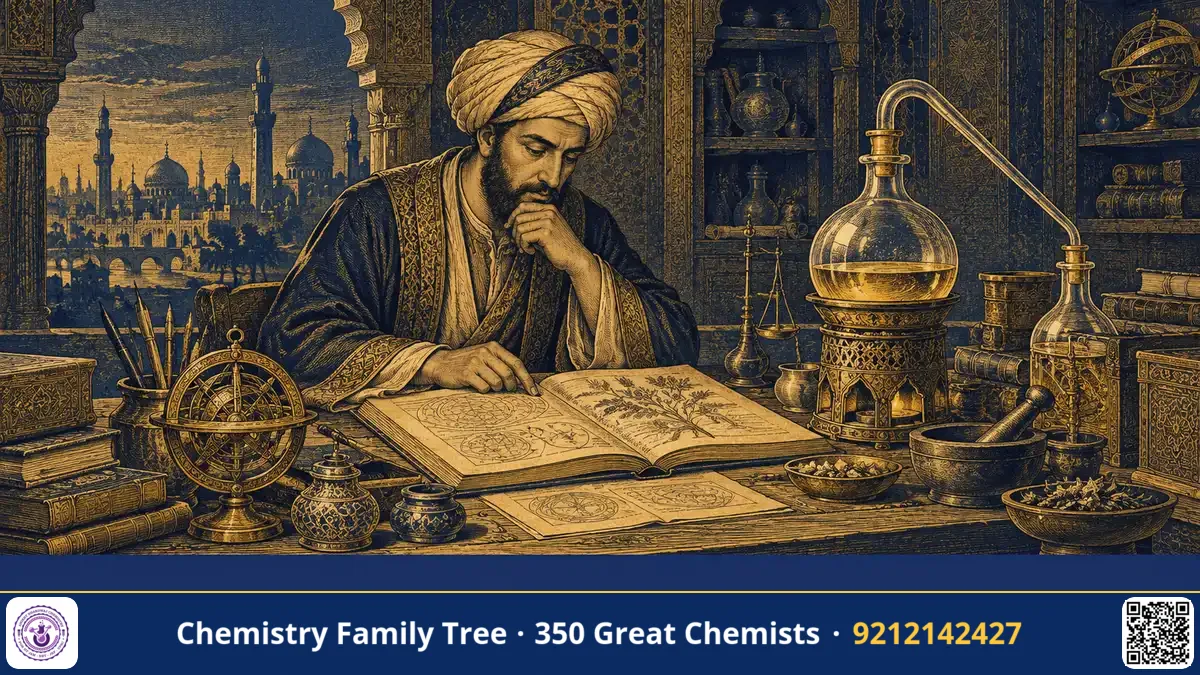
Few names in chemistry carry as much fame and as much mystery as Jabir ibn Hayyan. Medieval writers called him the master of alchemy; Europe knew him as Geber; modern textbooks often call him a father of chemistry. Yet historians cannot even agree on how many books he wrote. This biography keeps two lists apart: what the traditions say, and what scholars can support. His one-line legacy is simple: the writings in his name helped turn craft recipes into an organised laboratory science.
Early Life and Family
Tradition: Later biographers say Jabir was born around 721 CE (the CSV for this series gives c. 721–815), in or near Tus in Khorasan, now in north-eastern Iran. His father, Hayyan, is said to have been a druggist or pharmacist who supported the Abbasid cause and was executed for it; the young Jabir was then raised in Arabia and later lived in Kufa, in present-day Iraq. Some accounts instead place his family in the Yemeni tribe of Azd.
History: Almost none of this can be verified from sources written during his lifetime. Even the dates are traditional. Scholars therefore treat the biography as partly reconstructed. What is firmly known is that a large body of Arabic scientific writing appeared under his name in the 9th and 10th centuries.
Education and Mentors
Medieval sources describe Jabir as a student of the imam Ja'far al-Sadiq in Medina and as a pupil of earlier teachers in medicine and Greek learning. The Jabirian texts themselves refer to an early master, and they draw on Greek ideas of Aristotle, on the Hermetic tradition and on the practical experience of Egyptian and Syrian craftsmen. Because the Ja'far connection appears in texts that were written for the Ismaili and Shia readership, historians are cautious about it. A safe statement is that the corpus belongs to the intellectual world of Baghdad and Kufa, where Greek texts were being translated into Arabic.
Career Timeline
| Year | Event |
|---|---|
| c. 721 (traditional) | Birth, traditionally in Tus, Khorasan. |
| Late 8th century | Said to have worked in Kufa and in Baghdad under the patronage of the Barmakid family, viziers of Harun al-Rashid (tradition). |
| c. 815 (traditional) | Death, traditionally in Kufa or Tus. |
| 9th–10th century | Main body of Arabic Jabirian writings composed by a school of authors. |
| 1940s | Paul Kraus catalogues and analyses the corpus, showing its layered structure. |
| 13th–14th century | Latin works under the name Geber, including the Summa perfectionis, written in Europe. |
| 1678 | Richard Russell's English translation of Latin Geber books (published as "The Works of Geber") circulates. |
Major Scientific Contributions
The corpus is known for several themes, explained in more detail in our discovery post on Jabir:
- Sulfur-mercury theory: metals are composed of two principles in different proportions, with gold as the most balanced.
- Classification: substances grouped as spirits, metals and non-malleable bodies according to their behaviour on heating.
- Laboratory method: detailed descriptions of distillation, sublimation, calcination, crystallisation and filtration, with a strong statement that knowledge must come from practice.
- The balance: a theory of proportions among natures in substances, an early (though non-quantitative) step towards composition.
- Materials: preparations involving metals, salts such as sal ammoniac and compounds of arsenic and antimony.
A simple example for students: NH₄Cl ⇌ NH₃ + HCl is a reversible sublimation process that alchemists used and described, and that you still meet in qualitative analysis.
Awards, Honours and Nobel Prize
There was no Nobel Prize in his era, and no formal awards or institutional honours. His recognition is historical: his name became a byword for alchemy across the Islamic world and Europe, and the Latinised "Geber" attached itself to some of the most widely read chemical books of the Middle Ages. Students sometimes meet a claim that the English word "gibberish" comes from Geber; linguists regard this as uncertain, so do not use it in an exam. In modern times he is often called the "father of chemistry", which is a popular title and not a formal honour.
Personality, Struggles and Lesser-Known Facts
- A deliberately obscure style. The texts often use code words and scatter information across several books so that only a trained reader could assemble a procedure. This secrecy is part of why they are difficult.
- Patronage and politics. Tradition ties Jabir to the Barmakid viziers; when that family fell from power in 803, he is said to have suffered too and spent his last years in obscurity.
- Artificial generation (takwin). Some texts discuss making living beings in the laboratory. This is symbolic or speculative and not a documented experiment.
- The 3000-book claim. Medieval catalogues speak of thousands of treatises. Surviving works number in the hundreds of titles, which supports the school theory.
- Two Jabirs. The Arabic Jabir and the Latin pseudo-Geber are different authors, separated by centuries.
Legacy and Influence on Modern Chemistry
The Arabic words that enter English tell the story: alchemy, alembic, alkali, alcohol, elixir, antimony, soda, and many more. The Latin Geber texts were among the most read chemical treatises in Europe before Paracelsus, and Newton and Boyle read them. The sulfur-mercury theory was eventually replaced, but the insistence on classification, repeatable procedure and apparatus design remained. When you draw a distillation setup in your practical file, you are using a drawing tradition that began in this era.
Lessons for Students
- Separate legend from evidence. A good scientist asks, "What is the source?" before accepting a claim.
- Methods outlive theories. The theory of metals failed; the laboratory techniques survived.
- Record procedures clearly. The Jabirian texts were hard to use because they hid details. Modern science rewards the opposite.
- Science is a shared story. The development of chemistry passed through Greek, Arabic and Latin hands.
Quick Facts Box
- Born: c. 721 CE (traditional), possibly Tus, Khorasan
- Died: c. 815 CE (traditional), Kufa or Tus
- Nationality: Persian/Arab world of the Abbasid era (identity debated)
- Field: Alchemy, early chemistry
- Famous for: Sulfur-mercury theory, classification, laboratory methods
- Nobel Prize: None (pre-dates the prize)
FAQ
Where was Jabir ibn Hayyan born?
Tradition says Tus in Khorasan, though some accounts mention Kufa or Harran. There is no first-hand record.
Who was Geber?
"Geber" is the Latinised form of Jabir. The Latin books under that name were written in Europe later and are usually attributed to an author called pseudo-Geber.
Did Jabir invent distillation?
No single person invented it. The corpus describes the alembic and refined its use, building on Greek and Egyptian practice.
Why does his date of death vary?
All dates come from later biographers. Treat c. 721–815 as traditional and approximate.
Published by ABC Chemistry — IIT-JAM | CSIR-NET | GATE Chemistry Coaching. Visit abcchemistry.com
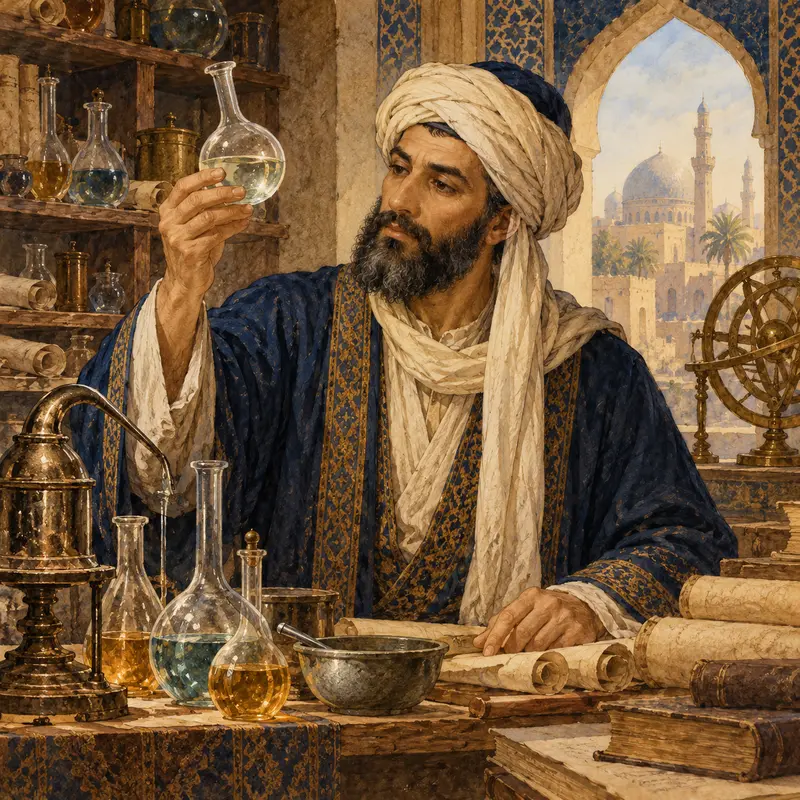
About the chemist
Jabir ibn Hayyan
c. 721-815 · Iraq
Early alchemy; distillation and acid preparation