The discovery, explained · Chemist no. 231 of 350
Jabir ibn Hayyan: The Sulfur-Mercury Theory and the Birth of Laboratory Method
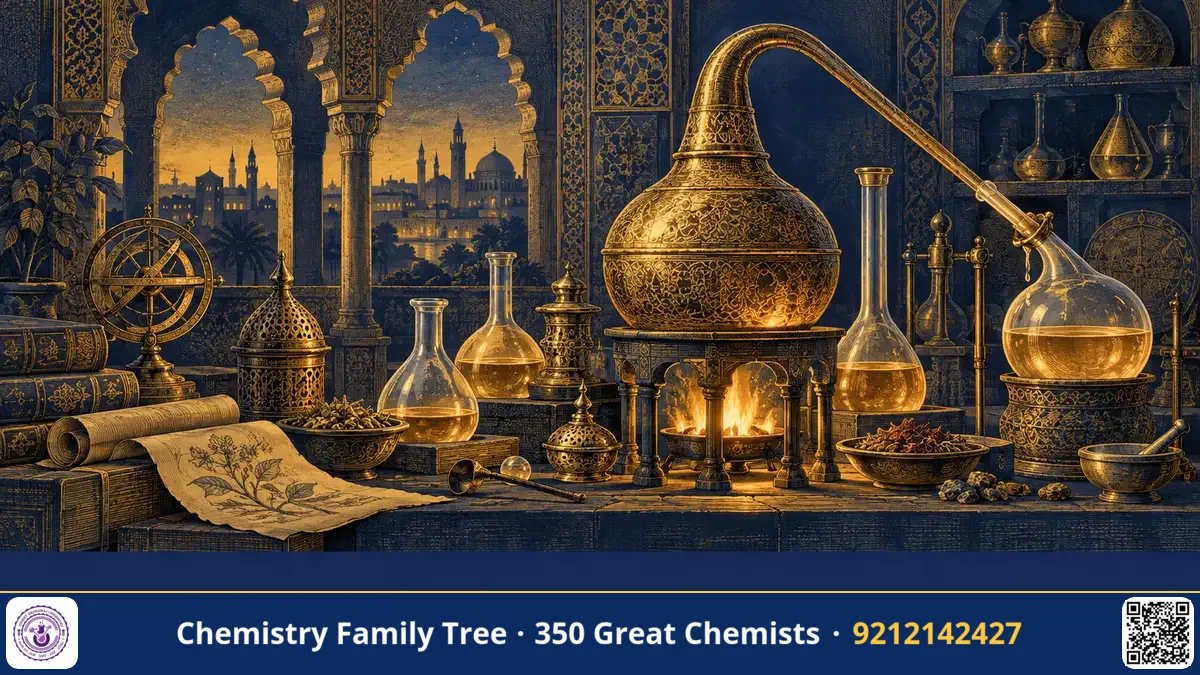
Every time you set up a distillation flask, weigh a sample or classify a substance as a metal, a non-metal or a volatile spirit, you follow habits that were sharpened in the early medieval Islamic world. The name most closely linked with those habits is Jabir ibn Hayyan, known in Latin Europe as "Geber". The works attributed to him introduced a theory of metals built on sulfur and mercury, a detailed practice of distillation and crystallisation, and a firm belief that chemistry must be learned in the laboratory. In this post we separate what is documented from what is legend, and then look at the chemistry that actually matters for your exams.
The Scientific Problem Before the Discovery
Greek natural philosophy, especially Aristotle, explained matter through four elements (earth, water, air, fire) and four qualities (hot, cold, wet, dry). This was a useful idea but it did not tell a craftsman why gold is yellow and heavy while lead is grey and soft, or how one metal might be turned into another. Aristotle also proposed two "exhalations" from the earth, one dry and smoky and one moist and vaporous, to explain minerals and metals. Practical workers in Egypt, Syria and Iraq already knew many operations: smelting, cupellation, dyeing, glassmaking and perfume-making. What they lacked was an organised theory that connected the qualities of substances to their composition, and a systematic way of recording procedures so that others could repeat them.
The Discovery: Legend and Documented History
The legend. Tradition describes Jabir as a pupil of the sixth Shia imam Ja'far al-Sadiq, a court alchemist under the Abbasid caliph Harun al-Rashid, and the author of several thousand treatises. Latin works under the name "Geber" were once thought to be his translations.
The documented history. Modern scholarship, starting with Paul Kraus in the 1940s, shows that the Arabic Jabirian corpus is a body of texts written mostly in the 9th and 10th centuries, probably by a school of authors who wrote under his name. Whether a single historical Jabir wrote any of it remains debated. The famous Latin books, such as the Summa perfectionis, were composed in Europe in the 13th–14th century by an author now called "pseudo-Geber". When you cite "Jabir" in an essay, say "the Jabirian corpus" to be safe.
Step 1: The sulfur-mercury theory
The corpus proposed that all metals are formed in the earth from two principles: a dry, smoky "sulfur" and a moist, vaporous "mercury". These are principles, not the ordinary yellow sulfur and liquid mercury we handle. Different proportions and degrees of purity give different metals, and gold is the most perfectly balanced. Base metals are "imperfect" because the principles are impure or badly proportioned. This is a qualitative cousin of modern composition-based thinking: properties come from what a substance is made of.
Step 2: The balance (mizan)
The texts speak of a "science of the balance", an attempt to assign numerical proportions to the natures in each substance. Much of it is numerological and cannot be reproduced, but the underlying idea, that composition should be expressed as measurable proportions, points towards quantitative chemistry.
Step 3: Classification of substances
The Jabirian works sort substances into three broad groups:
- Spirits: volatile substances that vaporise on heating, such as sulfur, arsenic sulfides, camphor and sal ammoniac (NH₄Cl).
- Metals (bodies): malleable, fusible materials such as gold, silver, copper, iron, lead and tin.
- Non-malleable bodies: stones and similar solids that break instead of flattening, such as glass and many minerals.
This is the oldest systematic classification of chemicals based on observed behaviour on heating, and the "volatile vs non-volatile" test remains a basic lab idea.
Step 4: Apparatus and operations
The corpus describes distillation using the alembic (from Arabic al-anbiq), along with sublimation, calcination, solution, filtration, crystallisation, evaporation and amalgamation. Substances said to be prepared or discussed include white lead (basic lead carbonate), ammonium chloride, and arsenic and antimony sulfides. Some Latin Geber texts describe strong mineral acids, including a solvent for gold; since those texts are later and from Europe, they should not be credited to the early Islamic period without caution.
The Chemistry Behind It
Although the theory itself has been replaced, several processes the corpus describes are real chemistry that you can write equations for.
- Calcination of metals: 2Pb + O₂ → 2PbO. Heating a metal in air gives a powdery "calx" (an oxide).
- Cupellation: lead oxidises to PbO, which is absorbed by the porous cupel, leaving silver or gold behind.
- Sublimation of sal ammoniac: NH₄Cl(s) ⇌ NH₃(g) + HCl(g). On cooling the vapours recombine as a solid. This is a reversible thermal decomposition, a phase-change-like example used in school labs.
- Roasting of sulfides: 2HgS + 3O₂ → 2HgO + 2SO₂, and on stronger heating HgO → Hg + ½O₂. Cinnabar was the classic source of mercury.
- Distillation: separation based on differences in boiling point, the same principle behind fractional distillation of petroleum.
Notice the link between theory and observation. Mercury and sulfur really do combine to give HgS (cinnabar, red; the black form is metacinnabar), so the idea that "metals are made of sulfur and mercury" had a visible, testable basis, even though it was over-generalised.
Applications Today
The operations in the corpus are the ancestors of modern lab and industrial techniques. Distillation is used in refineries, in making ethanol-free solvents and in producing pure water for pharmaceuticals. Sublimation is used to purify iodine, camphor, naphthalene and benzoic acid. Crystallisation purifies drugs and salts, including everyday items like sugar and the potash alum used in water clarification across India. Cupellation and fire assay are still used by hallmarking centres to test gold fineness. Even the idea of writing detailed, repeatable "recipes" lives on in laboratory manuals and in the experimental sections of every research paper.
Exam Corner
- The Jabirian corpus proposed that metals are composed of "sulfur" and "mercury" principles. These are not the elements as we know them.
- Substances were classified as spirits, metals and non-malleable bodies. NH₄Cl is a standard example of a sublimable "spirit".
- The alembic is the ancestor of the distillation still. The word "alembic" comes from Arabic al-anbiq; "alcohol", "alkali" and "alchemy" also have Arabic roots.
- The Latin "Geber" books are 13th–14th century European works, not translations of a single Arabic author. MCQ trap: do not say Geber discovered nitric acid with certainty.
- Sublimation of NH₄Cl is reversible: NH₄Cl ⇌ NH₃ + HCl. In a closed tube the solid reforms on the cooler part.
Common Misconceptions
- "Jabir wrote 3000 books alone." The large corpus is generally seen as the work of a school over a century or more.
- "Alchemy was just magic." Alchemy mixed mystical ideas with serious practical work. The practical side gave chemistry its tools and vocabulary.
- "Sulfur-mercury theory means ordinary S and Hg." The theory used philosophical principles that happened to share the names.
Quick Revision Box
- Name: Jabir ibn Hayyan (Latin: Geber); the corpus dates mainly to the 9th–10th century.
- Core theory: metals arise from "sulfur" and "mercury" principles in different proportions.
- Classification: spirits, metals, non-malleable bodies.
- Methods: distillation (alembic), sublimation, calcination, crystallisation, filtration.
- NH₄Cl sublimes reversibly: NH₄Cl ⇌ NH₃ + HCl.
- Pseudo-Geber: 13th–14th century Latin author, different from the Arabic corpus.
FAQ
Was Jabir ibn Hayyan a real person?
Medieval sources describe him as a real alchemist, but historians disagree about how much of the writing under his name he produced. The corpus is real; its single authorship is doubtful.
Did Jabir discover acids like sulfuric or nitric acid?
Credit is uncertain. Detailed, reliable recipes for strong mineral acids appear in later Latin texts, so it is safer not to claim them for the early Arabic authors.
Why is he called the father of chemistry?
The title reflects his influence on method, vocabulary and the culture of experiment. It is a popular label, not a formal honour, and it is shared in some writing with Robert Boyle and Lavoisier.
Is the sulfur-mercury theory still taught?
It is taught as history. The ideas of proportion and composition that it hints at were later formalised by Dalton, Proust and Lavoisier.
Published by ABC Chemistry — IIT-JAM | CSIR-NET | GATE Chemistry Coaching. Visit abcchemistry.com
About the chemist
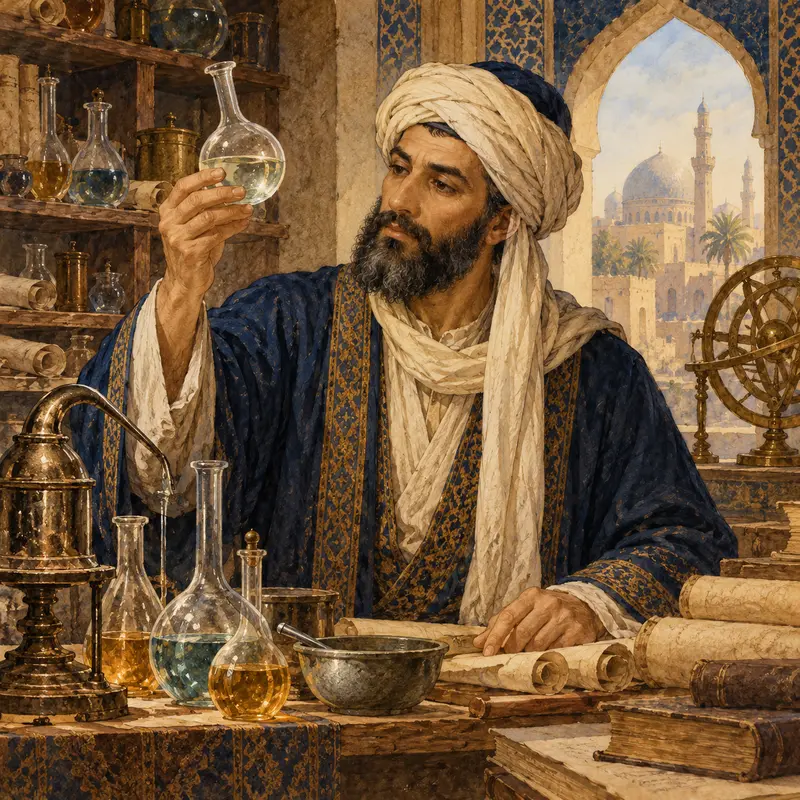
Jabir ibn Hayyan
c. 721-815 · Iraq
Early alchemy; distillation and acid preparation