Biography · Chemist no. 22 of 350
Jacobus Henricus van 't Hoff: The First Nobel Laureate in Chemistry

Jacobus Henricus van 't Hoff (1852–1911) was a Dutch physical chemist who changed three areas of chemistry: stereochemistry, chemical kinetics and the theory of solutions. He proposed the tetrahedral carbon atom, formulated the van 't Hoff equation and the law of osmotic pressure, and in 1901 won the first Nobel Prize in Chemistry. He also believed that imagination is a key ingredient of science. His legacy is on the first page of every stereochemistry chapter.
Early Life and Family
Van 't Hoff was born on 30 August 1852 in Rotterdam, the Netherlands, the third of seven children. His father, Jacobus Henricus van 't Hoff Sr., was a physician, and his mother was Alida Jacoba Kolff. As a boy he was thoughtful and dreamy, interested in nature, poetry and reading, and he gathered plants and read about famous scientists. His father hoped he would take up a practical career, so he studied technology first.
In 1878 he married Johanna Francina Mees, and they had four children, two daughters and two sons. The family lived in Amsterdam and later in Berlin.
Education and Mentors
He studied at the Polytechnic School in Delft, where he completed a two-year course in 1871, and then went on to the University of Leiden to study mathematics. In 1872 he went to Bonn to work in the laboratory of August Kekulé, and in 1873 to Paris where he worked with Charles-Adolphe Wurtz. In Paris he met Joseph Le Bel, who had also studied with Wurtz. He returned to the Netherlands and received his doctorate at Utrecht University in 1874 with a thesis on cyanoacetic and malonic acids. In the same year he published his tetrahedral carbon idea.
Career Timeline
| Year | Event |
|---|---|
| 1852 | Born in Rotterdam, 30 August |
| 1871 | Completes studies at Delft Polytechnic |
| 1872–1873 | Studies with Kekulé in Bonn and Wurtz in Paris |
| 1874 | Doctorate at Utrecht; publishes the tetrahedral carbon proposal |
| 1877 | Appointed lecturer at the University of Amsterdam |
| 1878 | Becomes professor of chemistry, mineralogy and geology at Amsterdam |
| 1884 | Publishes Études de dynamique chimique |
| 1886 | Publishes the osmotic pressure law for dilute solutions |
| 1887 | Co-founds the Zeitschrift für physikalische Chemie with Wilhelm Ostwald |
| 1896 | Moves to Berlin as professor at the Prussian Academy of Sciences |
| 1901 | Receives the first Nobel Prize in Chemistry |
| 1911 | Dies in Steglitz, Berlin, 1 March |
Major Scientific Contributions
- Stereochemistry. The tetrahedral carbon atom, which explains optical isomers and geometrical isomers. He also predicted that certain allenes should show optical activity, which was confirmed decades later.
- Chemical dynamics. Reaction order, molecularity, and the equation
d ln K/dT = ΔH°/RT². He also noted that reaction rates often increase two- to three-fold for each 10 °C rise. - Osmotic pressure.
π = CRT, and the factor i, which helped Arrhenius to develop ionic dissociation theory. See our discovery post for details. - Physical chemistry as a discipline. Together with Ostwald and Arrhenius, he founded the science of physical chemistry as a separate field.
- Geochemistry. In Berlin he studied the formation of oceanic salt deposits, such as those at Stassfurt, using phase equilibria. This work applied the phase rule of Gibbs to a large natural problem.
Awards, Honours and Nobel Prize
When the Nobel Prizes were first given in 1901, van 't Hoff received the first Nobel Prize in Chemistry "in recognition of the extraordinary services he has rendered by the discovery of the laws of chemical dynamics and osmotic pressure in solutions". He also received the Davy Medal of the Royal Society (1893) and was a member of the Royal Netherlands Academy of Arts and Sciences and a foreign member of many academies, including the Royal Society. Honorary degrees came from Harvard, Yale and other universities. Today the Van 't Hoff Institute for Molecular Sciences in Amsterdam bears his name.
Personality, Struggles and Lesser-Known Facts
- A young man with a big idea. His 1874 pamphlet came when he was 22 and had not yet finished his doctorate. It was written in Dutch, so few people read it at first, and a French version and a longer book followed in 1875.
- Kolbe's attack. In 1877 the influential German chemist Hermann Kolbe wrote a harsh and sarcastic criticism of van 't Hoff's ideas. He mocked them as fantasy from an unknown scholar at the Veterinary School in Utrecht, where van 't Hoff worked as an assistant at that time. Time proved Kolbe wrong.
- Imagination in science. In 1878 his inaugural lecture at Amsterdam was titled Imagination in Science. He studied the lives of many scientists and concluded that many of them had been strongly imaginative. He believed that a theory begins with a bold idea, and is then tested.
- A move for research. In 1896 he moved to Berlin because the Prussian Academy gave him a post with a light teaching load and well-equipped laboratory, so that he could spend time on research in salt deposits.
- Illness. He suffered from tuberculosis, and died in Berlin in 1911 at the age of 58.
Legacy and Influence on Modern Chemistry
All of organic stereochemistry, from R/S nomenclature to asymmetric synthesis, builds on van 't Hoff's picture. The van 't Hoff factor is used in all colligative property calculations, and the equation for the temperature dependence of K is a main tool of thermodynamics. Reverse osmosis and the study of membranes depend on his osmotic pressure law. The enormous pharmaceutical industry of today treats enantiomers as separate substances, and several Nobel Prizes in later years (for example to Knowles, Noyori and Sharpless in 2001 for chiral catalysis) rest on the foundation he laid.
Lessons for Students
- Use imagination, but test it. A bold idea needs experimental support.
- Do not be discouraged by criticism from famous people. Kolbe's harsh review did not change the facts.
- Cross subject boundaries: van 't Hoff used organic chemistry, physics, thermodynamics and geology.
- Models matter. A simple tetrahedron explained a great deal of chemistry.
Quick Facts Box
- Born: 30 August 1852, Rotterdam, Netherlands
- Died: 1 March 1911, Steglitz, Berlin, Germany
- Nationality: Dutch
- Field: Physical chemistry, stereochemistry
- Famous for: Tetrahedral carbon, van 't Hoff equation, osmotic pressure law
- Nobel: Chemistry, 1901 (the first ever awarded)
FAQ
Why was van 't Hoff's Nobel Prize the first in Chemistry?
The Nobel Prizes began in 1901, and the Royal Swedish Academy of Sciences chose him as the first chemistry laureate.
Did van 't Hoff and Le Bel work together?
They proposed similar ideas independently in 1874, although they knew each other from Paris.
Where did van 't Hoff work?
He worked in Utrecht, Amsterdam, and from 1896, in Berlin.
What is the van 't Hoff factor?
It is the ratio of the observed colligative effect to the effect calculated for a non-dissociating solute. It indicates the number of particles formed per formula unit.
Published by ABC Chemistry — IIT-JAM | CSIR-NET | GATE Chemistry Coaching. Visit abcchemistry.com
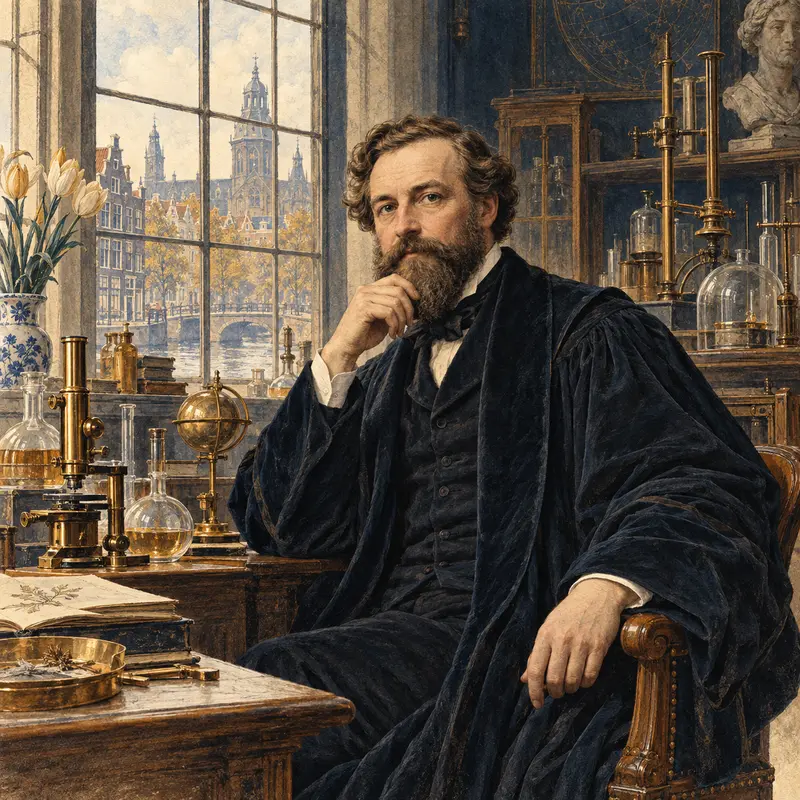
About the chemist
Jacobus Henricus van 't Hoff
1852-1911 · Netherlands · Nobel Chemistry 1901
Chemical kinetics; tetrahedral carbon