The discovery, explained · Chemist no. 22 of 350
van 't Hoff: Giving Molecules a Third Dimension and Solutions a Gas Law
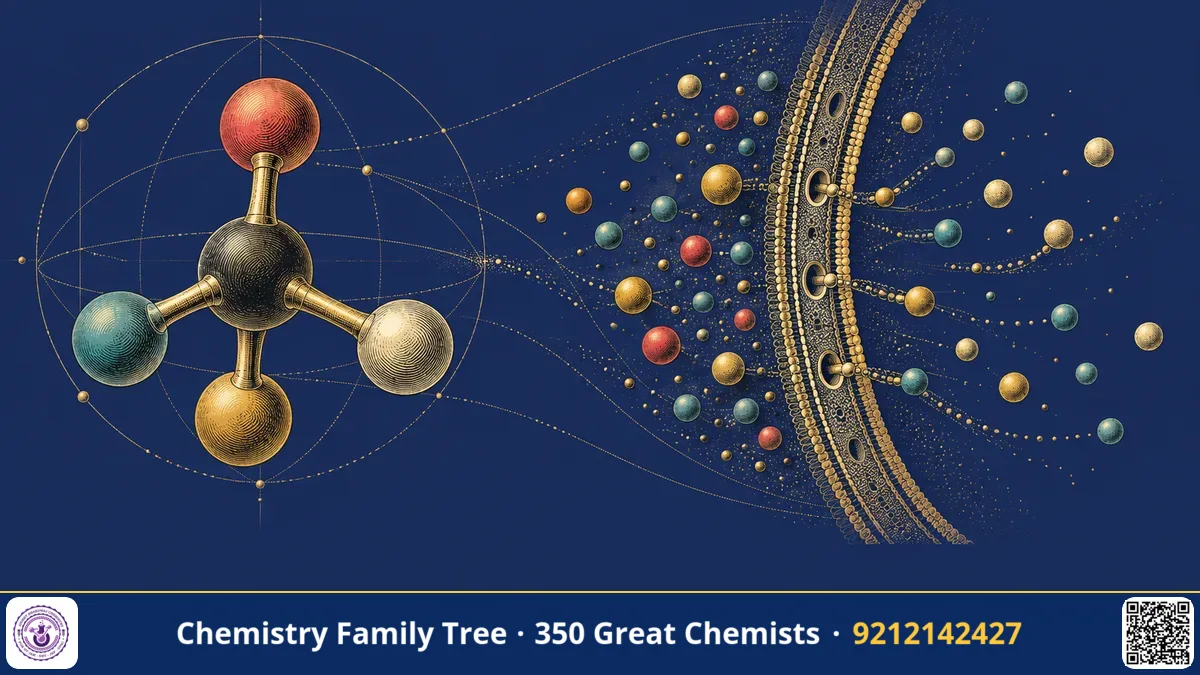
Jacobus Henricus van 't Hoff made three discoveries that every chemistry student meets repeatedly. In 1874 he proposed that the four bonds of a saturated carbon atom point towards the corners of a tetrahedron, founding stereochemistry. In the 1880s he showed that the laws of chemical kinetics and equilibrium could be given a clear mathematical form, with the famous van 't Hoff equation. In 1886 he showed that dilute solutions obey a law of osmotic pressure similar to the gas law. In 1901 he became the first person to receive the Nobel Prize in Chemistry.
The Scientific Problem Before the Discovery
Around 1870, structural formulae drawn on paper, as proposed by Kekulé and others, were very successful. But they were flat. Chemists had found puzzling cases which flat formulae could not explain. The best example is lactic acid, CH₃–CH(OH)–COOH. Two forms of it were known: one made by fermentation of sugar and another from muscle tissue. They had the same structure and the same physical properties, except that they rotated the plane of polarised light in opposite directions. In 1848 Louis Pasteur had earlier shown the same for tartaric acid crystals, and Johannes Wislicenus had noted this problem in lactic acid in 1873, but no one could say why.
Another unsolved problem was solutions. Why did salt water freeze below 0 °C? Why did a membrane allow water to pass and not sugar? Experiments by the botanist Wilhelm Pfeffer on osmotic pressure gave data, but no law.
The Discovery: Three Steps
1. The tetrahedral carbon (1874). At the age of 22, van 't Hoff published a short pamphlet in Dutch, suggesting that the four valencies of carbon are directed to the corners of a tetrahedron, with the carbon at the centre. If four different groups are attached, two arrangements exist that are non-superimposable mirror images, like left and right hands. Such a carbon is called an asymmetric (chiral) carbon. A molecule with n such centres can have up to 2ⁿ stereoisomers. Joseph Achille Le Bel independently reached a similar conclusion in France in the same year. The idea was fiercely attacked at first, but it explained optical activity, and also the cis–trans isomerism of alkenes such as maleic and fumaric acids, where rotation about a double bond is prevented.
2. Chemical dynamics (1884). In Études de dynamique chimique he classified reactions by order, defined molecularity, and gave the equation for how the equilibrium constant changes with temperature, called the van 't Hoff equation or reaction isochore:
d(ln K)/dT = ΔH° / RT²
Integrating between two temperatures:
ln(K₂/K₁) = −(ΔH°/R)(1/T₂ − 1/T₁)
3. Osmotic pressure (1886). Using Pfeffer's data, van 't Hoff noticed that the osmotic pressure π of a dilute solution was proportional to concentration and to absolute temperature, just as for a gas:
πV = nRT or π = CRT
For solutions that dissociate, he introduced the factor i, so that π = iCRT. Svante Arrhenius later explained this factor through ionic dissociation.
The Chemistry Behind It
Chirality in practice. A carbon attached to four different groups is a stereocentre. In lactic acid, the central carbon carries H, OH, CH₃ and COOH. The two enantiomers have the same melting point and the same reactions with achiral reagents, but rotate polarised light in opposite directions (+ and −). A 50:50 mixture is a racemic mixture and is optically inactive. Tartaric acid has two stereocentres, but because of internal symmetry it exists as a meso form, so it has three stereoisomers, not four.
Interpreting the van 't Hoff equation. A plot of ln K against 1/T has slope −ΔH°/R:
| Reaction type | Effect of raising temperature on K |
|---|---|
| Endothermic (ΔH° > 0) | K increases |
| Exothermic (ΔH° < 0) | K decreases |
This is the quantitative form of Le Chatelier's principle for temperature.
Colligative properties. The van 't Hoff factor is i = (observed colligative property) / (calculated value for a non-electrolyte). It gives the number of particles per formula unit. For example, for NaCl fully dissociated i ≈ 2, for CaCl₂ i ≈ 3, for glucose i = 1, and for association, such as acetic acid dimerising in benzene, i is less than 1. Using i, the formulae become: ΔTf = i Kf m, ΔTb = i Kb m and π = iCRT.
Applications Today
- Pharmaceuticals: the activity of drugs depends on stereochemistry. For example, one enantiomer of ibuprofen is mainly responsible for pain relief, and the thalidomide tragedy is often cited in discussions on enantiomers. India has a large chiral drug and fine chemical industry.
- Desalination: reverse osmosis, used in water purifiers in many Indian homes and in coastal desalination plants, works by applying a pressure higher than the osmotic pressure to push water through a membrane.
- Medicine: intravenous saline is made isotonic (0.9% NaCl) so that red blood cells do not shrink or swell.
- Food and agriculture: preservation by salt or sugar and the rise of water in plants involve osmosis.
- Thermodynamic data: scientists determine ΔH° and ΔS° from van 't Hoff plots of equilibrium constants at several temperatures.
- Antifreeze: ethylene glycol in car radiators works by freezing point depression.
Exam Corner
- Number of stereoisomers with n different stereocentres = 2ⁿ; with symmetrical molecules (such as tartaric acid) meso forms reduce this number.
- Osmotic pressure: π = iCRT. Isotonic solutions have equal osmotic pressures; reverse osmosis requires external pressure greater than π.
- van 't Hoff factor: i = 1 + α(n − 1) for dissociation; i = 1 − α(1 − 1/n) for association.
- van 't Hoff equation: slope of ln K vs 1/T is −ΔH°/R; K of endothermic reactions rises with T.
- van 't Hoff and Le Bel proposed the tetrahedral carbon in 1874; van 't Hoff received the first Nobel Prize in Chemistry in 1901.
Common Misconceptions
- "Enantiomers have different boiling points." They have identical physical properties except for the direction of rotation of polarised light and interactions with other chiral substances.
- "The sign of rotation (+/−) tells us R or S." There is no simple link; R/S is a naming rule and +/− is an experimental result.
- "i is always a whole number." For real solutions, i is often less than the ideal number because of ion pairing.
Quick Revision Box
- Tetrahedral carbon proposed in 1874 (van 't Hoff, with Le Bel).
- Asymmetric carbon: four different groups; up to 2ⁿ stereoisomers.
- Osmotic pressure law: π = CRT (and iCRT for electrolytes), 1886.
- Reaction isochore: d ln K/dT = ΔH°/RT².
- Études de dynamique chimique (1884) introduced reaction order and molecularity.
- First Nobel Prize in Chemistry, 1901.
FAQ
Who proposed the tetrahedral carbon first?
Van 't Hoff and Le Bel proposed it independently in 1874. Van 't Hoff's pamphlet appeared in September of that year, and Le Bel's paper appeared in November.
Why did people object to his theory?
It was thought too speculative, since it described atoms in space. Hermann Kolbe criticised it sharply in 1877. Later experiments confirmed it.
What is a racemic mixture?
An equimolar mixture of two enantiomers. It shows no optical rotation because the two rotations cancel.
How are the van 't Hoff and Arrhenius equations related?
Both involve temperature. The van 't Hoff equation deals with equilibrium constants and ΔH°, while the Arrhenius equation deals with rate constants and activation energy.
Published by ABC Chemistry — IIT-JAM | CSIR-NET | GATE Chemistry Coaching. Visit abcchemistry.com
About the chemist
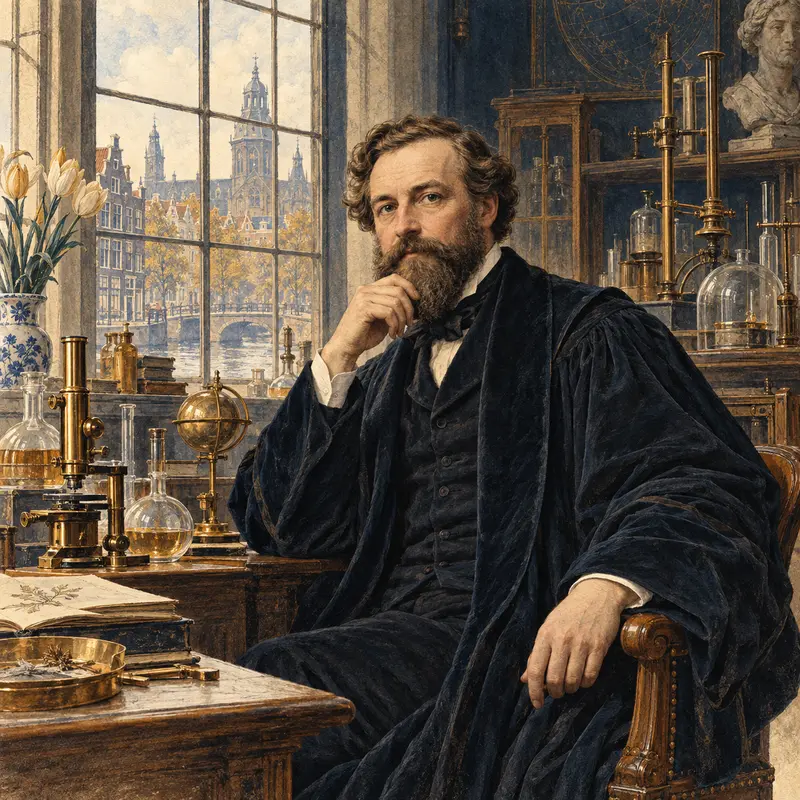
Jacobus Henricus van 't Hoff
1852-1911 · Netherlands · Nobel Chemistry 1901
Chemical kinetics; tetrahedral carbon