The discovery, explained · Chemist no. 121 of 350
James B. Sumner and the Crystals That Proved Enzymes Are Proteins
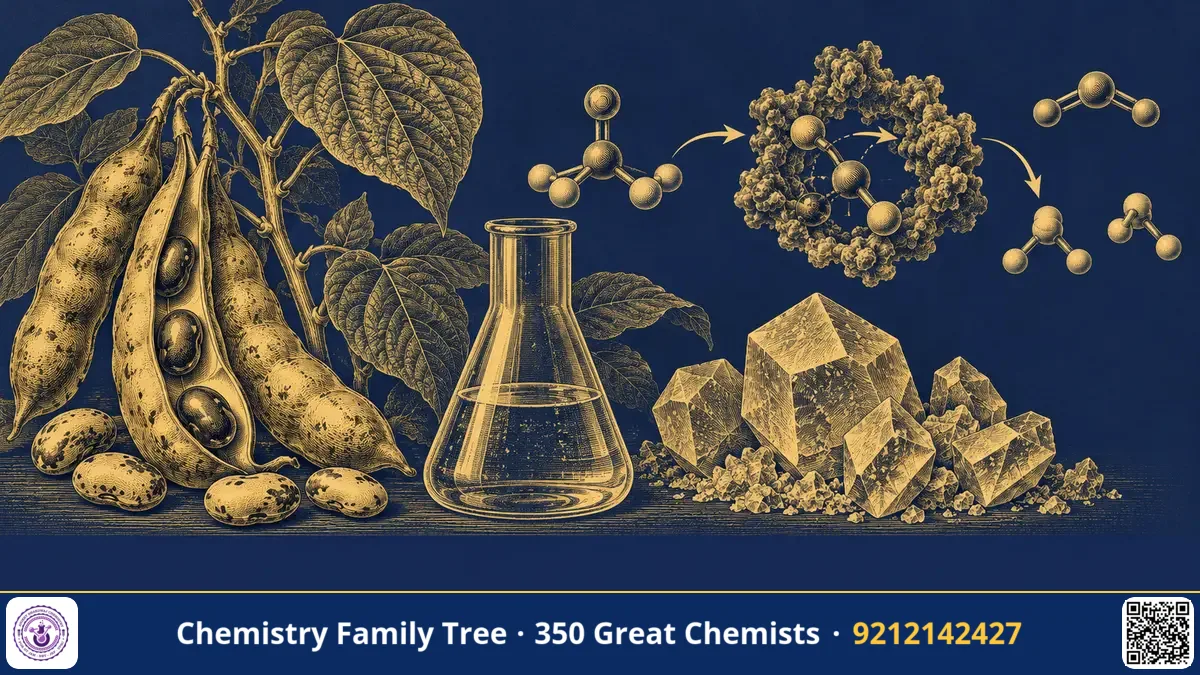
Before 1926 an enzyme was something mysterious. Chemists could see its effects, such as fermentation, digestion or the splitting of urea, but nobody could say what an enzyme was. Many leading scientists believed that enzymes were not proteins at all, but small active molecules carried on a colloidal support. In 1926 the American biochemist James Batcheller Sumner, working at Cornell University Medical College, obtained crystals of the enzyme urease from jack beans and showed that the crystals were pure protein and had all the catalytic power. For this discovery that enzymes can be crystallised he was awarded half of the Nobel Prize in Chemistry for 1946.
The Scientific Problem Before the Discovery
By the 1920s the idea of an enzyme was already known. Eduard Buchner had shown in 1897 that cell-free yeast juice can ferment sugar, which earned him the 1907 Nobel Prize in Chemistry. But what the active substance was remained unclear. The leading German chemist Richard Willstätter, a Nobel laureate himself, and his co-workers prepared very active enzyme solutions that gave no tests for protein. Willstätter concluded that enzymes are small molecules of unknown chemistry, adsorbed on colloidal carriers, and that the proteins in the preparations were only impurities.
- Enzyme preparations were always impure mixtures. Any active fraction might be a trace of an unknown catalyst.
- Protein chemistry was young. Many chemists doubted that large proteins were true molecules with defined structures.
- No enzyme had been obtained as a crystal. Crystals are the classical test of purity, since a pure compound can form a regular lattice but a mixture generally cannot.
The Discovery: Step by Step
Sumner chose urease, the enzyme that hydrolyses urea:
(NH₂)₂C=O + H₂O → CO₂ + 2NH₃ (catalysed by urease)
This reaction was a good choice for several reasons. The activity is easy to measure, since the ammonia formed can be titrated or detected with Nessler's reagent. Jack bean meal (from Canavalia ensiformis) is a rich source of this enzyme. He started in 1917 and worked on the problem for nine years, often against the advice of colleagues who believed it would fail.
- Extraction. Jack bean meal was extracted with aqueous acetone (about 30%). Acetone lowers the solubility of proteins, and at the right concentration it precipitates a selected group while leaving others in solution.
- Cooling. The extract was filtered and left in the cold (in a refrigerator at about 0-5 °C). After a time a fine deposit formed.
- Centrifugation. The sediment was collected by centrifuge and examined under the microscope. It was made of small crystals, mostly octahedral in shape.
- Test for activity. The crystals dissolved in water gave a strong urease activity. The activity was proportional to the amount of crystalline protein, and recrystallisation did not change the ratio of activity to protein.
- Test for protein. The crystals gave the usual protein tests (such as the biuret, xanthoproteic and Millon reactions) and were destroyed by proteases like pepsin and trypsin, which also destroyed the enzyme activity.
Sumner announced the result in 1926. He said that urease is a protein and that no other component was needed for its action. The claim was met with great scepticism. Willstätter's school strongly opposed it, arguing that Sumner's crystals were protein carrying a trace of the real enzyme. The matter was settled in the early 1930s, when John Howard Northrop crystallised pepsin and later trypsin and chymotrypsin, and showed in careful tests that the activity was a property of the protein. Sumner himself crystallised catalase from beef liver in 1937.
The Chemistry Behind It
Salting out and solvent precipitation. Protein solubility depends on the charge, the solvent and the temperature. Organic solvents like acetone lower the dielectric constant of the solution and weaken the water shell around the protein. This increases the electrostatic attraction between protein molecules, which then aggregate and come out of solution, in crystals if conditions are slow and gentle. Low temperature is important to prevent denaturation.
Urease structure and mechanism. It was later discovered, in 1975, by Dixon and co-workers, that urease contains nickel, which was the first nickel enzyme known. The active site has two Ni²⁺ ions bridged by a carbamylated lysine. One nickel binds urea through its oxygen, and the other activates a water molecule as a hydroxide nucleophile that attacks the carbonyl carbon. The intermediate breaks to give ammonia and carbamate, and the carbamate decomposes spontaneously:
H₂N–CO–O⁻ (carbamate) + H₂O → NH₃ + HCO₃⁻
Urease is among the most efficient enzymes known. It speeds up the hydrolysis of urea by a factor of about 10¹⁴ compared with the uncatalysed reaction. The first X-ray structure of a urease (from Klebsiella aerogenes) was reported in 1995.
Why crystallisation matters. Crystals are needed for X-ray diffraction. The step Sumner began opened the way to protein crystallography. Max Perutz, John Kendrew, Dorothy Hodgkin and others later used crystals of proteins to solve their three-dimensional structures.
Applications Today
- Medicine. The bacterium Helicobacter pylori in the stomach produces urease, which makes ammonia and neutralises acid around the cell. The urea breath test uses ¹³C- or ¹⁴C-labelled urea to detect this infection.
- Agriculture. Urea is the most common nitrogen fertiliser in India. Soil urease converts it to ammonia, and urease inhibitors such as NBPT are added to fertilisers to reduce nitrogen loss. Neem-coated urea is also used in India for slow release.
- Clinical analysis. Urease-based sensors and strips measure blood urea nitrogen and urea in dialysis.
- Biotechnology. Enzymes are now routinely purified, crystallised and used in industry for detergents, food processing and pharmaceuticals.
- Research. Urease-induced calcium carbonate precipitation is studied for soil strengthening.
Exam Corner
- Sumner crystallised urease from jack bean (Canavalia ensiformis) in 1926 using aqueous acetone, and proved that it is a protein.
- Urease catalyses CO(NH₂)₂ + H₂O → CO₂ + 2NH₃; it contains two Ni²⁺ ions in the active site.
- Sumner shared the 1946 Nobel Prize in Chemistry with Northrop and Stanley; he received half and the other two together received the other half.
- Enzymes (except ribozymes) are proteins; they lower activation energy without changing equilibrium.
- Catalase decomposes hydrogen peroxide: 2H₂O₂ → 2H₂O + O₂; Sumner crystallised it in 1937.
Common Misconceptions
- "All enzymes are proteins." Almost all are, but ribozymes (catalytic RNA), found later, are exceptions.
- "Sumner's result was accepted at once." It was disputed for several years, until further crystalline enzymes confirmed it.
- "Urease uses zinc or iron." It uses nickel, which was a surprise when discovered in 1975.
Quick Revision Box
- Urease crystallised in 1926 from jack bean meal with acetone.
- Proved the protein nature of enzymes.
- Urease active site: two nickel ions.
- Catalase crystallised by Sumner in 1937.
- Nobel Prize in Chemistry 1946, shared with Northrop and Stanley.
- Willstätter was the main critic of the protein view.
FAQ
Why did Sumner choose urease?
It is easy to measure, the beans are a rich source and the reaction is simple, so activity could be followed accurately through the purification.
How did Sumner prove that urease is a protein?
The crystals gave protein tests, were destroyed by proteases and had constant activity per unit of protein after repeated recrystallisation.
What is the reaction catalysed by urease?
The hydrolysis of urea to ammonia and carbon dioxide (carbamate is an intermediate).
Is Sumner's Nobel Prize in Medicine?
No. It was the Nobel Prize in Chemistry for 1946.
Published by ABC Chemistry — IIT-JAM | CSIR-NET | GATE Chemistry Coaching. Visit abcchemistry.com

About the chemist
James B. Sumner
1887-1955 · United States · Nobel Chemistry 1946
Crystallization of urease