Biography · Chemist no. 266 of 350
Sir James Dewar (1842-1923): The Scientist Who Brought Hydrogen to Liquid
Introduction
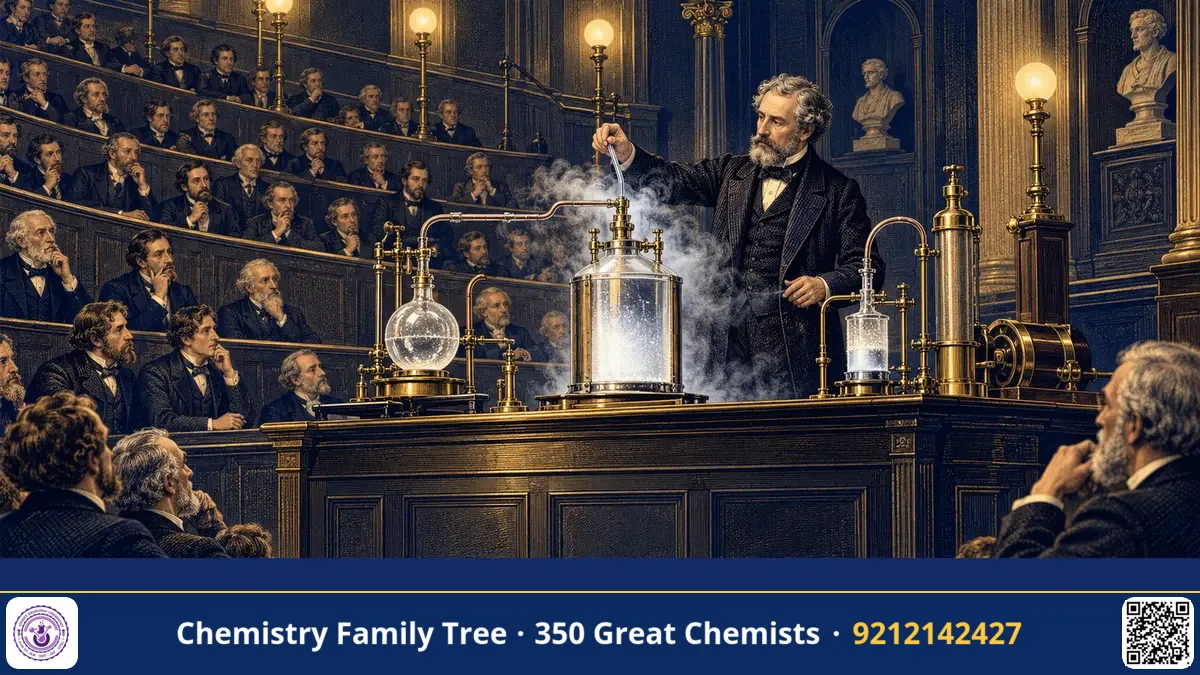
Sir James Dewar was a Scottish chemist and physicist who spent most of his career at the Cambridge University and the Royal Institution in London. He invented the vacuum flask, liquefied hydrogen, made solid hydrogen, proposed a famous structure for benzene and helped invent cordite, the smokeless explosive. His legacy in one line: he pushed experimental science to very low temperatures and left every laboratory the Dewar flask.
Early Life and Family
Dewar was born on 20 September 1842 in Kincardine-on-Forth, a small town in Scotland. He was the youngest of six sons of Thomas Dewar, a vintner (wine and spirits merchant) and innkeeper. His childhood was cut short by tragedy: when he was about ten years old, he fell through ice while playing on a frozen pond and became seriously ill with rheumatic fever; some sources say that this illness affected him for a long time. His parents died while he was in his early teens. He was cared for by his older brothers.
Education and Mentors
Dewar attended Dollar Academy, where he was a student of Dr Andrew Mitchell, the science teacher, who encouraged his interest. According to well-known stories, he made a fiddle (violin) during his youth and enjoyed craftsmanship, which helped him later when designing apparatus. He studied at the University of Edinburgh, where he came under the influence of Lyon Playfair, professor of chemistry, and became his assistant. He also worked in Edinburgh with Playfair on the chemistry of nitroprussides. Dewar spent a short time in Ghent with August Kekulé, who was then developing his theory of the structure of benzene.
Career Timeline
| Year | Event |
|---|---|
| 1842 | Born in Kincardine-on-Forth, 20 September |
| 1867 | Proposed several benzene formulae, including "Dewar benzene" |
| 1875 | Jacksonian Professor of Natural Experimental Philosophy, Cambridge |
| 1877 | Fullerian Professor of Chemistry at the Royal Institution, London |
| 1886 | Produced liquid oxygen in quantity |
| 1889 | Cordite patented with Frederick Abel |
| 1892 | Invented the vacuum flask |
| 1898 | Liquefied hydrogen |
| 1899 | Produced solid hydrogen |
| 1904 | Knighted |
| 1923 | Died in London, 27 March |
Major Scientific Contributions
- Vacuum flask (1892): A double-walled silvered glass vessel with a vacuum between the walls. See our discovery blog for the principle.
- Liquefaction of hydrogen (1898): Using Joule-Thomson cooling with pre-cooling by liquid air, followed by solid hydrogen in 1899.
- Dewar benzene (1867): A bicyclic formula for C₆H₆ later made in the laboratory.
- Cordite (1889): With Sir Frederick Abel, he developed a smokeless propellant made of nitroglycerine and guncotton gelatinised with acetone and mineral jelly, used by British forces.
- Low-temperature properties of matter: With the physicist J. A. Fleming, he studied the electrical resistance of metals at low temperature, and with G. D. Liveing he studied spectra of elements, at Cambridge.
- Adsorption of gases: He showed that cooled charcoal absorbs large amounts of gas, a method for producing high vacuum.
- Physiology of vision: Early in his career he studied the electrical response of the retina to light, together with John McKendrick.
Awards, Honours and Nobel Prize
- Fellow of the Royal Society (1877) and Rumford Medal of the Royal Society (1894).
- President of the Chemical Society (1897-99) and of the British Association for the Advancement of Science (1902).
- Knighted in 1904.
- He was nominated for the Nobel Prize in Chemistry and Physics many times but never won.
Personality, Struggles and Lesser-Known Facts
- Dewar did not patent the vacuum flask. A German glassblower, Reinhold Burger, who made flasks for his lab, patented a commercial version and founded the Thermos company in 1904. Dewar later took legal action about it but lost the case, which was a bitter experience.
- He had public rivalries. He quarrelled with Alfred Nobel's side over the cordite patent in a legal dispute with Nobel in 1893-94 and lost, and he had a long dispute with William Ramsay over discoveries of noble gases and who deserved credit for liquefying them.
- He was a spectacular lecturer at the Royal Institution, where he followed the tradition of Davy and Faraday and delivered the Friday Evening Discourses, with dramatic demonstrations of liquid air and liquid hydrogen.
- He worked mostly in his laboratory, with his assistants, and his wife Helen Rose Banks, whom he married in 1871, had no children.
- He lived for his research and devoted most of his adult life to the Royal Institution, where he had both a laboratory and living quarters.
Legacy and Influence on Modern Chemistry
Dewar opened the field of cryogenics. His methods were followed by Kamerlingh Onnes (liquid helium, 1908), whose discovery of superconductivity gave a Nobel Prize in Physics in 1913. Today liquid nitrogen, liquid oxygen and liquid hydrogen are industrial and medical materials. Dewar flasks are found in every chemistry laboratory, and the same principle is used in storage of liquefied natural gas and in cryogenic engines. His benzene isomer remains a favourite example of valence isomers in organic chemistry. For Indian students, Dewar's name appears in questions about benzene isomers, Joule-Thomson effect, liquefaction of gases and the thermos flask.
Lessons for Students
- Build your own tools. Dewar's skill in glass-working and design made his experiments possible.
- Protect your inventions. His lack of a patent cost him financially.
- Science is a team effort. Rivalry slowed progress for Dewar and others.
- Communicate science. His public lectures inspired many people.
- Misfortune need not stop you. An orphan from a small town became a Royal Institution professor.
Quick Facts Box
- Born: 20 September 1842, Kincardine-on-Forth, Scotland
- Died: 27 March 1923, London
- Nationality: Scottish (British)
- Field: Physical chemistry; low-temperature physics
- Famous for: Vacuum flask; liquid and solid hydrogen; Dewar benzene; cordite
- Nobel Prize: Nominated many times; never won
FAQ
Did Dewar get rich from the thermos flask?
No. He did not patent the invention, and the commercial thermos was patented by Reinhold Burger.
What is cordite?
A smokeless explosive propellant developed by Dewar and Abel, based on nitroglycerine and guncotton.
Where did Dewar work?
At the University of Cambridge and the Royal Institution in London.
Did Dewar win a Nobel Prize?
No, though he was nominated many times.
Published by ABC Chemistry — IIT-JAM | CSIR-NET | GATE Chemistry Coaching. Visit abcchemistry.com
About the chemist
James Dewar
1842-1923 · United Kingdom
Dewar flask; liquefying hydrogen