The discovery, explained · Chemist no. 266 of 350
James Dewar: The Vacuum Flask and the Race to Liquefy Hydrogen
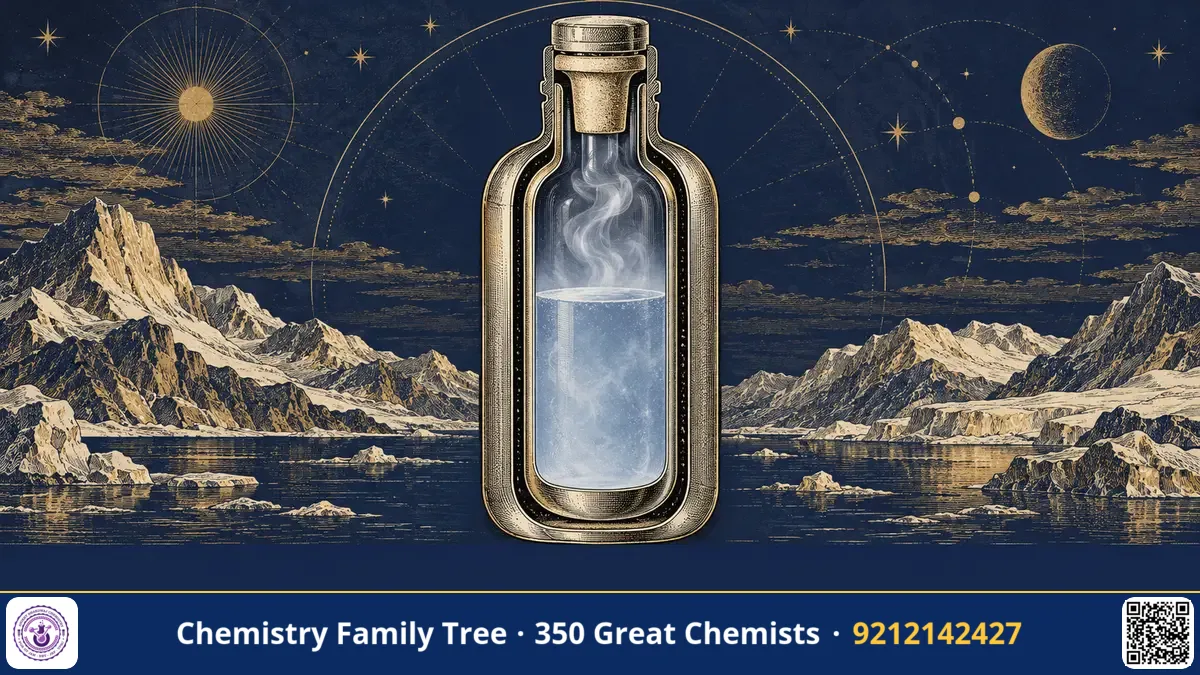
The steel flask that keeps your tea hot in winter and your water cold in summer is a direct descendant of an invention by the Scottish chemist and physicist Sir James Dewar. In 1892 he designed a double-walled glass vessel with a vacuum between the walls, to store liquefied gases. It is called the Dewar flask in laboratories, and the thermos in homes. With it, Dewar liquefied hydrogen in 1898, reaching 20 K, and in 1899 he made solid hydrogen. He also proposed a structure for benzene that carries his name. This blog explains the science behind his work and why it matters for chemistry students.
The Scientific Problem Before the Discovery
Through the 19th century, scientists tried to liquefy all gases. Faraday had liquefied chlorine and many other gases by pressure and cooling in the 1820s-1840s, but some, such as oxygen, nitrogen and hydrogen, resisted and were called "permanent gases". In 1869 Thomas Andrews showed that each gas has a critical temperature, above which it cannot be liquefied however high the pressure. The permanent gases have very low critical temperatures. In 1877, Cailletet and Pictet reported small amounts of liquid oxygen as a mist. In 1883 Wroblewski and Olszewski in Kraków obtained liquid oxygen and nitrogen in small quantity and for a short time.
Another big problem was practical: how to keep liquid air or hydrogen long enough to study it? These liquids boil at very low temperatures, and in an ordinary vessel they evaporate in seconds because heat comes in by conduction, convection and radiation.
The Discovery: Dewar's Steps
1. Liquid oxygen in quantity (1886). Dewar, working at the Royal Institution in London, produced liquid oxygen in bulk and studied its properties, such as its blue colour and its attraction to a magnet (paramagnetism).
2. The vacuum flask (1892). Dewar made a flask with two walls of glass, sealed together at the neck, with the air pumped out of the space between them. He then coated the inner surfaces with silver to reflect radiation.
- Vacuum stops conduction and convection, since there are no molecules to carry heat.
- Silvered surfaces reflect thermal radiation, so radiant heat transfer is small.
- Narrow neck and stopper minimise heat entering through the opening.
3. Liquid hydrogen (1898). Dewar used the Joule-Thomson effect: when a compressed real gas expands through a nozzle, it cools if its temperature is below its inversion temperature. For hydrogen the inversion temperature is about 200 K (−73 °C), so it must be pre-cooled before it can be liquefied by this method. Dewar used liquid air to cool compressed hydrogen to about 80 K, then allowed it to expand through a valve in a regenerative (counter-current) system in which the cooled gas cools the incoming gas.
Joule-Thomson coefficient:  μ_JT = (∂T/∂P)_H
μ_JT > 0 → cooling on expansion (below the inversion temperature)
Boiling points:  O2 90 K;  N2 77 K;  H2 20 K;  He 4.2 K
In 1898 he obtained liquid hydrogen at about 20 K, and in 1899 he made solid hydrogen at about 14 K. In 1908 Heike Kamerlingh Onnes in Leiden liquefied helium (4.2 K), the last of the "permanent" gases to fall, as Dewar did not have enough helium to make the attempt.
4. Dewar benzene (1867). Earlier in his career, in Edinburgh, Dewar suggested several possible structures for benzene, one of which is a bicyclic isomer (bicyclo[2.2.0]hexa-2,5-diene). Kekulé's structure was accepted, but the "Dewar benzene" was later actually prepared (1962, by van Tamelen) and is a valence isomer of benzene. It is not the benzene found in bottles.
The Chemistry Behind It
- Heat transfer: Heat moves by conduction, convection and radiation. A Dewar flask blocks all three, so the contents stay at nearly constant temperature for a long time.
- Critical temperature: A gas can be liquefied by pressure only below T_c. T_c values: H₂ 33 K, N₂ 126 K, O₂ 155 K, CO₂ 304 K, He 5.2 K. This is why CO₂ is easily liquefied (in fire extinguishers and dry ice) and hydrogen is not.
- Van der Waals forces: Gases with weaker intermolecular forces (H₂, He) have lower boiling points, and so they are harder to liquefy.
- Adsorption: Dewar also found that charcoal cooled in liquid air adsorbs gases strongly, which gave a method of creating high vacua. Cooled charcoal traps gases by physisorption, which increases at low temperature.
- Paramagnetism of O₂: Liquid oxygen is pale blue and is attracted to a magnet. This is explained by molecular orbital theory, as O₂ has two unpaired electrons in antibonding π* orbitals.
Applications Today
- Thermos flasks and insulated bottles: Used daily across India for tea, water and food.
- Cryogenic storage: Liquid nitrogen in Dewar vessels is used in hospitals, IVF clinics, blood banks and biology labs to preserve cells, semen and tissue.
- Rocket fuel: Liquid hydrogen and liquid oxygen are used in cryogenic engines, including India's ISRO cryogenic upper stage engines (the CE-20, in GSLV Mk III).
- MRI and superconductors: Liquid helium cools superconducting magnets in MRI machines and NMR spectrometers, and these use Dewar-type insulation.
- Industrial gases: Air separation plants produce liquid oxygen and nitrogen on a large scale by fractional distillation of liquid air.
- Calorimetry: Vacuum-insulated calorimeters are used for measuring heat changes.
Exam Corner
- Dewar flask: double-walled, evacuated, silvered; minimises conduction, convection and radiation.
- Dewar liquefied hydrogen in 1898; Onnes liquefied helium in 1908.
- Joule-Thomson effect: cooling on expansion below inversion temperature; hydrogen and helium warm up if expanded at room temperature.
- Dewar benzene is a valence isomer of benzene (bicyclic).
- Boiling points: He 4.2 K, H₂ 20 K, N₂ 77 K, O₂ 90 K.
Common Misconceptions
- "Dewar invented the Thermos brand." He invented the flask, but he did not patent it; the commercial thermos was developed by German glassblower Reinhold Burger and others.
- "Dewar benzene is the real structure of benzene." No, the real structure is a resonance hybrid of Kekulé structures.
- "A vacuum flask keeps heat in only." It slows heat transfer in both directions.
Quick Revision Box
- 1892: Dewar flask with a vacuum between silvered glass walls.
- 1898: Liquid hydrogen (20 K); 1899: solid hydrogen.
- Method: pre-cooling plus Joule-Thomson expansion and regenerative cooling.
- Dewar benzene: bicyclic valence isomer of benzene.
- Cooled charcoal adsorbs gases, which gives high vacuum.
- Liquid O₂ is blue and paramagnetic.
FAQ
Why does a vacuum flask keep drinks hot or cold?
The vacuum prevents conduction and convection, and the silvered walls reflect radiation, so heat transfer is very small.
Why was hydrogen hard to liquefy?
Its critical temperature is only 33 K and its inversion temperature is low, so it must be pre-cooled before Joule-Thomson expansion cools it.
Who liquefied helium?
Heike Kamerlingh Onnes, in 1908.
What is Dewar benzene?
A bicyclic isomer of C₆H₆ that Dewar proposed in 1867 and that was synthesised only in the 1960s.
Published by ABC Chemistry — IIT-JAM | CSIR-NET | GATE Chemistry Coaching. Visit abcchemistry.com
About the chemist
James Dewar
1842-1923 · United Kingdom
Dewar flask; liquefying hydrogen