Biography · Chemist no. 134 of 350
Jaroslav Heyrovský (1890-1967): The Czech Chemist Who Gave Electrochemistry a New Analytical Eye
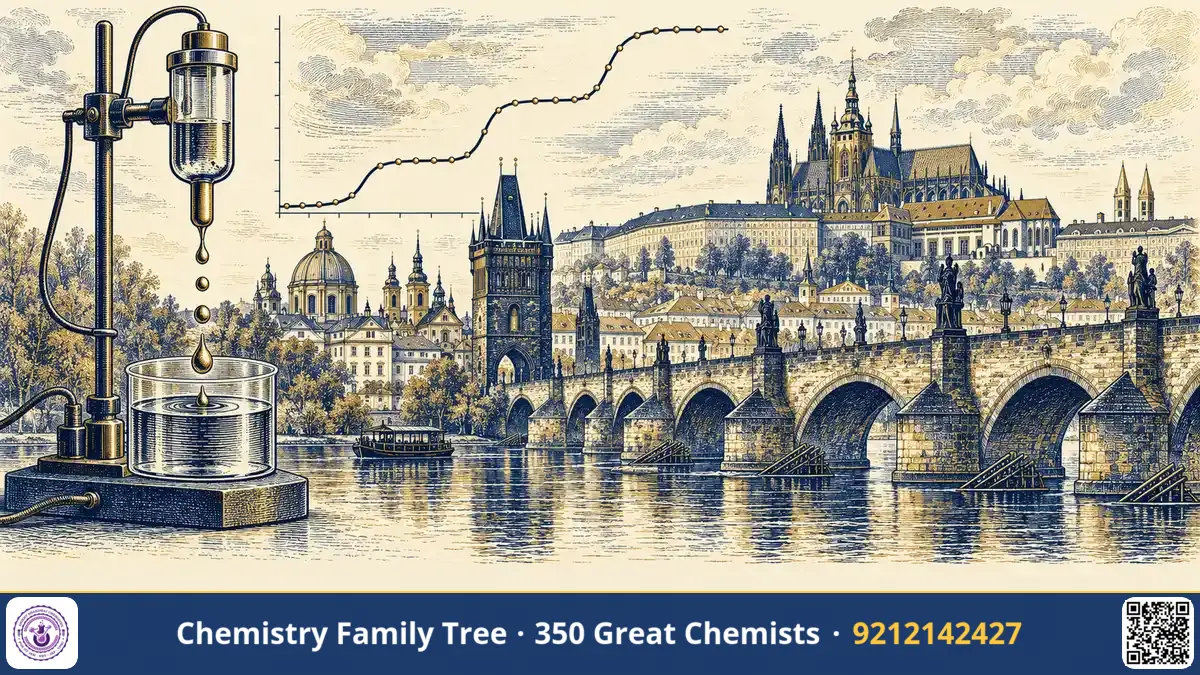
Jaroslav Heyrovský was a Czech physical chemist who invented polarography, a method of chemical analysis based on the current that flows at a dropping mercury electrode. He is regarded as the founder of modern electroanalytical chemistry, and in 1959 he became the first Czechoslovak scientist to receive a Nobel Prize in Chemistry. His one-line legacy: from a falling drop of mercury he built a method that detects and measures tiny amounts of substances in solution.
Early Life and Family
Heyrovský was born on 20 December 1890 in Prague, then part of the Austro-Hungarian Empire. His father, Leopold Heyrovský, was a professor of Roman law at Charles University, and the family was educated and cultured. Jaroslav grew up in a home where learning was valued. He attended a Prague gymnasium, and his interest in physics and chemistry grew during his school years.
Education and Mentors
He began his studies in 1909 at Charles University in Prague, studying chemistry, physics and mathematics. In 1910 he continued at University College London, where he studied chemistry and physics and obtained a bachelor's degree in 1913. In London he worked under the famous William Ramsay, the discoverer of the noble gases, and after Ramsay's retirement under Frederick Donnan, an expert in physical chemistry. He carried out research on the electrode potential of aluminium, which taught him about electrode processes at mercury surfaces. This was good preparation for his later discovery. The outbreak of the First World War cut his London studies short, and he returned to his country, completing his doctorate at Charles University in 1918, and later received a DSc from London in 1921.
Career Timeline
| Year | Event |
|---|---|
| 1890 | Born in Prague |
| 1910-1914 | Studies at University College London |
| 1914-1918 | Wartime service in a military hospital, working in medical radiology and pharmacy |
| 1918-1919 | Doctorate in Prague |
| 1920 | Appointed to Charles University, Prague |
| 1922 | Discovers polarography (10 February) |
| 1924 | Builds the first polarograph with Masuzo Shikata |
| 1926 | Becomes professor of physical chemistry at Charles University |
| 1950 | Heads the newly created Polarographic Institute (Czechoslovak Academy of Sciences) |
| 1959 | Nobel Prize in Chemistry |
| 1967 | Dies in Prague |
Major Scientific Contributions
Polarography. Using a mercury electrode that drips continuously from a capillary, Heyrovský obtained current-voltage curves with steps. The step position (half-wave potential, E½) shows which ion is present, and the step height (diffusion current) shows its concentration. D. Ilkovič gave the equation i_d = 607 n D^½ m^⅔ t^⅙ C in 1934.
The polarograph. With Shikata he constructed an instrument that recorded the curve automatically, one of the earliest automatic analytical instruments. It reduced analysis time from hours to minutes.
Electrode processes and organic polarography. He and his students used polarography to study reduction of organic compounds, catalytic hydrogen waves, and oxidation-reduction processes. Their results contributed to the understanding of electrode kinetics, reversibility, and mechanisms.
School of electrochemistry. He built a school in Prague that trained scientists from many countries. The Polarographic Institute that he led became a world centre. It later took his name as the J. Heyrovský Institute of Physical Chemistry of the Czech Academy of Sciences.
The theory and details are explained in the companion discovery article.
Awards, Honours and Nobel Prize
Heyrovský was awarded the 1959 Nobel Prize in Chemistry "for his discovery and development of the polarographic methods of analysis". He was a member of the Czechoslovak Academy of Sciences, received honorary degrees and memberships from foreign academies, and was widely recognised by scientific societies. His name lives on in the institute and in the Heyrovský Discussions on electrochemistry.
Personality, Struggles and Lesser-Known Facts
- During the First World War Heyrovský served as a dispenser and radiologist in a military hospital, and during these years he continued thinking about electrode problems. After the war he finished his doctorate.
- His own early curves were made by hand, noting each current reading as the voltage was changed; the automatic polarograph came two years later.
- Masuzo Shikata, a Japanese visitor to his laboratory, shared in the construction of the first polarograph in 1924, an early example of international scientific cooperation.
- He worked through two world-shaking political eras in Czechoslovakia: Nazi occupation in which the universities were closed, and the post-war communist period. He kept his research going and remained a respected scientist.
- The institute that grew from his laboratory in Prague now carries his name, the J. Heyrovský Institute of Physical Chemistry.
Legacy and Influence on Modern Chemistry
Polarography grew into voltammetry, which is now used all over the world: differential pulse, square wave, stripping voltammetry and cyclic voltammetry all descend from Heyrovský's idea of scanning potential and measuring current. Today's electrochemical sensors, from the glucose strips used by diabetic patients to heavy-metal sensors for water, rely on the same principles. In India, polarography and voltammetry are part of the electroanalytical chemistry syllabus of M.Sc., IIT-JAM, CSIR-NET and GATE. Questions on E½, diffusion current, supporting electrolyte and the Ilkovič equation are commonly asked.
Lessons for Students
- A good tool often comes from refining a familiar idea. Heyrovský renewed the electrode surface by letting mercury drip.
- Build instruments as well as theories. The automatic polarograph made the method useful to everyone.
- Collaborate across borders: Shikata from Japan, Ilkovič from Slovakia.
- Keep your research alive in hard times.
Quick Facts Box
- Born: 20 December 1890, Prague (Austria-Hungary)
- Died: 27 March 1967, Prague, Czechoslovakia
- Nationality: Czech (Czechoslovak)
- Field: Physical chemistry, electroanalytical chemistry
- Famous for: Polarography and the dropping mercury electrode
- Nobel Prize: Chemistry, 1959
FAQ
What is polarography used for?
For identifying and measuring electroactive substances, especially metal ions, in solution through current-voltage curves at a dropping mercury electrode.
Who built the first polarograph?
Heyrovský and Masuzo Shikata, in 1924.
Did Heyrovský study abroad?
Yes, at University College London, where he studied under William Ramsay and later Frederick Donnan.
Was his Nobel Prize shared?
No. The 1959 Nobel Prize in Chemistry was awarded to him alone.
Published by ABC Chemistry — IIT-JAM | CSIR-NET | GATE Chemistry Coaching. Visit abcchemistry.com
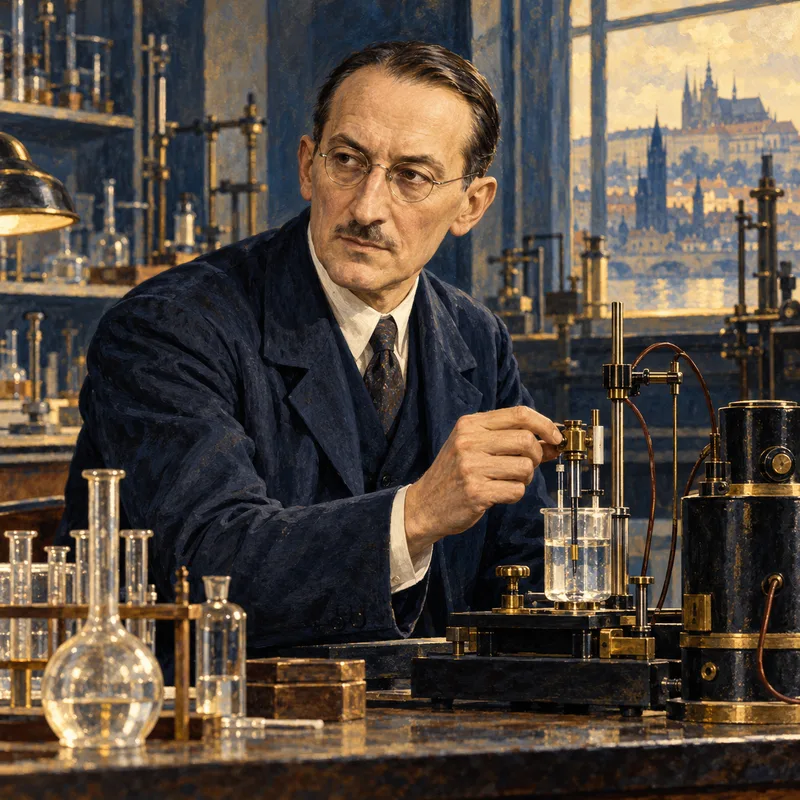
About the chemist
Jaroslav Heyrovský
1890-1967 · Czechoslovakia · Nobel Chemistry 1959
Polarography