The discovery, explained · Chemist no. 134 of 350
Jaroslav Heyrovský and Polarography: Analysing Chemistry with a Falling Drop of Mercury
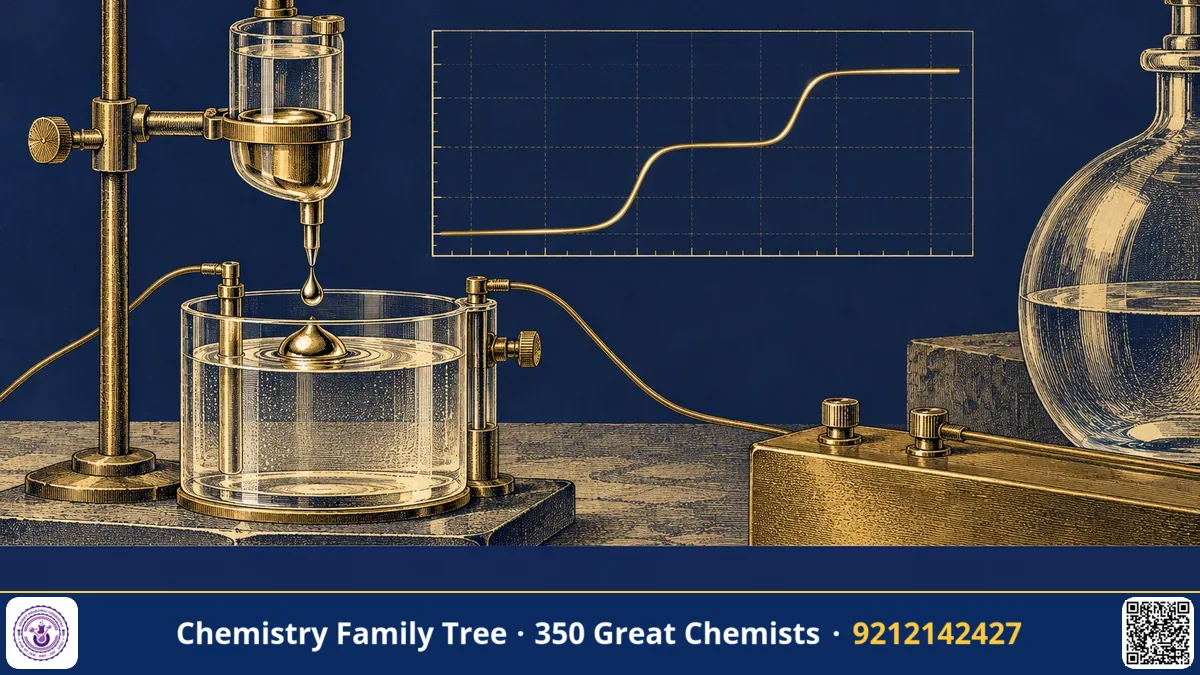
On 10 February 1922, in a laboratory in Prague, the Czech chemist Jaroslav Heyrovský recorded a current-voltage curve using a mercury electrode that dripped drop by drop from a fine glass capillary. The curve had a clear step, and the position and height of that step told him which substance was in the solution and how much. This was the birth of polarography, one of the most important electroanalytical methods of the twentieth century. For this discovery and its development, Heyrovský received the 1959 Nobel Prize in Chemistry. The ideas behind it, diffusion current, half-wave potential and the Ilkovič equation, are standard topics in JAM, NET and GATE.
The Scientific Problem Before the Discovery
Around 1900, chemists could measure the potential of an electrode at equilibrium (Nernst equation) and could carry out electrolysis at a solid metal electrode. But solid electrodes suffered from a serious problem: their surface changes during an experiment, as deposits form, gases stick and impurities accumulate, so currents were irreproducible. In dilute solutions the measurements were poor. There was no simple method to detect small amounts of several metal ions in one solution, such as lead, cadmium, zinc and copper, without lengthy separations and gravimetric work.
Heyrovský had studied the electrocapillary curve of mercury (the variation of surface tension with potential), in which the Lippmann capillary electrometer had been a classical tool, and he was studying the electrolytic deposition of aluminium on mercury. That background led him to investigate a mercury surface that renews itself continuously.
The Discovery: Step by Step
- The dropping mercury electrode (DME). Mercury flows from a reservoir through a thin glass capillary and falls in drops every few seconds into the solution. Each drop forms a fresh, clean, perfectly reproducible surface.
- The cell. The DME is the small working electrode (cathode) and a large pool of mercury or a calomel electrode serves as reference electrode. Its potential stays constant because it is large and non-polarisable.
- Scanning the voltage. The applied voltage is increased slowly, and the current is measured. In 1922 Heyrovský did it by hand, point by point, and observed that in a solution of an electroactive ion the current at first remains small, then rises sharply at a characteristic potential, and then levels off at a plateau.
- The polarograph (1924). With the Japanese chemist Masuzo Shikata, Heyrovský built an instrument that automatically recorded the current-voltage curve on photographic paper. It cut a day's work down to a few minutes. This was one of the first automatic analytical instruments.
The Chemistry Behind It
Consider the reduction of a metal ion at the dropping mercury electrode:
Cd²⁺ + 2e⁻ + Hg → Cd(Hg) (amalgam)
As the applied potential becomes more negative, the ions at the electrode surface are reduced. When the potential is negative enough, every ion reaching the surface is reduced instantly, and the current is limited by how fast ions arrive by diffusion. This gives the limiting (diffusion) current plateau. The step-shaped curve is called a polarographic wave.
- Half-wave potential (E½): the potential at which the current is half of the diffusion current. It is characteristic of the ion and its environment and is used for qualitative analysis. For a reversible reaction,
E = E½ + (0.0592/n) log [(i_d − i)/i]at 25 °C. - Diffusion current (i_d): proportional to concentration, so it is used for quantitative analysis.
In 1934 the Slovak chemist Dionýz Ilkovič, who worked with Heyrovský, derived the equation that links the average diffusion current to the experimental variables:
i_d = 607 · n · D^(1/2) · m^(2/3) · t^(1/6) · C
Here n is the number of electrons, D the diffusion coefficient (cm²/s), m the mass flow rate of mercury (mg/s), t the drop time (s) and C the concentration (mmol/L); the constant 607 gives the current in microamperes. The equation shows why the current is proportional to concentration (the basis of calibration), and why it depends on the height of the mercury column.
Practical points: a supporting electrolyte (such as KCl) is added in large excess to suppress migration current, so that only diffusion carries the ions to the electrode. Dissolved oxygen is removed by bubbling nitrogen, because O₂ gives two reduction waves of its own. A small amount of gelatin or Triton X-100 is added as a maximum suppressor to remove spurious current peaks.
Applications Today
- Trace metal analysis. Modern descendants of polarography, such as differential pulse polarography and anodic stripping voltammetry, can detect lead, cadmium, copper and zinc at parts-per-billion level in water, soil, food and blood.
- Pharmaceuticals. Many drugs and vitamins are reducible or oxidisable at an electrode and are assayed by voltammetric methods.
- Environmental monitoring. Heavy metals such as lead, cadmium and arsenic in drinking water and river samples are measured by stripping voltammetry, relevant to India's groundwater and industrial effluent monitoring.
- Organic electrochemistry. Reduction of aldehydes, ketones, nitro compounds and quinones has been studied by polarography, giving mechanisms and kinetics.
- Research. The ideas of mass transport and the diffusion layer spread into electrode kinetics, fuel cells, batteries and sensors.
Exam Corner
- Polarography uses a dropping mercury electrode (polarisable) and a non-polarisable reference electrode.
- E½ is used for qualitative analysis; the limiting diffusion current is used for quantitative analysis.
- Ilkovič equation: i_d = 607 n D^½ m^⅔ t^⅙ C.
- The supporting electrolyte removes the migration current; oxygen is removed with N₂; maxima suppressors remove current maxima.
- Residual current includes the condenser (charging) current, which limits detection to about 10⁻⁵ M for classical DC polarography.
Common Misconceptions
- "Mercury electrode means the mercury is consumed in the reaction." The mercury only acts as an inert electrode surface (or forms an amalgam).
- "Half-wave potential depends on concentration." For a reversible process, E½ is independent of concentration.
- "Polarography measures potential." It measures current as a function of applied potential.
Quick Revision Box
- Polarography was discovered by Heyrovský in 1922 with the dropping mercury electrode.
- Polarograph: built in 1924 with Shikata, the first automatic recording instrument.
- E½ identifies the species; i_d measures the amount.
- Ilkovič equation (1934): i_d = 607 n D^½ m^⅔ t^⅙ C.
- Supporting electrolyte, N₂ purging and maximum suppressors are essential.
- Nobel Prize in Chemistry 1959.
FAQ
Why is a dropping mercury electrode used?
Each drop gives a fresh, reproducible surface, and mercury has a high hydrogen overpotential, so a wide negative potential range is available.
What is the half-wave potential?
It is the potential at which the current is half of the limiting diffusion current, characteristic of the reducible substance.
Why is a supporting electrolyte added?
To remove migration of the analyte ions in the electric field, so that the current is controlled only by diffusion.
When did Heyrovský receive the Nobel Prize?
In 1959, in Chemistry, for the discovery and development of polarographic methods of analysis.
Published by ABC Chemistry — IIT-JAM | CSIR-NET | GATE Chemistry Coaching. Visit abcchemistry.com
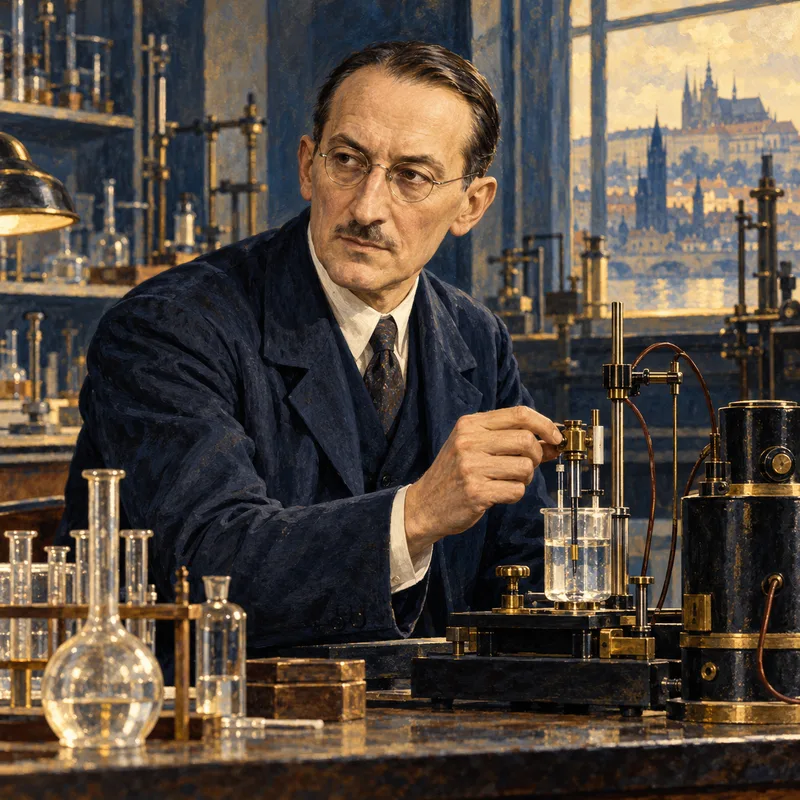
About the chemist
Jaroslav Heyrovský
1890-1967 · Czechoslovakia · Nobel Chemistry 1959
Polarography