Biography · Chemist no. 244 of 350
Jean-Baptiste Dumas (1800-1884): Chemist, Teacher and Statesman of France
Introduction
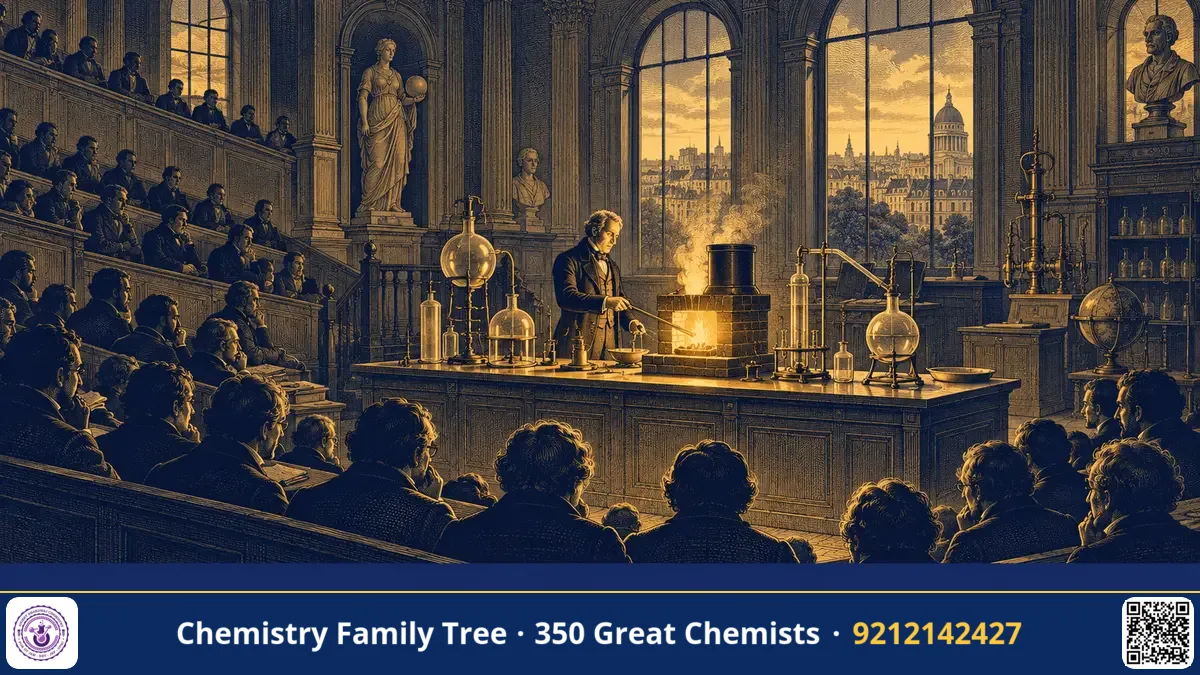
Jean-Baptiste Andre Dumas was one of the leading French chemists of the nineteenth century. He gave chemistry the Dumas methods for vapour density and for nitrogen analysis, helped to fix atomic weights, studied the substitution of hydrogen by chlorine, and trained a generation of students, among them Wurtz. He was also a politician who served as a minister. His legacy in one line: a great teacher and organiser who linked laboratory chemistry with the life of the nation.
Early Life and Family
Dumas was born on 14 July 1800 in Ales, in the south of France, in the Gard region. His father was the town clerk. As a boy he went to the local school, and he was drawn to the sciences and to books on natural history. Because the family was not rich, he was apprenticed as a young man to an apothecary in Ales. He left that work at the age of about sixteen to continue his studies, which shows early determination. A reading of Napoleonic-era events also shaped his generation, since the years of his boyhood were years of war, and French science was supported by the state.
Education and Mentors
In 1816 Dumas went to Geneva and worked in an apothecary's shop. There he met the physician Jean-Louis Prevost, with whom he did physiological research on the blood and on the process of fertilisation, publishing joint papers in the early 1820s. Geneva also put him in touch with leading scientists, including the Swiss chemists Auguste de la Rive and Alexandre Marcet. In 1821 he moved to Paris, where Alexander von Humboldt supported him, and he became a demonstrator at the Ecole Polytechnique. Louis Jacques Thenard was another senior figure who helped his early career.
Career Timeline
| Year | Event |
|---|---|
| 1800 | Born at Ales, France |
| 1816-1821 | Works in Geneva as an apothecary and researcher with Prevost |
| 1821 | Moves to Paris |
| 1826 | Publishes the method of vapour density by the sealed bulb |
| 1829 | Helps to found the Ecole Centrale des Arts et Manufactures |
| 1832 | Elected to the Academie des Sciences; discovery of anthracene with Laurent is reported in this period |
| 1834-1839 | Studies of chloroform and substitution, trichloroacetic acid |
| 1840-1841 | Atomic weight of carbon redetermined with Stas |
| 1849-1851 | Minister of Agriculture and Commerce |
| 1868 | Becomes permanent secretary of the Academie des Sciences |
| 1875 | Elected to the Academie francaise |
| 1884 | Dies at Cannes on 11 April |
Major Scientific Contributions
- Vapour density and nitrogen analysis: The two Dumas methods are still taught, and modern combustion analysers are based on the nitrogen method.
- Atomic weights: With the Belgian chemist Jean Servais Stas he determined the atomic weight of carbon by burning pure carbon and weighing CO2, and found it close to 12 when oxygen is 16. He also examined the weight of water, giving a value for the composition of water by synthesis, that is, by passing hydrogen over hot copper oxide.
- Organic chemistry: With Peligot he established the composition of methyl alcohol (wood spirit) and named the radical "methylene" in 1835. He discovered the composition of chloroform and described the substitution of hydrogen by chlorine. He proposed the "type theory" idea that a molecule keeps its type when atoms are replaced by equivalent atoms.
- Classification of elements: In 1857-1860 he arranged elements in families by similar properties and by differences in atomic weights, an early step towards the periodic table.
- Physiology and agriculture: He studied the chemistry of respiration and nutrition of plants and animals, and wrote a large treatise on applied chemistry.
CH3COOH + 3 Cl2 -> CCl3COOH + 3 HCl      (substitution, 1839)
Kjeldahl vs Dumas: wet digestion -> NH3      dry combustion -> N2
Awards, Honours and Nobel Prize
Dumas was a member of the Academie des Sciences from 1832 and served as its permanent secretary. He was made a member of the Academie francaise in 1875, an honour that few scientists received. He was elected a Foreign Member of the Royal Society of London, received the Royal Society's Copley Medal in 1843, and held many honours from other countries. He was a senator under the Second Empire, and he was Master of the Mint in the 1860s. Since he died in 1884, he never had the chance for a Nobel Prize, which began in 1901.
Personality, Struggles and Lesser-Known Facts
- He was known as a very fine lecturer, whose lectures at the Sorbonne drew large audiences, and he was admired for his clear and elegant speech.
- In 1829 he took part in founding the Ecole Centrale des Arts et Manufactures in Paris, a school for training engineers for industry, which still exists.
- He wrote a long "Traite de chimie appliquee aux arts", and this book was widely used by industry.
- His substitution theory was involved in a famous dispute over credit with Auguste Laurent, and the public discussion became bitter. Historians agree that Laurent's ideas were important, and that Dumas's position at the top of the French scientific system made it hard for Laurent to be heard.
- In his later years he was devoted to the Academie and to the editing of works of Lavoisier, whose work he admired and whose collected writings were published in his time.
Legacy and Influence on Modern Chemistry
Dumas's students included Charles Adolphe Wurtz, Jean Stas worked with him, and many others carried his methods into laboratories around the world. His combustion nitrogen method is the ancestor of the automated analysers used for nitrogen and protein testing. His work on substitution helped to end the strict electrochemical dualism of Berzelius and moved organic chemistry towards the structural ideas of the second half of the century. His atomic weight work, with its great care, supported the later acceptance that carbon should be 12, which in 1961 became the basis of the unified atomic mass unit.
Lessons for Students
- Good methods outlive theories. Many of the theories of the 1830s were replaced, but the Dumas method is still taught.
- Begin with whatever you have. Dumas started as an apothecary's apprentice and became a minister.
- Share credit generously. The dispute with Laurent shows how neglect of a colleague's work can harm both science and reputation.
- Teach what you learn. Dumas's influence came as much from his students as from his own papers.
Quick Facts Box
- Born: 14 July 1800, Ales, France
- Died: 11 April 1884, Cannes, France
- Nationality: French
- Field: Organic and analytical chemistry, atomic weights
- Famous for: Dumas vapour density and nitrogen methods; substitution reactions
- Nobel Prize: None (died before the prizes began); Copley Medal 1843
FAQ
What is Jean-Baptiste Dumas famous for?
He is famous for the Dumas methods of vapour density and nitrogen estimation, for his work on atomic weights and for the substitution of hydrogen by chlorine in organic compounds.
Was Dumas a politician?
Yes. He served as French Minister of Agriculture and Commerce from 1849 to 1851 and later as a senator and Master of the Mint.
Who were Dumas's famous students?
Charles Adolphe Wurtz was one of his well-known students and assistants, and many other French chemists trained under his influence.
Did Dumas win a Nobel Prize?
No. He died in 1884, before the Nobel Prizes began, but he won the Copley Medal in 1843.
Published by ABC Chemistry — IIT-JAM | CSIR-NET | GATE Chemistry Coaching. Visit abcchemistry.com
About the chemist
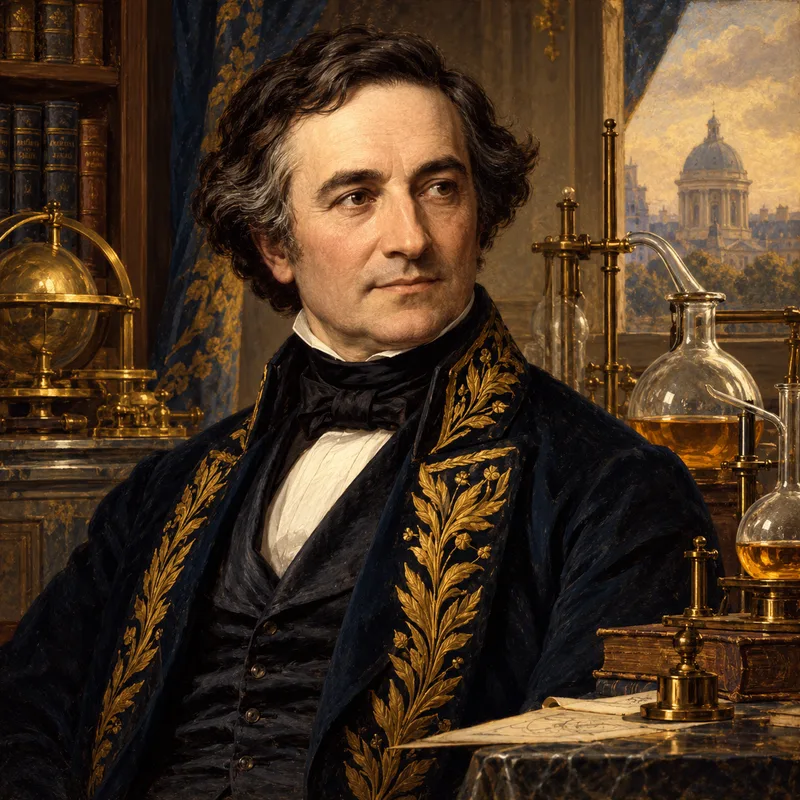
Jean-Baptiste Dumas
1800-1884 · France
Vapor density method; organic analysis