Biography · Chemist no. 89 of 350
Jean-Marie Lehn: The French Chemist Who Created "Chemistry Beyond the Molecule"
Jean-Marie Pierre Lehn is a French chemist, born in 1939, who founded the field of supramolecular chemistry: the study of how molecules recognise each other, assemble and work together through non-covalent interactions. His legacy in one line: he taught chemists to design not only molecules but also the organised systems that molecules can form. He shared the 1987 Nobel Prize in Chemistry with Donald Cram and Charles Pedersen. His cryptands, helicates and ideas about self-assembly appear in textbooks and exam syllabi all over the world.
Early Life & Family
Lehn was born on 30 September 1939 in Rosheim, a small town in Alsace, eastern France. His father ran a bakery, and the family lived in a modest home in a region that suffered greatly in the years of the Second World War, when Alsace was annexed by Germany. As a boy Lehn was interested in music and played the organ, and he was also an excellent student. He has often described how he came to science through broad interests in arts, philosophy and nature.
Education & Mentors
Lehn studied at the University of Strasbourg. He did his doctoral work under Guy Ourisson, an organic chemist who used nuclear magnetic resonance (NMR) to study natural products. Lehn obtained his doctorate in 1963 and worked on NMR studies of molecular structure and on processes such as nitrogen inversion. In 1964-1965 he spent a year as a postdoctoral researcher at Harvard University with R. B. Woodward, who was then leading the synthesis of vitamin B12. This experience showed him the power of planned organic synthesis, and in later years he applied those skills to the synthesis of cage molecules. Returning to Strasbourg, he combined his interests in organic synthesis, physical methods and biology.
Career Timeline
| Year | Event |
|---|---|
| 1939 | Born in Rosheim, Alsace, France (30 September) |
| 1963 | Doctorate at the University of Strasbourg, under Guy Ourisson |
| 1964-1965 | Postdoctoral year with R. B. Woodward at Harvard University |
| 1969 | First synthesis of cryptands with Dietrich and Sauvage |
| 1970 | Becomes professor at the University of Strasbourg |
| 1979 | Appointed to the chair of Chemistry of Molecular Interactions at the Collège de France, Paris |
| 1987 | Nobel Prize in Chemistry |
| 1987 onward | Develops helicates, self-assembly and dynamic covalent chemistry |
| 2002 | Helps to found the Institute of Supramolecular Science and Engineering (ISIS) in Strasbourg |
Major Scientific Contributions
- Cryptands: three-dimensional cage ligands that bind alkali and alkaline-earth metal ions with high selectivity.
- Supramolecular chemistry as a field: he gave the field its name, its concepts (molecular recognition, preorganisation) and a broad research programme.
- Self-assembly and helicates: spontaneous formation of double-helical metal complexes from oligobipyridine strands and copper(I).
- Dynamic covalent chemistry: using reversible bond formation to let molecular systems adapt and select the best structure.
- Chemistry of information: ideas on how supramolecular systems store and process information, in analogy with biology.
The synthesis and details of cryptands are covered in the companion discovery blog on supramolecular chemistry.
Awards, Honours & Nobel Prize
The Nobel Prize in Chemistry 1987 was awarded jointly to Donald J. Cram, Jean-Marie Lehn and Charles J. Pedersen "for their development and use of molecules with structure-specific interactions of high selectivity". Lehn has also received many honours, including honorary doctorates, membership of the French Academy of Sciences and other academies in Europe and America. He has held a professorship at the Collège de France, one of France's most prestigious institutions of learning, where professors lecture to the public without giving degrees.
Personality, Struggles & Lesser-Known Facts
- He was the son of a baker and grew up in a small Alsatian town. His story shows that scientific excellence does not depend on privileged backgrounds.
- He is a musician and played the organ in his youth, and he often links the ideas of harmony and organisation in music to the order of molecular assemblies.
- He worked as a postdoctoral researcher with Woodward, one of the greatest synthetic chemists of the century.
- His cryptand work was inspired by biological ionophores, natural molecules that carry ions through membranes. He studied biology to understand what chemistry should imitate.
- He shared his prize with Cram and Pedersen. Pedersen made crown ethers by accident in industry; Cram and Lehn developed the ideas into a planned science.
- He has been very active as an advocate for fundamental research and for scientific cooperation, including between France and other countries.
Legacy & Influence on Modern Chemistry
Supramolecular chemistry is now one of the major branches of chemistry. It supports the design of molecular sensors, drug-delivery systems, self-healing materials and metal-organic frameworks. The 2016 Nobel Prize in Chemistry for molecular machines (Sauvage, Stoddart, Feringa) belongs to the same intellectual tradition, and Jean-Pierre Sauvage had been Lehn's early co-worker on the cryptands. Concepts such as host-guest binding, preorganisation, self-assembly and self-sorting help explain how DNA, proteins and cell membranes work. In teaching, Lehn's definition of supramolecular chemistry as "chemistry beyond the molecule" is one of the most quoted lines in chemistry.
Lessons for Students
- Look to nature for ideas. Enzymes and ion carriers inspired cryptands.
- Combine skills. Synthesis, spectroscopy and biology all came together in his work.
- Build the field, not only the compound. Naming and organising a new area allows others to join.
- Keep culture in your life. Music and art can enrich scientific thinking.
Quick Facts Box
- Born: 30 September 1939, Rosheim, Alsace, France
- Died: Not recorded in our source list (listed as 1939-); please check a current source
- Nationality: French
- Field: Organic and supramolecular chemistry
- Famous for: Cryptands; founding of supramolecular chemistry
- Nobel Prize: Chemistry, 1987 (with D. J. Cram and C. J. Pedersen)
FAQ
Where did Lehn work for most of his career?
At the University of Strasbourg and at the Collège de France in Paris.
Who was Lehn's doctoral supervisor?
Guy Ourisson, an organic chemist at the University of Strasbourg.
What is the difference between Lehn's and Pedersen's discoveries?
Pedersen discovered crown ethers (two-dimensional rings). Lehn created cryptands (three-dimensional cages) and developed the broader field of supramolecular chemistry.
What is dynamic covalent chemistry?
It is a method that uses reversible covalent reactions, so that a mixture of components can rearrange and the most stable assembly forms.
Published by ABC Chemistry — IIT-JAM | CSIR-NET | GATE Chemistry Coaching. Visit abcchemistry.com
About the chemist
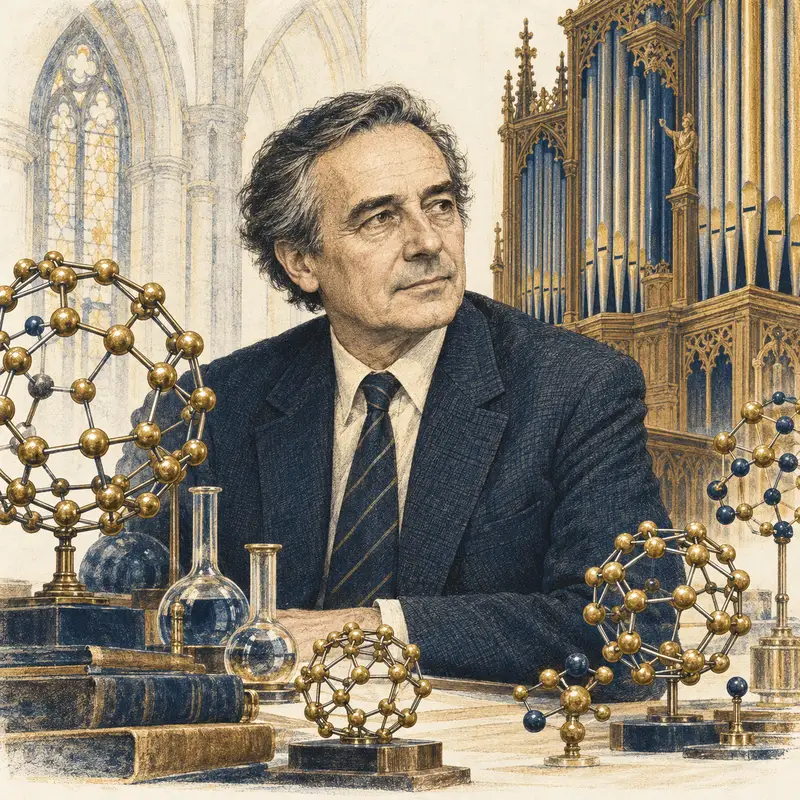
Jean-Marie Lehn
1939- · France · Nobel Chemistry 1987
Supramolecular chemistry