The discovery, explained · Chemist no. 89 of 350
Cryptands and Supramolecular Chemistry: Jean-Marie Lehn's "Chemistry Beyond the Molecule"
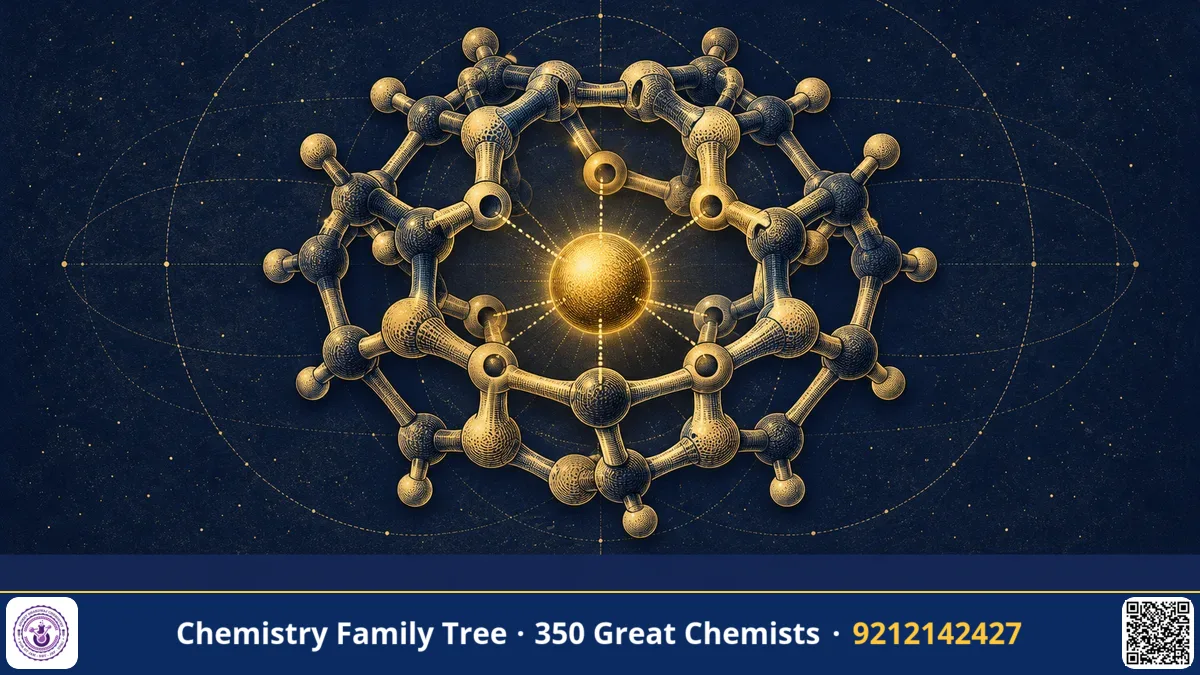
Traditional chemistry is the chemistry of the covalent bond: atoms are joined into molecules. But in living cells, enzymes recognise substrates, DNA strands pair, and ions cross membranes without any new covalent bonds forming. These actions depend on weaker forces such as hydrogen bonds, ion-dipole attractions and van der Waals forces. Jean-Marie Lehn of Strasbourg, France, asked whether chemists could design molecules that recognise each other through such forces. In 1969 he made the first cryptands, three-dimensional cage molecules that capture metal ions with great strength and selectivity. He developed from this the new field of supramolecular chemistry, which he described as "chemistry beyond the molecule". Lehn shared the 1987 Nobel Prize in Chemistry with Donald Cram and Charles Pedersen.
The Scientific Problem Before the Discovery
Lehn's interest came from neurochemistry and biological processes. How do nerve cells use sodium and potassium ions? How do enzymes pick one substrate among thousands? Natural compounds such as valinomycin, an antibiotic that carries K+ across membranes, show that organic molecules can bind specific ions. Chemists wanted synthetic models.
In 1967 Charles Pedersen had discovered the crown ethers, flat rings of repeating -CH2CH2O- units that bind alkali metal ions. They were an exciting advance, but they were two-dimensional: the ion sits in a ring and can slip out sideways, and its complexes were not very strong in polar solvents. Lehn thought that a three-dimensional cage would hold an ion more tightly and distinguish between ions of different sizes more accurately.
The Discovery / Experiment — Step by Step
Lehn and his co-workers in Strasbourg, working with Jean-Pierre Sauvage and Bernard Dietrich, built bicyclic cage molecules using a synthesis in several stages:
- Start with a diaza-crown ether, a macrocycle with two nitrogen atoms at opposite positions, and an acid chloride derivative of a polyether diacid.
- High-dilution coupling. Mixing the diamine with the diacid dichloride in very dilute solution favours ring closure (intramolecular reaction) over polymer formation (intermolecular reaction). The result is a bicyclic diamide.
- Reduction. Reducing the amide C=O groups with a hydride reagent, such as diborane or lithium aluminium hydride, gives the bicyclic polyether-diamine, the cryptand.
Diaza-18-crown-6 + ClOC–CH2OCH2CH2OCH2–COCl → macrobicyclic diamide (high dilution)
Diamide + reducing agent (e.g. LiAlH4 or B2H6) → cryptand N[(CH2CH2O)2CH2CH2]3N
The most famous cryptand is [2.2.2], with three bridges, each with two oxygen atoms, between two bridgehead nitrogen atoms; the numbers show the number of oxygen atoms in each bridge. The cryptands [2.1.1] and [2.2.1] are smaller. When a metal ion enters the central cavity, the ion is surrounded by six oxygen atoms and two nitrogen atoms, and the complex is called a cryptate.
K+ + [2.2.2] cryptand ⇌ [K ⊂ 2.2.2]+ (very large formation constant)
The Chemistry Behind It
Selectivity by size
Cryptand binding depends on how well the ion fits the cavity:
| Host | Best-fitting ion |
|---|---|
| [2.1.1] cryptand | Li+ |
| [2.2.1] cryptand | Na+ |
| [2.2.2] cryptand | K+ (also binds Ba2+ and Sr2+ strongly) |
Why are cryptates stronger than crown ether complexes?
- Cryptate effect: the complexes of cryptands are much more stable than those of the corresponding crown ethers, often by several orders of magnitude.
- Preorganisation: the cryptand is already shaped like a cage before it meets the ion. It loses little entropy upon binding, and few conformational changes are needed.
- Complete encapsulation: the ion is wrapped on all sides, so the solvent cannot easily replace the donor atoms.
- Chelate and macrocyclic effects: multidentate binding releases solvent molecules, which increases entropy.
Self-assembly and molecular recognition
Lehn's concept of "molecular recognition" describes a host recognising a guest by size, shape and charge, like Emil Fischer's "lock-and-key" idea for enzymes. Later, Lehn showed self-assembly: for example, strands of oligobipyridine and copper(I) ions come together spontaneously to form double-helical complexes (helicates) in which the metal ions sit in a tetrahedral environment of four nitrogen atoms. He also introduced dynamic covalent chemistry, in which reversible bonds allow a system to select the best product from many possibilities.
Applications Today
- Medical imaging: cryptand [2.2.2] (sold as Kryptofix 222) is used with potassium carbonate in the synthesis of the PET tracer 18F-fluorodeoxyglucose (FDG), where it makes fluoride a strong nucleophile for substitution.
- Ion-selective sensors: cryptand and crown ether derivatives are used in electrodes and fluorescent sensors for Na+, K+ and Ca2+ in blood.
- Phase-transfer catalysis: they bring ionic reagents into organic solvents, making "naked" and highly reactive anions.
- Nuclear waste and metal separation: cryptands and similar hosts are studied for selective capture of cations such as Sr2+ and Cs+.
- Nanotechnology and materials: self-assembled capsules, cages and molecular machines follow Lehn's principles; the 2016 Nobel Prize in Chemistry for molecular machines used related concepts.
Exam Corner — 5 Likely Points
- Cryptand [2.2.2] has 2 N and 6 O donor atoms in a bicyclic cage, and binds K+ best.
- Cryptate effect: cryptand complexes are more stable than crown ether complexes because of preorganisation and complete encapsulation.
- Supramolecular chemistry: chemistry of non-covalent interactions between molecules (host-guest, self-assembly).
- High-dilution technique favours cyclisation over polymerisation.
- Nobel Prize in Chemistry 1987: Cram, Lehn, Pedersen, for host-guest molecules with structure-specific interactions.
Common Misconceptions
- "Supramolecular chemistry only deals with weak forces, so it is not important." Many biological processes depend on weak forces working together.
- "Cryptands and crown ethers are the same." Crown ethers are monocyclic; cryptands are bicyclic or polycyclic and bind more strongly.
- "A bigger cavity always binds better." Selectivity comes from a good fit, not simply from size.
Quick Revision Box
- Lehn made the first cryptands in 1969 in Strasbourg.
- [2.2.2] cryptand: N(CH2CH2OCH2CH2OCH2CH2)3N.
- Cryptates are more stable than crown ether complexes (cryptate effect).
- Supramolecular chemistry covers recognition, self-assembly and molecular devices.
- Kryptofix 222 is used in PET tracer synthesis.
- Nobel Prize in Chemistry 1987 shared with D. J. Cram and C. J. Pedersen.
FAQ
What does "[2.2.2]" mean in a cryptand's name?
It gives the number of oxygen donor atoms in each of the three bridges that connect the two nitrogen atoms.
Why is high dilution used in the synthesis?
At low concentration, the two ends of one molecule are more likely to meet each other than another molecule, so rings form instead of polymers.
What is a helicate?
A helicate is a metal complex in which one or more ligand strands wrap around metal ions like a helix, as in the double-helical complexes of copper(I).
How is Lehn's work related to biology?
Enzymes, receptors, DNA base pairing and ion channels all use molecular recognition, which Lehn's synthetic systems copy and explain.
Published by ABC Chemistry — IIT-JAM | CSIR-NET | GATE Chemistry Coaching. Visit abcchemistry.com
About the chemist
Jean-Marie Lehn
1939- · France · Nobel Chemistry 1987
Supramolecular chemistry