Biography · Chemist no. 206 of 350
Jean-Pierre Sauvage: The Chemist Who Taught Molecules to Link and Move
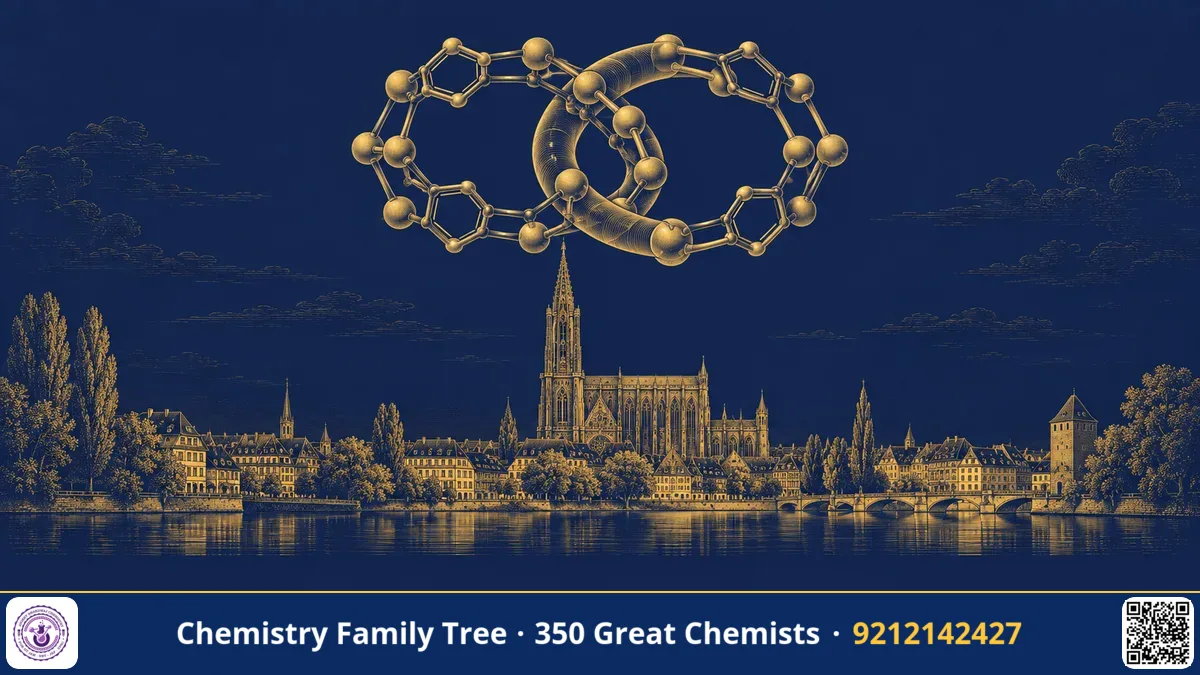
Jean-Pierre Sauvage (born 21 October 1944) is a French chemist, an emeritus professor at the University of Strasbourg, and one of three winners of the 2016 Nobel Prize in Chemistry. His legacy in one line: he found a practical way to interlock molecular rings, and thereby helped found the field of artificial molecular machines.
Early Life and Family
Sauvage was born in Paris. He grew up in post-war France, a period when science and technology were seen as pillars of national recovery. He showed interest in science and mathematics at school, and he later described a curiosity about how matter is organised at the level of molecules. Few personal details of his family are widely documented, so we leave them aside here.
Education and Mentors
Sauvage studied chemistry at the University of Strasbourg, in the city that became his scientific home. He carried out his doctoral research under Jean-Marie Lehn, who would himself win the Nobel Prize in Chemistry in 1987 for supramolecular chemistry. Sauvage worked with Lehn on cryptands, three-dimensional cage-like ligands that bind metal ions, and received his doctorate in the early 1970s. He also did a postdoctoral stay with Malcolm Green at Oxford, working in organometallic chemistry. This blend of coordination chemistry, ligand design and supramolecular thinking shaped his later breakthroughs.
Career Timeline
| Year | Event |
|---|---|
| 1944 | Born in Paris, France |
| Early 1970s | Doctorate at Strasbourg with Jean-Marie Lehn |
| 1970s | Postdoctoral research at Oxford with Malcolm Green |
| 1979 | Becomes a research director at the French CNRS in Strasbourg |
| 1983 | Publishes the copper-templated synthesis of a catenane |
| 1980s-1990s | Makes molecular knots; develops catenane and rotaxane switches |
| 2016 | Shares the Nobel Prize in Chemistry |
Major Scientific Contributions
- Templated catenane synthesis: used Cu(I) and two phenanthroline ligands to thread and interlock rings in good yield.
- Molecular knots: built a trefoil knot on a double-helix metal template, one of the first synthetic molecular knots.
- Redox-switchable machines: showed that changing the oxidation state of a metal moves one ring relative to another.
- Artificial muscles: his group designed linked rotaxane dimers that mimic muscle contraction and extension at the molecular scale.
- Photochemistry of metal complexes: early work on ruthenium and copper complexes for light-driven electron transfer and artificial photosynthesis ideas.
The details of the chemistry are explained in our companion post on catenane synthesis.
Awards, Honours and Nobel Prize
In 2016, the Nobel Prize in Chemistry was shared by Jean-Pierre Sauvage, Sir J. Fraser Stoddart and Bernard L. Feringa "for the design and synthesis of molecular machines". Sauvage is a member of the French Academy of Sciences and has received many other distinctions, including honours from French scientific institutions. He is an emeritus professor at the University of Strasbourg and a member of the Institut de Science et d'Ingénierie Supramoléculaires there.
Personality, Struggles and Lesser-Known Facts
- A lab of chemists, not a lab of machines: Sauvage often stressed that the field was driven by curiosity about structure, not by a goal of building devices.
- Inspired by nature: Biological motors such as ATP synthase and muscle proteins motivated him to ask whether chemists could make simpler artificial analogues.
- Twenty-seven percent: The original catenane synthesis gave a yield of about 27 percent, a spectacular jump from earlier efforts where yields were tiny.
- Same city, three generations: Strasbourg's tradition links Lehn, Sauvage and many successors; a single city became a centre of supramolecular chemistry.
- Waiting for recognition: The importance of the 1983 result was appreciated over time. The Nobel arrived more than three decades later, when the field of molecular machines had matured.
Legacy and Influence on Modern Chemistry
Sauvage's template idea became a general strategy: use non-covalent interactions or metal coordination to pre-organise molecules, then lock the arrangement with covalent bonds. This strategy is used in synthesis of rotaxanes, knots, molecular cages and polymers. Today, researchers in many countries, including India, work on molecular switches, interlocked materials and nano-scale devices that trace directly to the 1983 breakthrough. He also helped to make chemistry visible to the public by showing how beautiful molecular topology can be.
It is worth understanding why his approach mattered for the wider practice of chemistry. Before the template idea, a synthetic chemist who wanted an unusual shape had to rely on luck. After it, the question became one of design: choose a metal ion with a known coordination geometry, choose ligands that fit that geometry, and let the metal organise the pieces. This is the same logic students meet in coordination chemistry, where Cu(I), Zn(II) or Ru(II) each prefer a particular arrangement of donor atoms. Sauvage showed that this textbook knowledge can be used as a construction tool. Younger chemists who followed him now make molecular machines, rotaxane polymers and even molecular ribbons using ideas that trace back to his Strasbourg laboratory. His career also shows the value of a long, steady research programme: the same family of copper-phenanthroline complexes served him for photochemistry, for catenanes, for knots and for machines.
Lessons for Students
- Know your basics deeply. Sauvage's insight came from understanding Cu(I) geometry, a topic you study in class 12 and B.Sc.
- Borrow ideas across topics. He applied coordination chemistry to a topology problem.
- A good mentor matters. Working with a creative supervisor gave him tools and ambition.
- Be patient. Recognition can arrive decades after the work.
- Think of function. Ask not only "what is the structure?" but "how does it move?"
Quick Facts Box
- Born: 21 October 1944, Paris, France
- Died: Living (as of this writing)
- Nationality: French
- Field: Coordination and supramolecular chemistry
- Famous for: Templated synthesis of catenanes, molecular knots, molecular machines
- Nobel: Chemistry 2016, shared with Fraser Stoddart and Ben Feringa
FAQ
Who was Sauvage's doctoral supervisor?
Jean-Marie Lehn, who won the Nobel Prize in Chemistry in 1987.
What is the main idea of his Nobel-winning work?
Using a metal ion as a template to link molecular rings into a catenane, which gave rise to controllable molecular machines.
Where did he work?
Mainly in Strasbourg, France, with the CNRS and the University of Strasbourg.
Why is it relevant to coaching students?
It connects coordination chemistry, ligand field ideas and supramolecular concepts that appear in inorganic chemistry papers.
Published by ABC Chemistry — IIT-JAM | CSIR-NET | GATE Chemistry Coaching. Visit abcchemistry.com
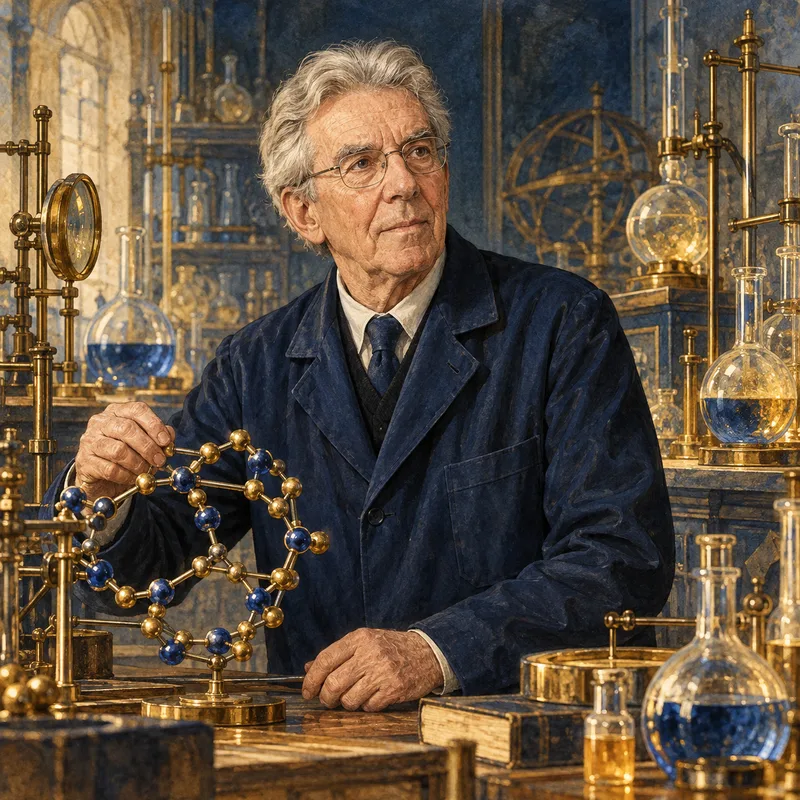
About the chemist
Jean-Pierre Sauvage
1944- · France · Nobel Chemistry 2016
Catenanes and molecular machines