The discovery, explained · Chemist no. 206 of 350
Jean-Pierre Sauvage and the First Catenane: Linking Molecules Like Chain Links
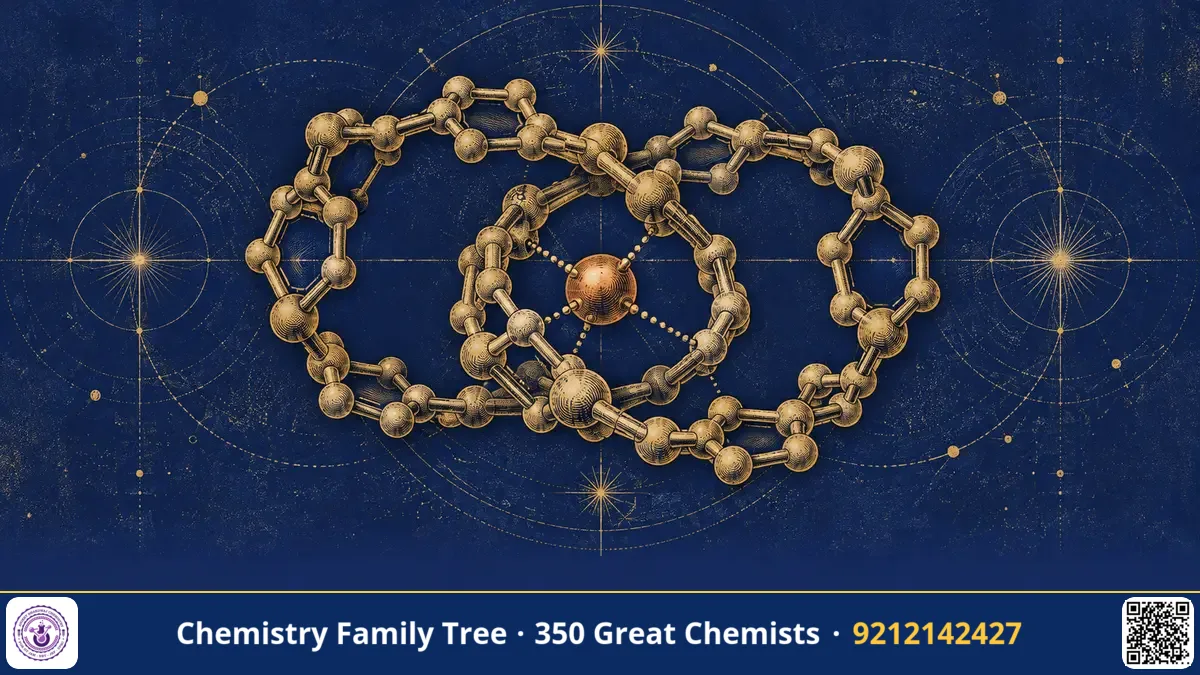
Can two molecules be linked together like two rings of a chain without any chemical bond between them? This sounds like a puzzle, but chemists wondered about it for decades. In 1983, Jean-Pierre Sauvage and his team in Strasbourg, France, answered with an elegant, high-yielding method that used a metal ion as a template. They made a catenane, a molecule made of two interlocked rings. This work opened the road to artificial molecular machines, and in 2016 Sauvage shared the Nobel Prize in Chemistry with Fraser Stoddart and Ben Feringa "for the design and synthesis of molecular machines".
The Scientific Problem Before the Discovery
Chemists had imagined interlocked molecules since the early 1960s. The names come from Latin: catena means chain. A [2]catenane has two rings, each threaded through the other. The bond between them is not a normal covalent bond; it is a mechanical bond, because the rings cannot separate unless one of them is broken.
Early syntheses relied on statistics. If you close a large ring in the presence of another ring, there is a very small chance that a chain end threads through the ring before closing. The yields were tiny, often much less than one percent. That is useless for real research. Nature, however, already makes interlocked and knotted DNA, so chemists felt it must be possible to do better. What was missing was a way to control threading.
The Discovery: Step by Step
Sauvage's group was studying transition-metal complexes for light-driven electron transfer, mostly copper(I) and ruthenium(II) complexes of ligands like 1,10-phenanthroline. This background gave him a key idea: use a metal ion to hold two ligands in a defined shape, in effect a molecular "template".
- Choose the ligand: 2,9-disubstituted 1,10-phenanthroline units are bidentate, meaning they bind a metal ion through two nitrogen atoms.
- Use Cu(I) as template: Copper(I) is d¹⁰ and prefers a four-coordinate, roughly tetrahedral geometry. Two phenanthrolines bind to one Cu⁺ ion, with their planes almost perpendicular to each other, like two crossed blades.
- Prepare the threaded complex: One phenanthroline is part of a macrocycle (a ring). The other is part of an open-chain molecule with reactive ends. When Cu⁺ is added, the open chain threads through the ring because both ligands wrap around the metal.
- Close the second ring: The two ends of the threaded chain are joined by a ring-closing reaction (originally a Williamson-type etherification, linking hydroxyl-bearing ends through a polyether chain).
- Remove the metal: Treatment with cyanide removes copper as [Cu(CN)ₓ] complexes, giving the free catenane with two interlocked rings.
[Cu(ring-phen)(chain-phen)]⁺ → ring closing → [Cu(catenate)]⁺ → CN⁻ → catenane (free) + Cu(I) cyanide complex
The first demonstration was published in 1983, with a yield of about 27 percent, a huge improvement over earlier statistical efforts. Later optimisation of the same template idea gave much higher yields. Sauvage's work was a breakthrough because it showed that interlocked structures could be made rationally rather than by chance.
Next steps: knots and motion
Using the same principle with metal templates, Sauvage's group also made molecular knots, such as a trefoil knot, using a double-helical arrangement of ligands around two metal centres. They also began to ask how the rings in a catenane could move. In copper catenanes, the rings can be made to change position when the metal changes oxidation state, because Cu(I) prefers four-coordination and Cu(II) prefers five or six. This redox-triggered motion is a simple example of a molecular machine and led to rotaxane and catenane "muscles" that contract and extend.
The Chemistry Behind It
- Coordination chemistry: Cu(I) has a d¹⁰ configuration with no crystal-field preference, so geometry is set by sterics and electrostatics, which favours tetrahedral coordination. Cu(II) (d⁹) favours square planar or square pyramidal geometry due to Jahn-Teller distortion.
- Template effect: The metal holds the reacting parts in the right orientation, reducing the entropy cost of threading and increasing effective molarity.
- Mechanical bond: The rings are held together topologically, not by atoms sharing electrons. Breaking a ring is the only way to separate them.
- Pi-stacking and chelate effect: The flat aromatic phenanthrolines stack and chelate strongly, which stabilises the complex.
- Redox switching: Changing Cu(I) to Cu(II) electrochemically changes the preferred geometry, and the ring moves to satisfy it.
Applications Today
- Molecular machines: Switches, shuttles and rotors built from rotaxanes and catenanes are used to study motion at the nanoscale.
- Smart materials: Mechanically interlocked polymers can show unusual toughness and self-healing behaviour.
- Drug delivery research: Gated nanocarriers that open on a chemical or light signal.
- Data storage ideas: Bistable molecules that exist in two states can in principle store bits.
- Teaching topology: Catenanes link chemistry with mathematics through knot theory.
It is fair to add that most of these applications are still at the research stage. The Nobel recognised the creation of a new field, in the way that the Wright brothers' first flights opened aviation.
Exam Corner
- Define catenane: two or more rings interlocked by a mechanical bond.
- Why is Cu(I) suitable as a template? d¹⁰, prefers tetrahedral four-coordination with two bidentate phenanthrolines.
- How is the metal removed? By cyanide, forming stable copper cyanide complexes.
- Nobel 2016 Chemistry: Sauvage, Stoddart, Feringa (molecular machines).
- Difference between rotaxane and catenane: a rotaxane is a ring threaded on an axle with end stoppers; a catenane has two interlocked rings.
Common Misconceptions
- "Catenanes have a covalent bond between rings." No. The linkage is mechanical, not covalent.
- "The metal remains in the final catenane." It is used as a template and then removed, although metal-containing catenanes are also useful.
- "Molecular machines are tiny robots." They are molecules with controlled, repeatable motion in response to a stimulus; they are not robots with brains.
Quick Revision Box
- First template-synthesised catenane: Sauvage, 1983, Strasbourg.
- Template: Cu(I) with two 1,10-phenanthroline ligands.
- Metal removal with CN⁻.
- Cu(I) prefers 4-coordination; Cu(II) prefers 5 or 6.
- Also made molecular knots such as the trefoil knot.
- Nobel Prize in Chemistry 2016, shared with Stoddart and Feringa.
FAQ
What is a mechanical bond?
It is a connection between molecular parts that arises from their interlocking shapes. The parts cannot separate without breaking a covalent bond in one of them.
Why was the template method such a big step?
It replaced a statistical gamble with a designed process, giving useful yields and making catenanes and other topologies available to all chemists.
What is a ligand like phenanthroline?
1,10-Phenanthroline is a flat, aromatic molecule with two nitrogen atoms positioned to chelate a metal ion, a classic bidentate ligand also used in the ferroin redox indicator.
Is this topic in the syllabus?
Template synthesis, chelate effect, Cu(I) versus Cu(II) geometry and supramolecular chemistry are all relevant to JAM, NET and GATE inorganic chemistry.
Published by ABC Chemistry — IIT-JAM | CSIR-NET | GATE Chemistry Coaching. Visit abcchemistry.com
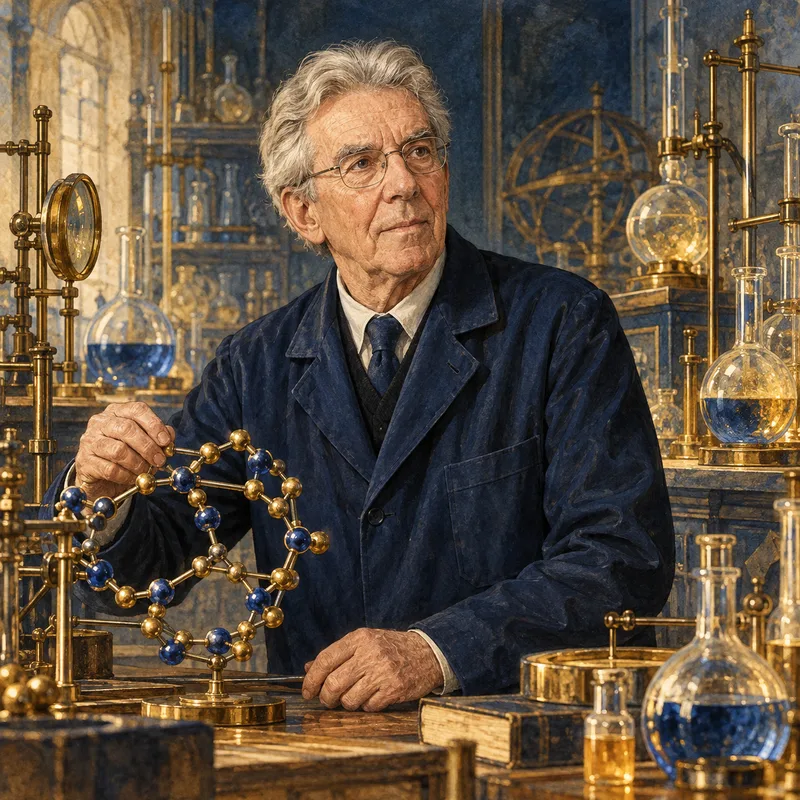
About the chemist
Jean-Pierre Sauvage
1944- · France · Nobel Chemistry 2016
Catenanes and molecular machines