Biography · Chemist no. 99 of 350
Jennifer A. Doudna: From Hawaii to Rewriting the Genetic Code
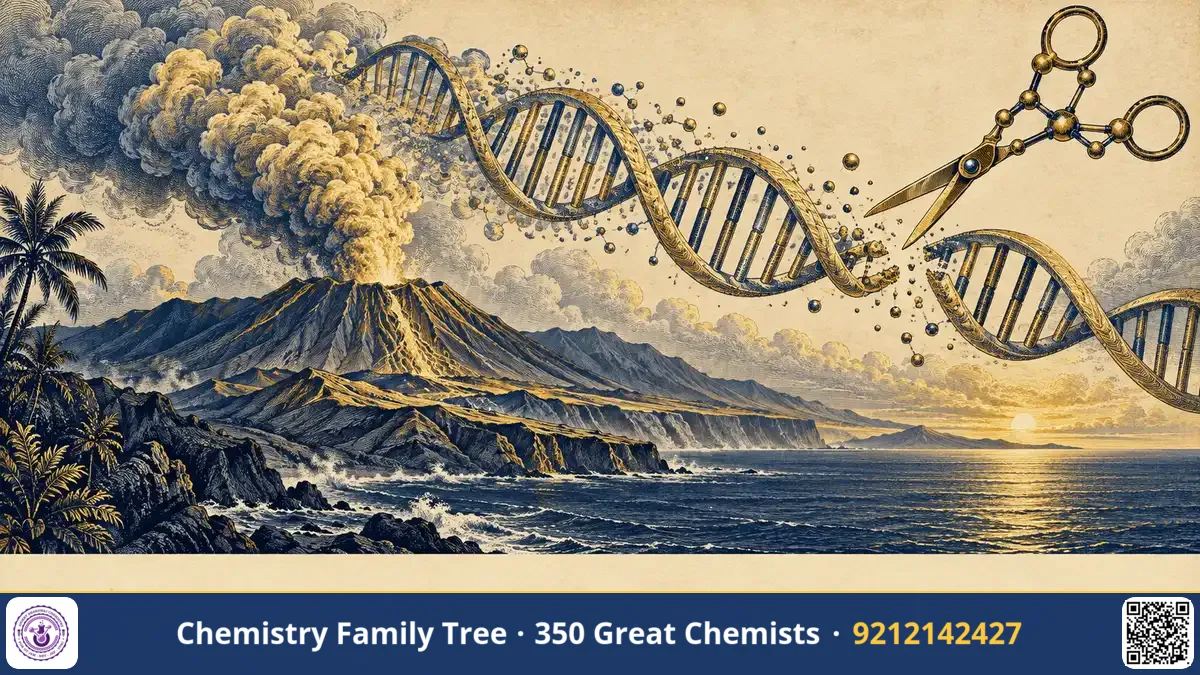
Jennifer Anne Doudna (born 1964) is an American biochemist at the University of California, Berkeley. She is best known as a co-inventor, with Emmanuelle Charpentier, of the CRISPR-Cas9 genome-editing technology, and the two women shared the 2020 Nobel Prize in Chemistry. Before CRISPR, Doudna was a leading researcher on the three-dimensional structure and chemistry of RNA. Her legacy in one line: she helped turn a bacterial defence system into a tool that allows scientists to edit the DNA of living cells with unprecedented precision.
Early Life and Family
Doudna was born on 19 February 1964 in Washington, D.C., and moved as a child to Hilo on the island of Hawaii, where she grew up. Her father taught literature at the University of Hawaii at Hilo. She has said that growing up surrounded by tropical nature fed her curiosity about living things. As a schoolgirl, she was given a copy of James Watson's book The Double Helix by her father, which introduced her to the story of DNA. She has recalled that someone at school told her girls did not go into science, and she decided to prove that wrong. She is married to Jamie Cate, a fellow biochemist at Berkeley.
Education and Mentors
Doudna studied chemistry at Pomona College in California and earned her bachelor's degree in 1985. She moved to Harvard University for her PhD in biochemistry and molecular pharmacology, which she completed in 1989 under Jack Szostak, who later won the Nobel Prize in Physiology or Medicine in 2009. In Szostak's lab she worked on making a self-replicating RNA enzyme, a ribozyme, which connected to the RNA world hypothesis. She then did postdoctoral research at the University of Colorado Boulder with Thomas Cech, who had shared the Nobel Prize in Chemistry in 1989 for the discovery of catalytic RNA. Working with two such mentors prepared her to study how RNA folds and acts.
Career Timeline
| Year | Event |
|---|---|
| 1964 | Born in Washington, D.C., USA; grew up in Hilo, Hawaii |
| 1985 | BA in Chemistry, Pomona College |
| 1989 | PhD, Harvard University (Jack Szostak) |
| 1989-1991 | Postdoctoral research at the University of Colorado Boulder (Thomas Cech) |
| 1994 | Joined Yale University as a faculty member |
| 1996 | Published the crystal structure of a group I ribozyme domain with Jamie Cate and colleagues |
| 2002 | Moved to the University of California, Berkeley |
| 2012 | Published with Charpentier and colleagues the programmable Cas9 paper in Science |
| 2014 | Founded the Innovative Genomics Institute at Berkeley (with UCSF) |
| 2020 | Nobel Prize in Chemistry (shared with Charpentier) |
Major Scientific Contributions
1. RNA structure. At Yale, Doudna's group used X-ray crystallography to solve the structure of a group I intron ribozyme domain, one of the first large catalytic RNA structures. This showed that RNA can fold into compact structures with active sites, much like proteins.
2. RNA interference and Dicer. At Berkeley, she studied enzymes such as Dicer that cut double-stranded RNA to make small RNAs for gene silencing. This expertise in RNA-protein machines made her an ideal partner when CRISPR was recognised as an RNA-guided system.
3. CRISPR-Cas9. In 2012, the paper by Martin Jinek, Krzysztof Chylinski, Ines Fonfara, Michael Hauer, Jennifer Doudna and Emmanuelle Charpentier showed that Cas9 is a dual-RNA-guided DNA endonuclease that can be reprogrammed by changing a guide sequence:
Cas9 + sgRNA + target DNA (with NGG PAM) → double-strand break → repair by NHEJ or HDR
You can follow the mechanism in our discovery post on CRISPR-Cas9. Doudna's group also determined structures of Cas9 bound to guide RNA and DNA, which showed how the protein changes shape when it finds its target.
Awards, Honours and Nobel Prize
The Nobel Prize in Chemistry 2020 was awarded to Emmanuelle Charpentier and Jennifer A. Doudna "for the development of a method for genome editing". It was the first time that a Nobel Prize in science was awarded to two women alone. Before this, Doudna and Charpentier received several major awards, including the Breakthrough Prize in Life Sciences (2015) and the Princess of Asturias Award for Technical and Scientific Research (2015), and a share of the Kavli Prize in Nanoscience (2018) with Virginijus Šikšnys. She is a Howard Hughes Medical Institute investigator and a member of the US National Academy of Sciences. For more honours, see an official biography.
Personality, Struggles and Lesser-Known Facts
- The book that started it: A gift of The Double Helix from her father sparked her interest in DNA.
- Ethics first: Doudna has spoken in public about the risk of misuse. In her book A Crack in Creation (2017, with Samuel Sternberg), she describes a troubling dream about explaining CRISPR to a dictator, and she has called for open global debate on editing human embryos.
- Reaction to the 2018 embryo case: When a scientist in China announced the birth of gene-edited babies in 2018, Doudna and many other researchers criticised the work as premature and unethical.
- Patent disputes: Her university and the Broad Institute (MIT and Harvard) were involved in a long legal fight about who holds the patents for CRISPR use in human cells. This shows how scientific discovery and commerce can get tangled.
- Company founder: She co-founded start-ups such as Caribou Biosciences, and was involved in the early stages of other genome-editing companies, to move technology from the lab to clinics.
Legacy and Influence on Modern Chemistry
CRISPR is now used in nearly every biology laboratory. It enables rapid creation of disease models, new diagnostic tests and gene therapies. The first CRISPR-based medicine, for sickle cell disease and beta-thalassaemia, was approved in 2023, and many other trials are ongoing. At the same time, Doudna's career is a case study in chemistry's reach: understanding RNA structure and enzyme mechanism led to a technology that changes medicine and agriculture. For Indian students, the story shows that the boundaries between chemistry, biochemistry and biotechnology are thin, and that a strong basic understanding of nucleic acid chemistry can lead to major innovations.
Lessons for Students
- Study fundamentals. Her years of RNA structure work prepared her for CRISPR.
- Collaborate across labs and countries. The key paper combined the strengths of two research groups.
- Ignore discouragement. An early comment that girls do not do science did not stop her.
- Think about ethics. A powerful tool needs responsible use.
Quick Facts Box
- Born: 19 February 1964, Washington, D.C., USA
- Died: Living
- Nationality: American
- Field: Biochemistry, RNA biology, genome editing
- Famous for: CRISPR-Cas9 genome editing
- Nobel: Chemistry 2020 (shared with Emmanuelle Charpentier)
FAQ
Who shared the 2020 Nobel Prize with Doudna?
Emmanuelle Charpentier, a French microbiologist and biochemist.
Where does Jennifer Doudna work?
At the University of California, Berkeley, where she is a professor of chemistry and of molecular and cell biology and founder of the Innovative Genomics Institute.
Did Doudna study chemistry?
Yes. Her undergraduate degree at Pomona College was in chemistry, and her PhD at Harvard was in biochemistry.
Is CRISPR approved for use in humans?
Yes, in selected cases. The first CRISPR-based therapy for sickle cell disease and beta-thalassaemia was approved in 2023 in the UK and the US.
Published by ABC Chemistry — IIT-JAM | CSIR-NET | GATE Chemistry Coaching. Visit abcchemistry.com
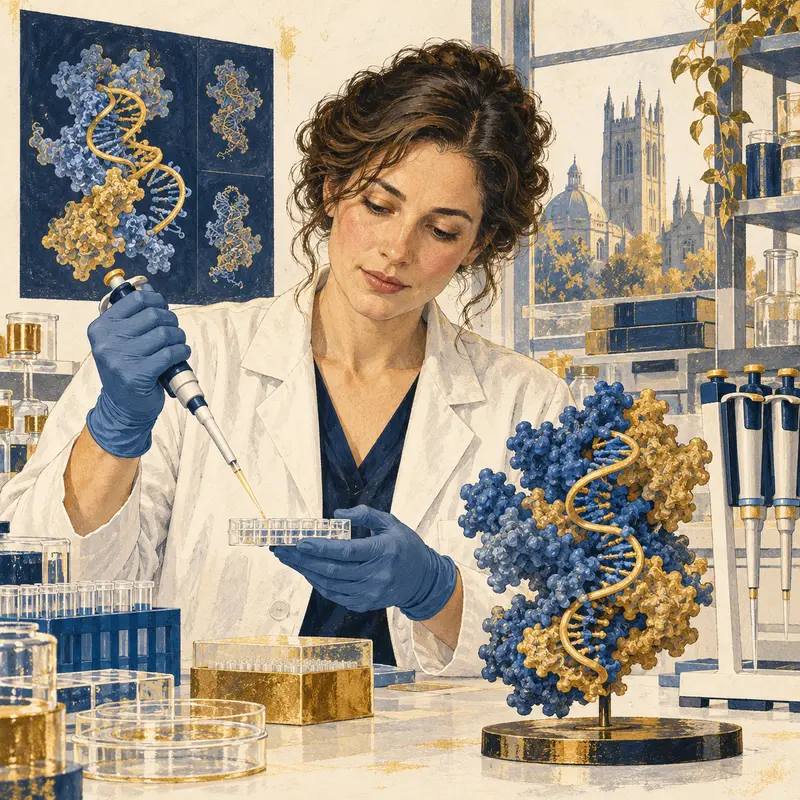
About the chemist
Jennifer Doudna
1964- · United States · Nobel Chemistry 2020
CRISPR-Cas9 genome editing