The discovery, explained · Chemist no. 99 of 350
Jennifer Doudna and CRISPR-Cas9: Molecular Scissors Guided by RNA
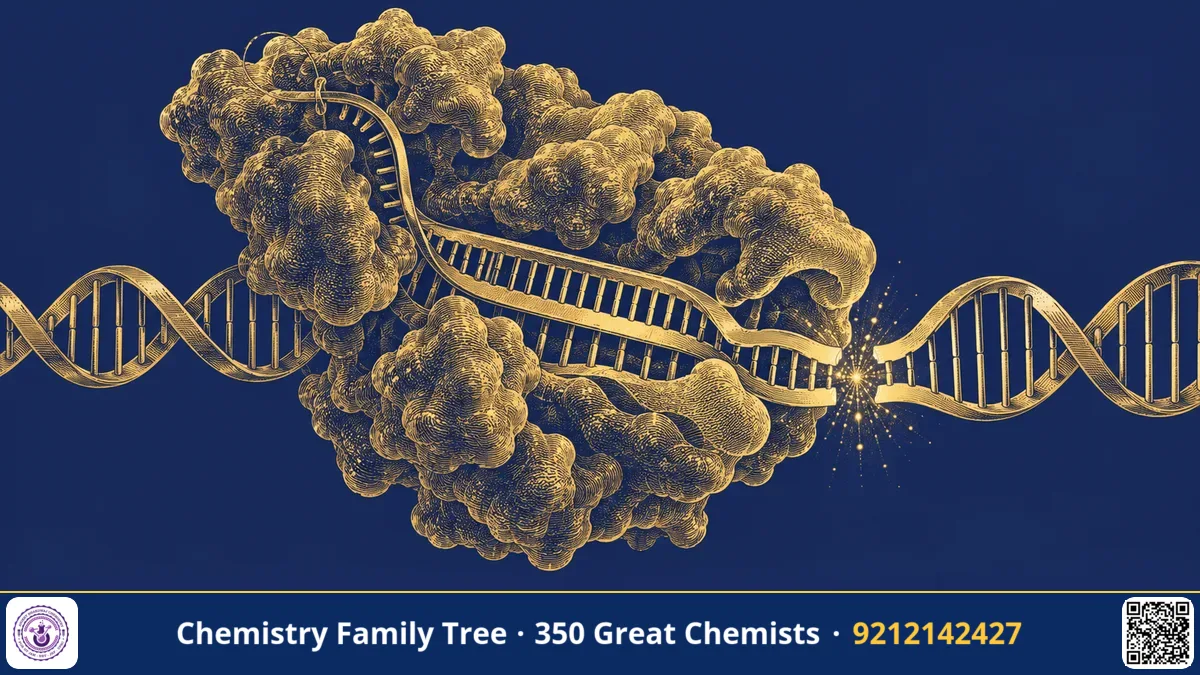
Imagine a word processor for DNA, in which you can search for a particular sentence in the genome and correct a spelling mistake. That is what CRISPR-Cas9 gene editing allows scientists to do. In 2012 Jennifer A. Doudna, working with Emmanuelle Charpentier and co-workers, showed that the bacterial protein Cas9 can be programmed with a short RNA to cut any DNA sequence of choice in a test tube. This turned a bacterial immune system into a general tool for editing genomes. In 2020 Doudna and Charpentier received the Nobel Prize in Chemistry "for the development of a method for genome editing". For chemistry students this topic links nucleic acid chemistry, enzyme mechanism and base pairing, and it increasingly appears in biochemistry-related questions.
The Scientific Problem Before the Discovery
Before CRISPR, scientists could change genes in some organisms, but the methods were slow, costly or imprecise. Zinc-finger nucleases (ZFNs) and TALENs could cut DNA at specific places, but each new target needed a new protein to be designed and built, which could take months. Another approach used random insertion of DNA, which did not allow precise correction of a specific mutation.
Meanwhile, microbiologists studying bacteria had found odd repeating sequences in their DNA. Yoshizumi Ishino reported such repeats in E. coli in 1987, and later they were named CRISPR, meaning clustered regularly interspaced short palindromic repeats. Work by Francisco Mojica and others suggested that the spacers between the repeats match viral DNA, and in 2007 Rodolphe Barrangou, Philippe Horvath and colleagues showed that bacteria use CRISPR as an adaptive immune system against viruses (bacteriophages). The mechanism was still unknown.
The Discovery: Step by Step
- Immunity in bacteria. A bacterium that survives a virus stores a short piece of the virus's DNA in its own CRISPR region as a spacer. This is a molecular memory.
- Making guide RNAs. When the same virus returns, the CRISPR region is transcribed into RNA. In the Type II system of Streptococcus pyogenes, a CRISPR RNA (crRNA) pairs with a trans-activating CRISPR RNA (tracrRNA). Charpentier's group discovered the role of tracrRNA in 2011.
- Cas9 as a nuclease. In 2012, the labs of Doudna and Charpentier purified Cas9 and showed in vitro that the crRNA:tracrRNA pair guides Cas9 to a matching DNA and that Cas9 cuts both strands. The paper was published in Science in June 2012.
- Simplification. They fused crRNA and tracrRNA into a single guide RNA (sgRNA). Now one only has to change about 20 nucleotides of the sgRNA to retarget Cas9 to a new site.
- Use in cells. In 2013 several groups, including those of Feng Zhang and George Church, showed that CRISPR-Cas9 works in human and mouse cells. Doudna's lab also contributed. A race of applications began.
The Chemistry Behind It
The molecular recognition is based on Watson-Crick base pairing (A–T/U, G–C) between the guide RNA and the target DNA:
guide RNA spacer (20 nt):   5'–G A U C ... –3'   (RNA uses U instead of T)
target DNA strand:          3'–C T A G ... –5'   (pairs A–T, U–A, G–C)
non-target strand:          5'–...[20 nt]–N G G–3'   (PAM = NGG)
(The sequence above is only a schematic.) The key components:
- PAM (protospacer adjacent motif): For Cas9 from S. pyogenes, it is 5'-NGG-3' next to the target on the non-target strand. Cas9 first looks for a PAM; without it, no cutting occurs. This stops bacteria from cutting their own CRISPR spacers.
- R-loop formation: After PAM recognition, the DNA is unwound and the guide RNA pairs with the target strand, displacing the other strand.
- Two nuclease domains: The HNH domain cleaves the target strand (the strand complementary to the guide), and the RuvC domain cleaves the other strand. The result is a blunt double-strand break (DSB) about three base pairs upstream of the PAM.
- Chemistry of cutting: The nuclease domains use Mg²⁺ ions to hydrolyse phosphodiester bonds in DNA, producing a 3'-OH and a 5'-phosphate.
How the cell repairs the cut
| Pathway | Needs template? | Result |
|---|---|---|
| NHEJ (non-homologous end joining) | No | Small insertions or deletions (indels); often disrupts a gene (knockout) |
| HDR (homology-directed repair) | Yes, a donor DNA | Precise correction or insertion of a sequence |
A "dead" Cas9 (dCas9), with both nuclease domains inactivated, binds DNA without cutting and can be used to switch genes on or off. Later tools, such as base editors and prime editors, use modified Cas9 to change single bases without a full double-strand break.
Applications Today
- Medicine: In late 2023 the first CRISPR-Cas9 therapy, called Casgevy, was approved in the United Kingdom and the United States for sickle cell disease and beta-thalassaemia. Cells are edited outside the body and returned to the patient.
- Diagnostics: Related CRISPR enzymes (Cas12, Cas13) are used for rapid detection of nucleic acids. In India, the FELUDA test developed by CSIR-IGIB for detecting the COVID-19 virus used a Cas9 protein.
- Agriculture: Genome editing is used to create crops with higher yield or resistance to stress. Indian research institutes have been working on genome-edited rice.
- Research: Scientists create disease models in cells and animals, and screen thousands of genes at once.
- Ethics: Editing of human embryos that can pass to future generations raises serious ethical and legal questions. Doudna herself has called for careful, public discussion.
Exam Corner
- CRISPR = clustered regularly interspaced short palindromic repeats; Cas9 = CRISPR-associated protein 9, an RNA-guided DNA endonuclease.
- Nobel Prize in Chemistry 2020: Emmanuelle Charpentier and Jennifer Doudna.
- SpCas9 needs the PAM sequence 5'-NGG-3' next to the target. Guide RNA is about 20 nt.
- Cas9 has two nuclease domains: HNH (cuts the target strand) and RuvC (cuts the non-target strand). It makes a blunt double-strand break.
- Repair: NHEJ gives indels and gene knockout; HDR with a donor template gives precise edits.
Common Misconceptions
- "Doudna discovered CRISPR." Many scientists contributed. Doudna and Charpentier showed that Cas9 can be programmed for cutting DNA.
- "CRISPR never makes mistakes." Off-target cutting can occur at similar sequences, and it is a major focus of safety research.
- "CRISPR is a protein." The system needs both protein (Cas9) and RNA (guide RNA).
Quick Revision Box
- CRISPR is a bacterial adaptive immune system against viruses.
- Cas9 + sgRNA finds DNA by base pairing and a PAM (NGG).
- HNH and RuvC domains cut the two strands; Mg²⁺ is needed.
- 2012 Science paper: Jinek, Chylinski, Fonfara, Hauer, Doudna, Charpentier.
- Repair by NHEJ (knockout) or HDR (precise edit).
- Nobel Prize in Chemistry 2020 to Charpentier and Doudna.
FAQ
What does CRISPR-Cas9 do?
It uses a guide RNA to lead the Cas9 enzyme to a chosen DNA sequence, where Cas9 makes a double-strand cut that the cell repairs, allowing genes to be disrupted or corrected.
Why is it in a chemistry Nobel Prize?
The discovery explains a molecular mechanism, the RNA-guided cleavage of DNA, and provides a chemical tool for modifying nucleic acids, so the Nobel committee recognised it in chemistry.
What is a PAM?
A short DNA sequence next to the target site that Cas9 must recognise before it unwinds and cuts the DNA. For SpCas9 it is NGG.
Is gene editing used in India?
Yes, in research, diagnostics and crop improvement. Rules for human germline editing are strict and it is not permitted for reproduction.
Published by ABC Chemistry — IIT-JAM | CSIR-NET | GATE Chemistry Coaching. Visit abcchemistry.com
About the chemist
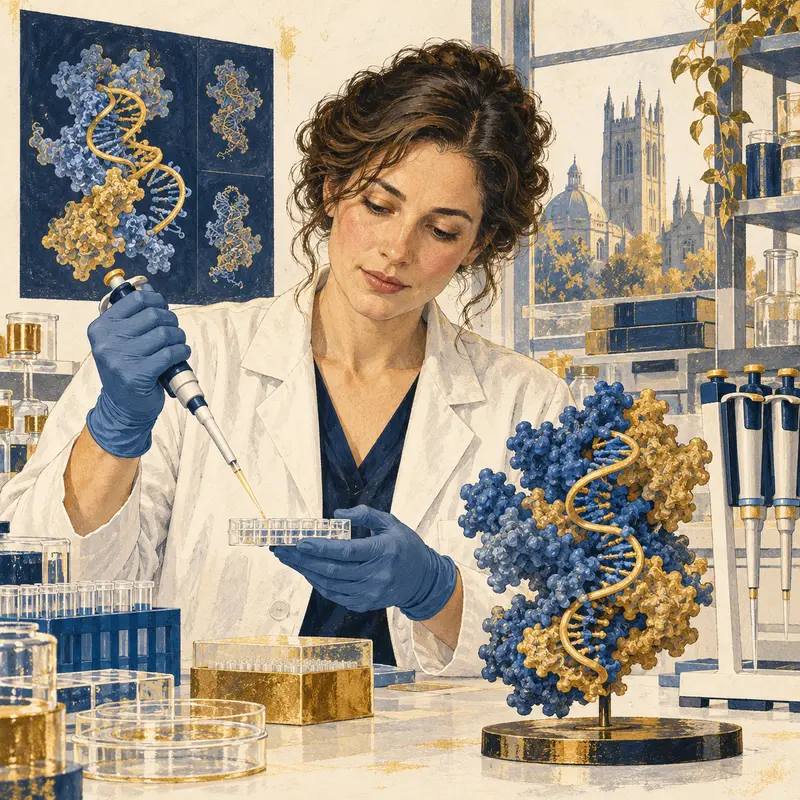
Jennifer Doudna
1964- · United States · Nobel Chemistry 2020
CRISPR-Cas9 genome editing