Biography · Chemist no. 153 of 350
Jerome Karle: Complete Life and Legacy of a Crystallography Pioneer
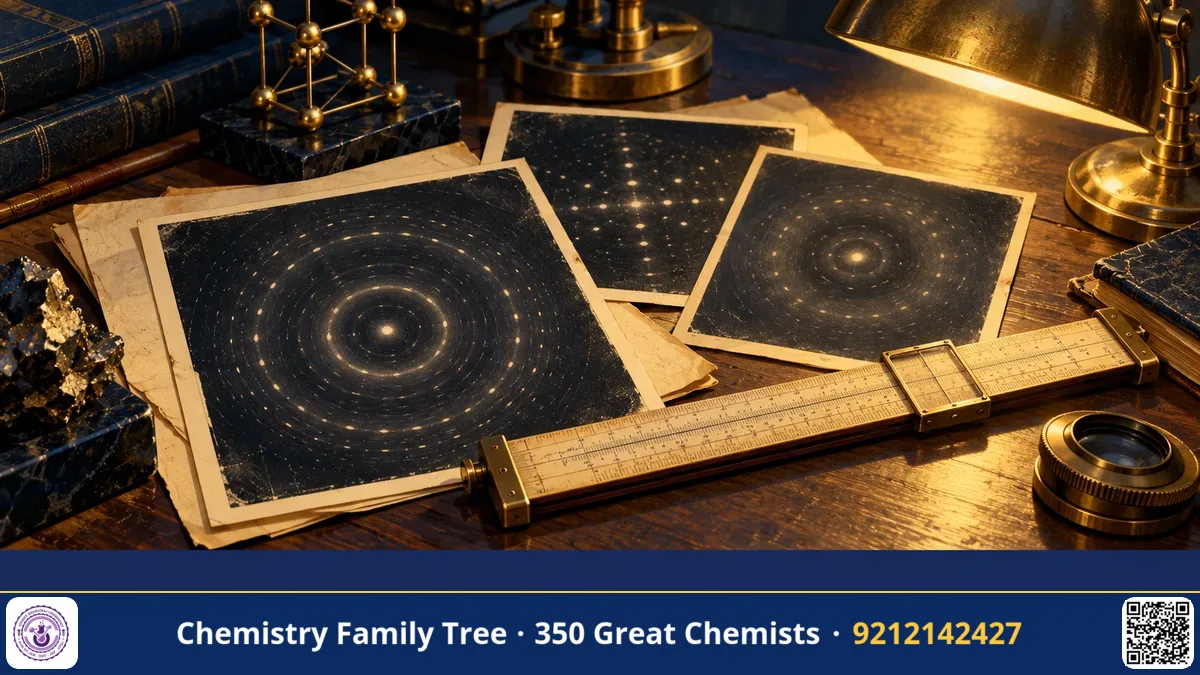
Jerome Karle (1918–2013) was an American physical chemist who spent most of his working life at the US Naval Research Laboratory in Washington, D.C. Together with the mathematician Herbert Hauptman he developed direct methods, the mathematical tools that let chemists determine crystal structures from X-ray diffraction data. They shared the 1985 Nobel Prize in Chemistry. His legacy is simple to state: when a chemist today draws the exact 3D structure of a newly made molecule from a crystal, Karle's ideas sit inside the software that makes it possible.
Early Life and Family
Jerome Karle was born on 18 June 1918 in New York City. He grew up in a modest family in the years between the two World Wars. He attended public schools in New York, which at that time offered a strong education for talented children of immigrant families. Details of his early family life are modest in public records, so this article keeps to what is well established.
Education and Mentors
Karle studied at the City College of New York, where he took his bachelor's degree in 1937. He then moved to Harvard University and received a master's degree in biology in 1938. His interest turned to physical chemistry, and he went to the University of Michigan, where he completed his PhD in physical chemistry in 1944. At Michigan he worked on electron diffraction of gases, a technique in which a beam of electrons is scattered by molecules in the vapour phase to reveal bond lengths and angles. This training in diffraction methods became the foundation for everything that followed. At Michigan he also met Isabella Lugoski, a fellow chemistry student, whom he married; she became a distinguished crystallographer herself.
Career Timeline
| Year | Event |
|---|---|
| 1918 | Born in New York City, 18 June |
| 1937 | Bachelor's degree, City College of New York |
| 1938 | Master's degree in biology, Harvard University |
| 1944 | PhD in physical chemistry, University of Michigan |
| 1943–1944 | Worked on the Manhattan Project at the University of Chicago |
| 1946 | Joined the US Naval Research Laboratory, Washington, D.C. |
| 1953 | Karle and Hauptman publish their monograph on the phase problem for centrosymmetric crystals |
| 1985 | Shares the Nobel Prize in Chemistry with Herbert Hauptman |
| 2013 | Dies in Annandale, Virginia, 6 June |
Major Scientific Contributions
The central contribution is the solution of the phase problem in X-ray crystallography. A diffraction experiment records the intensity of each reflection, proportional to |F|², but loses the phase. Karle and Hauptman showed that, because electron density is positive and concentrated on atoms, the phases of strong reflections are linked by probability relations such as φ(h) ≈ φ(k) + φ(h − k). Using these relations, a computer can find a set of phases that gives a chemically sensible structure.
Other important contributions include:
- Early work on gas-phase electron diffraction, which gave molecular geometries of simple molecules.
- Development of theory for anomalous dispersion methods, where scattering at wavelengths near an absorption edge helps to recover phases.
- Application of these methods to peptides, steroids and other biologically important molecules in collaboration with Isabella Karle.
Awards, Honours and Nobel Prize
In 1985 Jerome Karle and Herbert Hauptman were awarded the Nobel Prize in Chemistry "for their outstanding achievements in the development of direct methods for the determination of crystal structures." This was a Chemistry prize, even though the mathematical content is heavy. Karle was also a member of the US National Academy of Sciences and received other honours from scientific societies during his long career. He remained at the Naval Research Laboratory for decades and continued to publish into later life.
Personality, Struggles and Lesser-Known Facts
- A mathematician's approach: Though trained as a chemist, Karle was comfortable with advanced mathematics, which was unusual among experimental chemists of his time.
- Years of scepticism: Direct methods were initially met with doubt. Many crystallographers felt that a mathematical shortcut could not replace heavy-atom methods. Acceptance came as computers made the calculations practical.
- A scientific partnership at home: His wife Isabella Karle worked in the same laboratory and became a leading crystallographer. Their combined experience linked theory and experiment.
- Manhattan Project: During the war he worked for a period at the University of Chicago on the project, before returning to his own research field.
- Government scientist: Unlike most Nobel laureates, he spent his career in a government laboratory rather than a university.
Legacy and Influence on Modern Chemistry
Before direct methods, solving the structure of a molecule with 20 to 50 non-hydrogen atoms could take months or years. After them, with automated diffractometers and software, it can take a few hours. Today, programs based on direct methods are used in universities, pharmaceutical companies and national laboratories around the world, including many Indian institutes. The Cambridge Structural Database contains hundreds of thousands of organic and organometallic structures, and a very large share of them were solved by methods that trace back to Karle and Hauptman.
Lessons for Students
- Look for hidden information. The phases seemed lost, yet they were hidden in the amplitudes.
- Mix subjects. A chemist working with a mathematician produced a breakthrough neither field alone would have found.
- Be patient with new ideas. Acceptance can take years; good work should still be developed carefully.
- Learn mathematics. Fourier series, probability and matrices are tools of modern chemistry.
Quick Facts Box
- Born: 18 June 1918, New York City, USA
- Died: 6 June 2013, Annandale, Virginia, USA
- Nationality: American
- Field: Physical chemistry, X-ray crystallography
- Famous for: Direct methods for solving the phase problem
- Nobel: 1985, Chemistry (shared with Herbert Hauptman)
FAQ
Where did Jerome Karle work?
He worked at the US Naval Research Laboratory in Washington, D.C., from 1946 for the rest of his career, after earlier study at CCNY, Harvard and the University of Michigan.
Was Jerome Karle's Nobel Prize in Physics or Chemistry?
Chemistry. The 1985 prize was for direct methods for determining crystal structures.
Who was Herbert Hauptman?
Hauptman was an American mathematician and Karle's long-time collaborator. They shared the 1985 prize.
What should I remember for exams?
Remember the phase problem, the relation of intensity to |F|², and that direct methods use statistical relations among structure-factor phases. Also remember the year, 1985.
Published by ABC Chemistry — IIT-JAM | CSIR-NET | GATE Chemistry Coaching. Visit abcchemistry.com
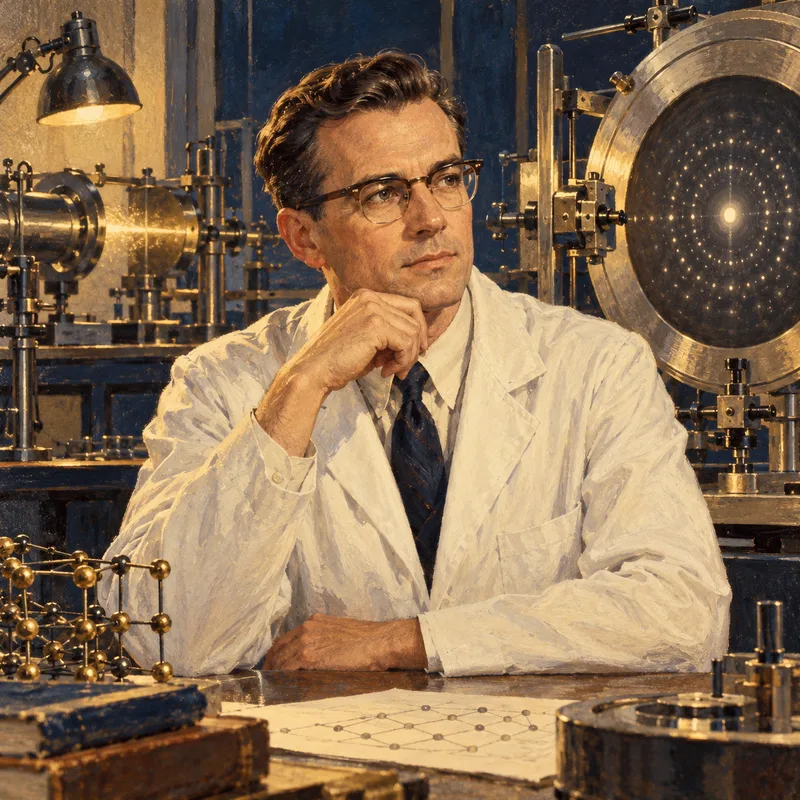
About the chemist
Jerome Karle
1918-2013 · United States · Nobel Chemistry 1985
Direct methods for crystal structures