The discovery, explained · Chemist no. 153 of 350
Jerome Karle and Direct Methods: How the Phase Problem Was Solved
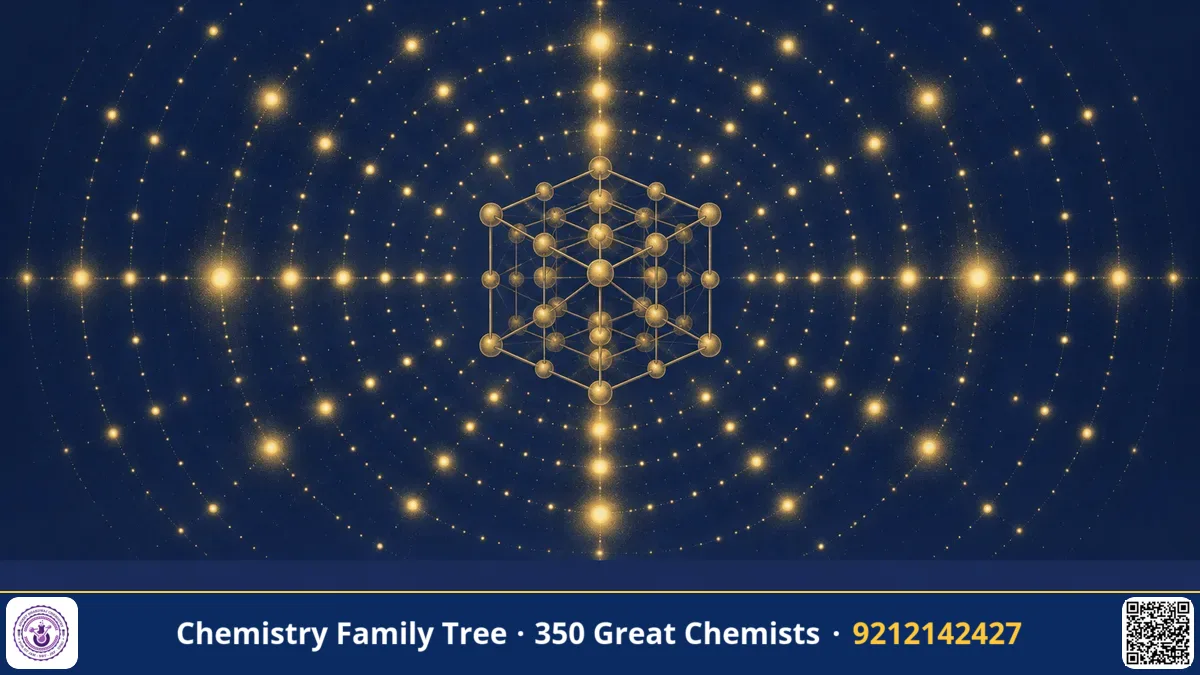
Every time you see a 3D picture of a drug molecule or a protein in a textbook, there is a good chance that it began as a pattern of black spots on a detector. Turning those spots into atomic positions looked impossible for decades, because half of the needed information was missing. Jerome Karle, working with the mathematician Herbert Hauptman, found a way to recover that missing information directly from the measured intensities. Their direct methods turned structure determination of small molecules from months of trial and error into a routine job for a computer. For this work they shared the 1985 Nobel Prize in Chemistry. For students of IIT-JAM, CSIR-NET and GATE, this story is a perfect link between X-ray diffraction, Fourier series and probability.
The Scientific Problem Before the Discovery
When X-rays pass through a crystal, the electrons of the atoms scatter them. Because atoms sit on a regular lattice, the scattered waves interfere and give sharp diffraction spots at angles that obey Bragg's law:
nλ = 2d sinθ
The positions of the spots tell us the unit cell size and symmetry. The intensities of the spots tell us where the atoms are inside the cell. The link between the two is the structure factor F(hkl), a complex number with an amplitude and a phase:
F(hkl) = Σ fj exp[2πi(hxj + kyj + lzj)] = |F| exp(iφ)
Here fj is the atomic scattering factor of atom j and (x, y, z) are its fractional coordinates. The electron density at any point is a Fourier sum over all reflections:
ρ(x,y,z) = (1/V) Σ |F(hkl)| exp(iφ) exp[-2πi(hx + ky + lz)]
The detector records only intensity, and I ∝ |F|². The phase φ is lost. This is the famous phase problem. Without phases you cannot calculate ρ, so you cannot see the molecule. Early crystallographers used the Patterson function, which uses only |F|², and heavy-atom tricks, but these worked well only when a heavy atom was present or the structure was very small. For a general organic molecule with 30 or more atoms, many thought the problem had no general solution.
The Discovery: Turning Probability into Phases
In the late 1940s Karle was at the US Naval Research Laboratory in Washington, where Hauptman joined him. Both were interested in extracting structural information from diffraction data. Their key insight was simple but bold: the phases are not completely free. Because the electron density of a real crystal is never negative and is made of discrete, separate atoms, the phases of different reflections are related to each other.
The main steps of their approach can be summarised as follows.
- Normalise the data. The observed intensities are converted to normalised structure factors (E values) so that the effect of atomic scattering falling off with angle is removed.
- Use inequalities. Starting from the fact that ρ ≥ 0, Karle and Hauptman derived determinant inequalities among structure factors. These restricted the possible phases.
- Use probability. For strong reflections, the phase of one reflection can be predicted from the phases of two others whose indices add up to it. This is the triple-product (or sigma-2) relationship.
- Start with a few known phases. The origin of the unit cell can be fixed by choosing the phases of a few reflections freely. From these, other phases are generated step by step.
- Refine and compute. Once a set of phases is chosen, a Fourier map is calculated and atoms are located. The model is then refined against the data.
In 1953 they published a monograph on solving the phase problem for centrosymmetric crystals. For centrosymmetric structures the phase can only be 0 or π, so the sign of F is just + or −, which makes the first tests easier. Later work extended the methods to non-centrosymmetric crystals, where the phase can take any value between 0 and 2π.
A well-known relation behind the idea is the triple-product relation for strong reflections:
φ(h) ≈ φ(k) + φ(h − k)
When the normalised amplitudes of these three reflections are all large, the probability that this relation holds is high. By chaining many such relations, a consistent set of phases emerges. In practice computers test many starting sets and choose the one that gives the most sensible structure. This is why the method became practical as computing power grew in the 1960s and 1970s, and why programs such as SHELX and SIR are built on these ideas today.
The Chemistry Behind It
The most important idea for students is that information about phases is hidden in the amplitudes because atoms are discrete and the density is positive. If atoms were smeared out in a random way, no relation would exist. The sharpness of atomic peaks is what produces statistical links between reflections.
| Term | Meaning |
|---|---|
| Bragg's law | Condition for constructive interference, nλ = 2d sinθ |
| Structure factor F | Complex sum of waves scattered by all atoms in the cell |
| Phase problem | Only |F|² is measured; phase φ is lost |
| Patterson function | Fourier map using |F|² only; shows interatomic vectors |
| Direct methods | Statistical use of |E| values to derive phases |
Karle also made later contributions on anomalous scattering. When X-ray wavelength is near an absorption edge of an atom in the crystal, the scattering factor changes, and measurements at more than one wavelength can reveal phases. This idea, extended as multiwavelength anomalous diffraction (MAD), is widely used for protein structures.
Applications Today
- Drug discovery: Structures of new organic compounds and drug candidates are solved in hours by single-crystal X-ray diffraction using direct methods.
- Natural products: The absolute structure of complex molecules from plants and marine organisms is confirmed by crystallography.
- Materials chemistry: Metal-organic frameworks, zeolites and coordination compounds are routinely characterised.
- Biology: Related ideas help solve protein structures, including phasing from anomalous scattering.
- India: University and national laboratories such as IISc, IITs and CSIR institutes run single-crystal diffractometers, and M.Sc. students learn to solve structures with SHELX-type software.
Exam Corner
- Jerome Karle and Herbert Hauptman received the 1985 Nobel Prize in Chemistry for direct methods of determining crystal structures.
- The phase problem arises because detectors measure intensity (I ∝ |F|²) and not phase.
- Bragg's law: nλ = 2d sinθ. Spot positions give cell dimensions; spot intensities give atom positions.
- Patterson maps use |F|² and are strong for heavy-atom structures; direct methods use probability relations among phases.
- For a centrosymmetric crystal, the structure factor is real and the phase is 0 or π.
Common Misconceptions
- "X-ray photographs directly show atoms." No. The pattern is in reciprocal space; a mathematical transformation is needed to get the structure.
- "Direct methods give the structure without any calculation of a Fourier map." The name only means that phases come directly from amplitudes; a Fourier map is still computed.
- "Phases are random." They are not. Positivity and atomicity of electron density link them.
Quick Revision Box
- Structure factor: F(hkl) = |F| eiφ; intensity gives only |F|².
- Electron density is a Fourier sum of F values with their phases.
- Direct methods: normalised E values, triple-product relation, probability.
- Karle and Hauptman: 1985 Nobel Prize in Chemistry.
- Karle also contributed to anomalous scattering ideas used in MAD phasing.
- Used in SHELX, SIR and many other structure programs.
FAQ
Did Jerome Karle win the Nobel Prize alone?
No. He shared the 1985 Nobel Prize in Chemistry with Herbert Hauptman for the development of direct methods for determining crystal structures.
What exactly is lost in an X-ray diffraction experiment?
The phase of each diffracted wave. The detector counts photons, which gives intensity, but the relative timing of the waves is not recorded.
Is direct methods useful for proteins?
It works best for small molecules, usually up to a few hundred atoms. For large proteins other phasing methods such as molecular replacement and anomalous dispersion are more common, though direct-methods ideas are used in locating heavy atoms.
Why is this topic important for GATE and NET?
Questions on Bragg's law, structure factor, systematic absences and the phase problem appear in solid-state and physical chemistry sections. Understanding why phases matter helps you answer conceptual questions quickly.
Published by ABC Chemistry — IIT-JAM | CSIR-NET | GATE Chemistry Coaching. Visit abcchemistry.com

About the chemist
Jerome Karle
1918-2013 · United States · Nobel Chemistry 1985
Direct methods for crystal structures