Biography · Chemist no. 178 of 350
John B. Fenn: The Late Bloomer Who Taught Proteins to Fly
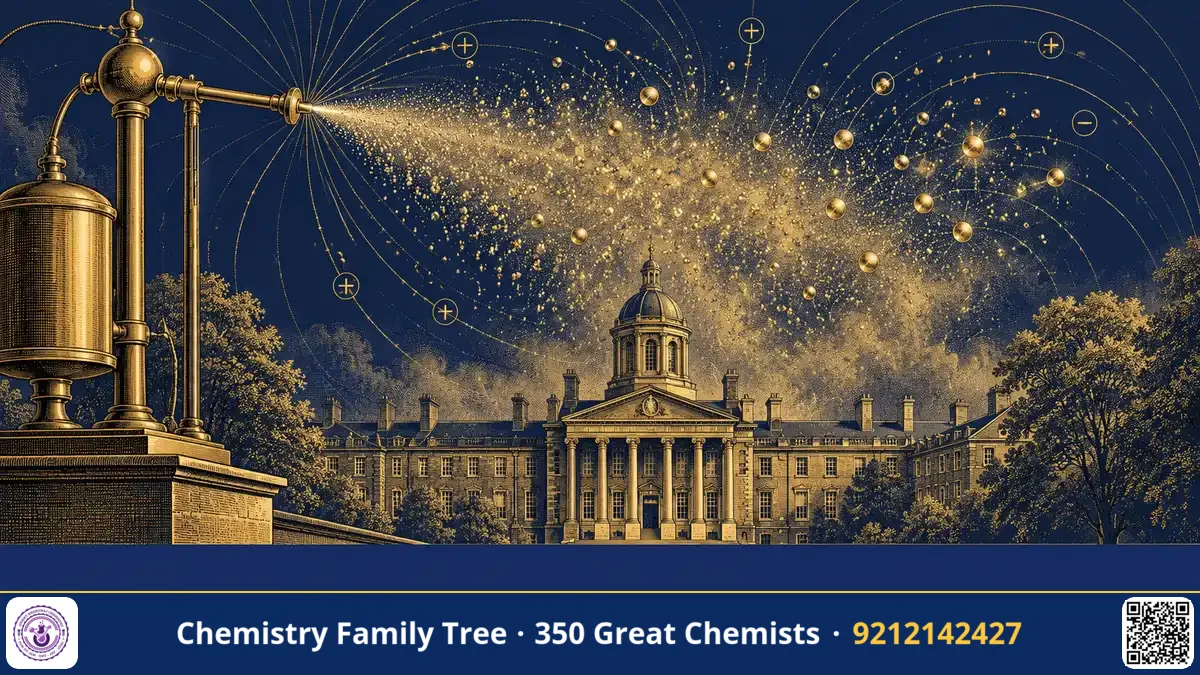
John Bennett Fenn (1917–2010) was an American chemist and engineer whose electrospray ionization method opened mass spectrometry to proteins and other large biomolecules. He shared the 2002 Nobel Prize in Chemistry with Koichi Tanaka, while the other half of the prize went to Kurt Wüthrich. Fenn's story is remarkable because his most famous work was done late in his career, and he received the Nobel Prize at the age of 85.
Early Life and Family
John Fenn was born on 15 June 1917 in New York City, USA. He grew up in Berea, Kentucky, where his family moved when he was a child. His father worked at Berea College, and the family lived in a small college town. Fenn attended the college's preparatory school. Berea College is well known for providing education to students who cannot afford high fees, and the environment taught him the value of hard work.
Education and Mentors
Fenn studied at Berea College, where he received a bachelor's degree in chemistry in 1937. He then went to Yale University for graduate work in chemistry and received his PhD in 1940. After completing his PhD, he worked in industry for several years. In 1945, he moved to Princeton University, where he worked in the Project SQUID jet-propulsion research programme, studying combustion and rocket propulsion. This experience introduced him to supersonic gas flows and molecular beams, which later became the base of the electrospray work.
Career Timeline
| Year | Event |
|---|---|
| 1917 | Born in New York City on 15 June |
| 1937 | Bachelor's degree, Berea College |
| 1940 | PhD in chemistry, Yale University |
| 1940s | Industrial research, then Project SQUID at Princeton University from 1945 |
| 1959 | Became professor of engineering at Yale University |
| 1960s–70s | Research on molecular beams and supersonic free jets |
| 1984–89 | Developed electrospray ionization for mass spectrometry of large molecules |
| 1987 | Reached Yale's retirement age of 70 and had to give up his regular position |
| 1994 | Moved to Virginia Commonwealth University as a research professor |
| 2002 | Nobel Prize in Chemistry, shared with Koichi Tanaka and Kurt Wüthrich |
| 2010 | Died on 10 December in Richmond, Virginia |
Major Scientific Contributions
- Molecular beams and supersonic jets. At Yale, Fenn studied how gases expand through nozzles to form beams in which molecules are cooled and move in the same direction. These ideas helped chemists study reactions with precise control.
- Electrospray ionization (ESI). He turned the earlier idea of Malcolm Dole into a practical method for forming multiply charged ions of large molecules, including proteins, in the gas phase.
- Mass spectrometry of proteins. His 1989 report in Science showed that proteins of tens of thousands of daltons could be weighed accurately.
- Impact on proteomics. ESI, in combination with liquid chromatography and tandem MS, led to modern proteomics and metabolomics.
For the details of the technique and the m/z equations, read the companion post on electrospray ionization.
Awards, Honours and the Nobel Prize
In 2002, the Nobel Prize in Chemistry was divided: one half jointly to John B. Fenn and Koichi Tanaka "for their development of soft desorption ionisation methods for mass spectrometric analyses of biological macromolecules", and the other half to Kurt Wüthrich "for his development of nuclear magnetic resonance spectroscopy for determining the three-dimensional structure of biological macromolecules in solution". He also received awards from mass spectrometry societies. He was the oldest of the three laureates that year.
Personality, Struggles and Lesser-Known Facts
- Forced retirement. Yale had a mandatory retirement age of 70, and he had to give up his regular position in the late 1980s, just as ESI was succeeding. He later joined Virginia Commonwealth University, where he continued the work.
- Late bloomer. His best-known work was done when he was in his late sixties, and the Nobel Prize came at 85. He is often cited as proof that good science has no age limit.
- A legal dispute. After the Nobel Prize, Yale University took legal action against Fenn over the rights to patents related to ESI, and the court case was decided in Yale's favour in 2005. The case is often discussed in debates about university patent policy.
- Engineer and chemist. He worked as a professor of engineering at Yale, and used engineering ideas such as fluid dynamics in chemistry.
- Humour. His lecture on the work has a famous title, "Electrospray wings for molecular elephants", the phrase used by Fenn to describe how ESI makes large molecules fly.
Legacy and Influence on Modern Chemistry
Electrospray ionization is one of the most important tools in analytical chemistry and biology. It is present in nearly every proteomics laboratory, pharmaceutical analysis lab and clinical chemistry laboratory in the world. It allows scientists to weigh proteins, to study drug metabolism and to find disease markers. In India, ESI-based LC–MS/MS is used in drug testing, food safety and forensic work, and the topic is part of instrumental analysis in M.Sc. courses and GATE chemistry and CSIR-NET syllabi.
Lessons for Students
- Never think that it is too late. Fenn's best work came in his late sixties and he won the Nobel Prize in his eighties.
- Build on old ideas. Dole's idea was waiting for the right expert to make it work.
- Combine disciplines. Engineering skills in gas dynamics helped to solve a chemical problem.
- Persist despite obstacles. Retirement rules and early failure did not stop him.
Quick Facts Box
- Born: 15 June 1917, New York City, USA
- Died: 10 December 2010, Richmond, Virginia, USA
- Nationality: American
- Field: Analytical chemistry, mass spectrometry, chemical engineering
- Famous for: Electrospray ionization (ESI) of biomolecules
- Nobel: Chemistry, 2002 (half, shared with Koichi Tanaka; Kurt Wüthrich received the other half)
FAQ
How old was Fenn when he won the Nobel Prize?
He was 85 years old, born in June 1917 and awarded the prize in 2002.
Where did he work most of his career?
At Yale University, and later at Virginia Commonwealth University.
Who shared the 2002 Nobel Prize in Chemistry?
Koichi Tanaka shared half with Fenn; Kurt Wüthrich received the other half.
What is Fenn's most important contribution?
The development of electrospray ionization for mass spectrometry, enabling the analysis of large biomolecules like proteins.
Published by ABC Chemistry — IIT-JAM | CSIR-NET | GATE Chemistry Coaching. Visit abcchemistry.com
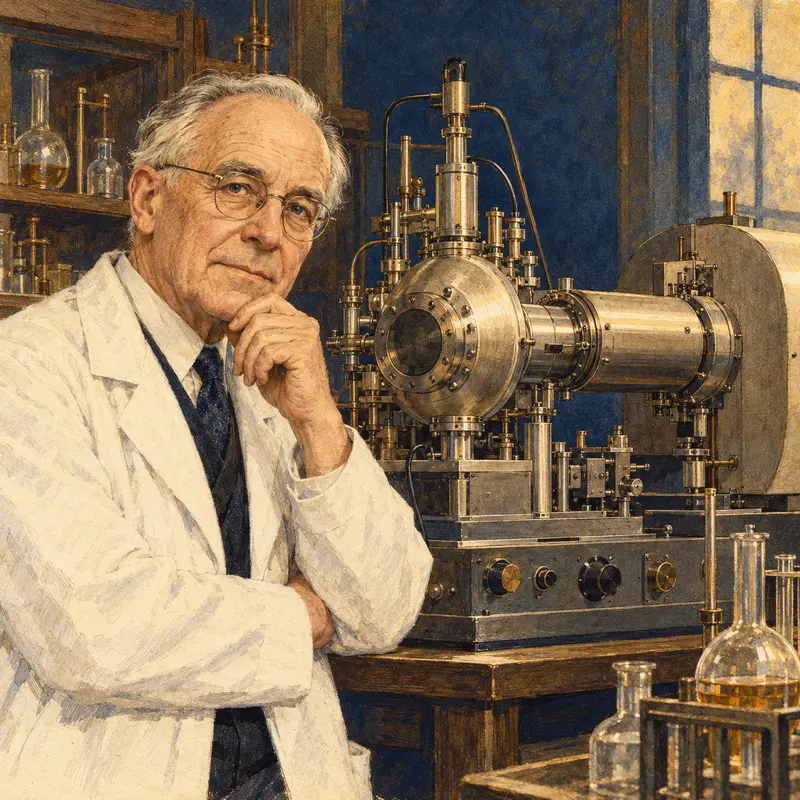
About the chemist
John B. Fenn
1917-2010 · United States · Nobel Chemistry 2002
Electrospray ionization for mass spectrometry