The discovery, explained · Chemist no. 178 of 350
John B. Fenn and Electrospray Ionization: Making Giant Molecules Fly
Mass spectrometry measures the mass-to-charge ratio of ions in the gas phase. For small, volatile molecules this was easy for decades. But for large, fragile and non-volatile molecules, such as proteins, it seemed impossible: heating a protein to vaporise it destroys it. John B. Fenn solved this problem with electrospray ionization (ESI), which turns a liquid sample into gas-phase ions gently and without breaking the molecules. In 2002, Fenn shared the Nobel Prize in Chemistry with Koichi Tanaka (soft laser desorption) "for their development of soft desorption ionisation methods for mass spectrometric analyses of biological macromolecules", while the other half went to Kurt Wüthrich for NMR of proteins in solution.
The Scientific Problem Before the Discovery
A mass spectrometer has three basic parts: an ion source, a mass analyser and a detector. The analyser separates ions according to m/z, where m is mass and z is the number of charges. The older ion sources, such as electron impact (EI), bombard gas-phase molecules with 70 eV electrons. These need the sample to be volatile and they cause heavy fragmentation. For large biomolecules such as peptides and proteins, nucleic acids, polysaccharides and synthetic polymers, no easy method existed.
Another problem is the mass range. Many analysers, such as quadrupoles, can scan only up to an m/z of a few thousand. A protein with mass 20,000 daltons carrying a single charge has m/z 20,000, which is far out of range. The challenge was to find a method that (1) brings large molecules from solution into the gas phase as intact ions and (2) gives them multiple charges, so that m/z falls within the range of common instruments.
The Discovery: Step by Step
- Earlier idea. In the 1960s, Malcolm Dole at Northwestern University had sprayed polystyrene solutions in an electric field and tried to detect the ions. His experiments showed that charged droplets could produce macro-ions, but he could not obtain a proper mass spectrum.
- Fenn's background. Fenn was an expert in molecular beams and supersonic free-jet expansions at Yale University. In the 1980s, he took up Dole's idea. His group built a system in which a solution was sprayed through a needle at high voltage in front of an inlet to a mass spectrometer.
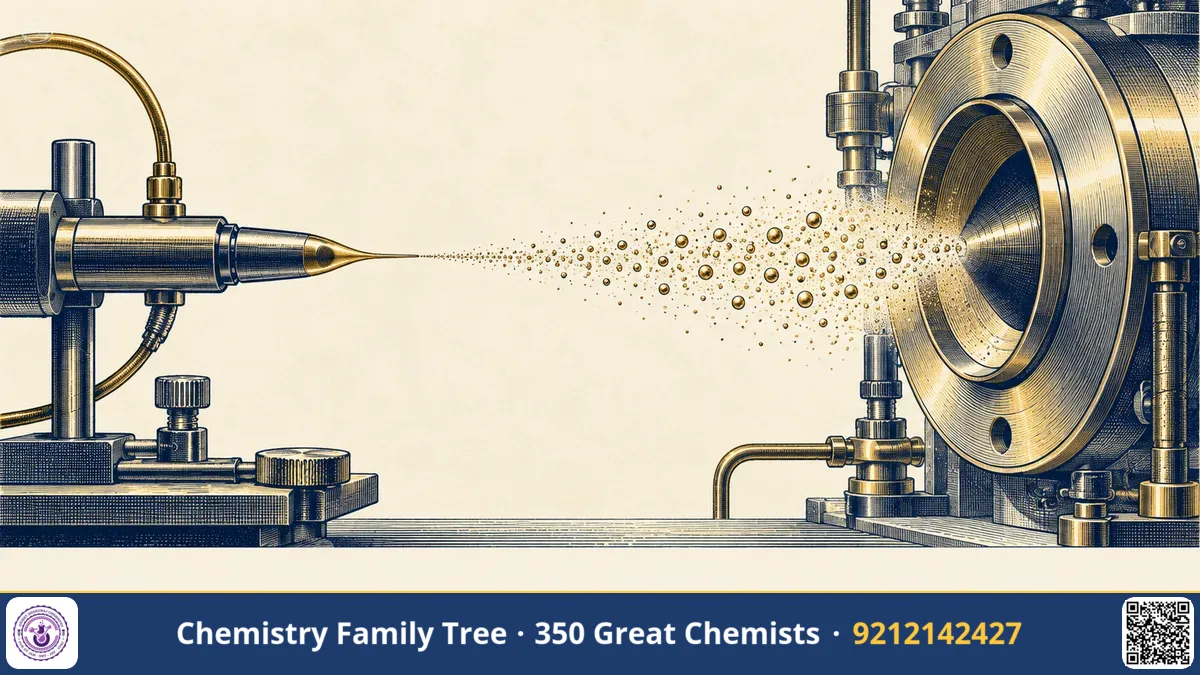
- Experiment. A solution of the analyte in a volatile solvent (such as methanol–water with a little acid) was pumped through a fine capillary held at a few kilovolts. The strong field formed a Taylor cone and a spray of charged droplets. A countercurrent flow of warm dry nitrogen gas helped to evaporate the solvent. The remaining ions entered the vacuum system of the mass spectrometer.
- Breakthrough (1984–1989). Fenn and co-workers reported the first successful ESI mass spectra of small molecules in 1984, and then in 1988–89 of large molecules such as polyethylene glycol and proteins. Their spectra showed that proteins carried many charges, and that the molecular mass could be calculated accurately. A presentation and publication in 1989 in Science showed that ESI could analyse proteins of tens of thousands of daltons.
The Chemistry Behind It
How the electrospray works
- At the capillary tip, the electric field charges the surface of the liquid, which forms a Taylor cone and emits a fine jet.
- The jet breaks into highly charged droplets, each with a few thousand to a few hundred thousand charges.
- As solvent evaporates, the droplet shrinks and the charge density increases until the Rayleigh limit is reached, where Coulomb repulsion balances surface tension. The droplet then divides (Coulomb fission) into smaller droplets.
- Finally, naked analyte ions are released into the gas phase, by mechanisms called the ion evaporation model (for small ions) and the charged residue model (for large globular molecules such as proteins).
Multiple charging and the mass calculation
A protein of mass M picks up n protons, giving ions [M + nH]n+ at
m/z = (M + n × 1.008) / n
Two adjacent peaks in the spectrum differ by one charge. If the peak with n charges is at m1 and the next peak, with (n + 1) charges, is at m2, with m2 < m1, then:
n = (m₂ − 1.008) / (m₁ − m₂)
M = n (m₁ − 1.008)
For example, a peak at m/z 1000 and the next at m/z 909.1 correspond to n = 10, and M is about 9990 Da. A computer algorithm called deconvolution converts the whole envelope of peaks to a single zero-charge mass spectrum.
Why is ESI "soft"?
Little excess energy is given to the molecule, so the covalent bonds do not break. In many conditions even non-covalent complexes, such as enzyme–inhibitor and protein–ligand complexes, can survive. ESI is easily coupled to liquid chromatography (LC–MS) because it starts from a liquid, and it works at atmospheric pressure.
ESI versus MALDI
| Feature | ESI | MALDI |
|---|---|---|
| Sample state | Solution | Solid, mixed with matrix |
| Charge | Multiple charges | Mostly single charge |
| Coupling | Easy with HPLC | Offline, plate-based |
| Typical analyser | Quadrupole, ion trap, Orbitrap, TOF | TOF |
Applications Today
- Proteomics: LC–ESI–MS/MS identifies thousands of proteins in a cell sample by sequencing peptides.
- Drug development: Measuring drug metabolites in blood and checking the purity of biopharmaceuticals, such as monoclonal antibodies.
- Newborn screening and clinical labs: Tandem mass spectrometry detects metabolic disorders from a few drops of blood.
- Environmental and food analysis: Detection of pesticide residues, antibiotics and toxins in water and food. Indian testing laboratories use LC–MS/MS for export quality control.
- Polymer and inorganic chemistry: ESI-MS is used to characterise polymers, organometallic complexes and catalytic intermediates.
Exam Corner
- ESI is a soft ionisation technique producing multiply charged ions [M + nH]n+ in positive mode, or [M − nH]n− in negative mode.
- Formula: m/z = (M + n × 1.008)/n. Given two adjacent peaks you can find n and M.
- Rayleigh limit: the charge at which Coulomb repulsion equals surface tension, leading to droplet fission.
- ESI is easily coupled to HPLC, while MALDI is typically used with TOF analysers.
- Nobel Prize in Chemistry 2002: half to Fenn and Tanaka (soft desorption ionisation for macromolecules), half to Wüthrich (NMR).
Common Misconceptions
- "ESI always gives a peak at M + 1." For large molecules, there are many peaks, each with a different number of charges.
- "Soft ionisation means no fragmentation ever." Fragmentation can be induced deliberately in tandem MS (collision-induced dissociation).
- "Fenn invented mass spectrometry." He developed a new ionisation method; mass spectrometry itself was developed earlier by J. J. Thomson, F. W. Aston and others.
Quick Revision Box
- ESI: solution sprayed from a high-voltage capillary; Taylor cone; charged droplets.
- Solvent evaporation and Coulomb fission at the Rayleigh limit lead to gas-phase ions.
- Gives multiply charged ions; mass by deconvolution.
- Idea started with Malcolm Dole; Fenn made it work for proteins (1989).
- Coupled with LC; basis of modern proteomics.
- Nobel Prize in Chemistry 2002 (with Tanaka; Wüthrich shared the year).
FAQ
Why do proteins carry many charges in ESI?
Proteins have many basic sites (such as lysine, arginine and the N-terminus) that can pick up protons in acidic solution. The more charges, the lower the m/z, which fits the range of the analyser.
What is a Taylor cone?
It is the cone-shaped meniscus of liquid formed at the capillary tip in a strong electric field, from whose tip a fine jet emerges.
Who was Malcolm Dole?
He was a chemist at Northwestern University who in the late 1960s attempted electrospray of polymer solutions; Fenn's later work built on this concept.
Is ESI used in India?
Yes. LC–MS/MS instruments with ESI sources are used in universities, pharmaceutical quality control labs, food-testing labs and hospitals across India.
Published by ABC Chemistry — IIT-JAM | CSIR-NET | GATE Chemistry Coaching. Visit abcchemistry.com
About the chemist
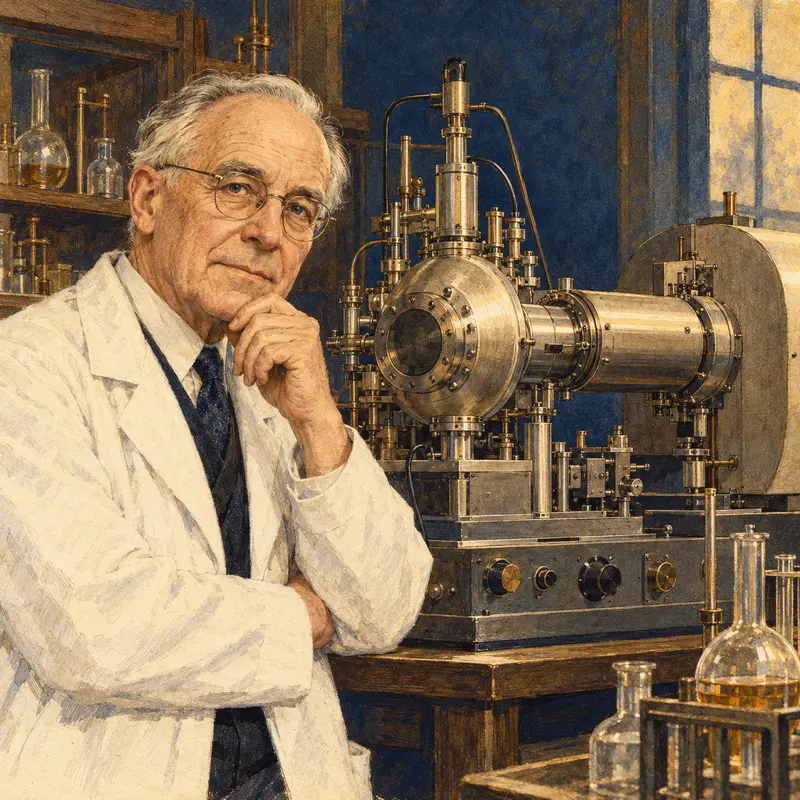
John B. Fenn
1917-2010 · United States · Nobel Chemistry 2002
Electrospray ionization for mass spectrometry